AI Dubbing
June 10, 2026
AI Dubbing: The Complete Guide to AI-Powered Video Dubbing
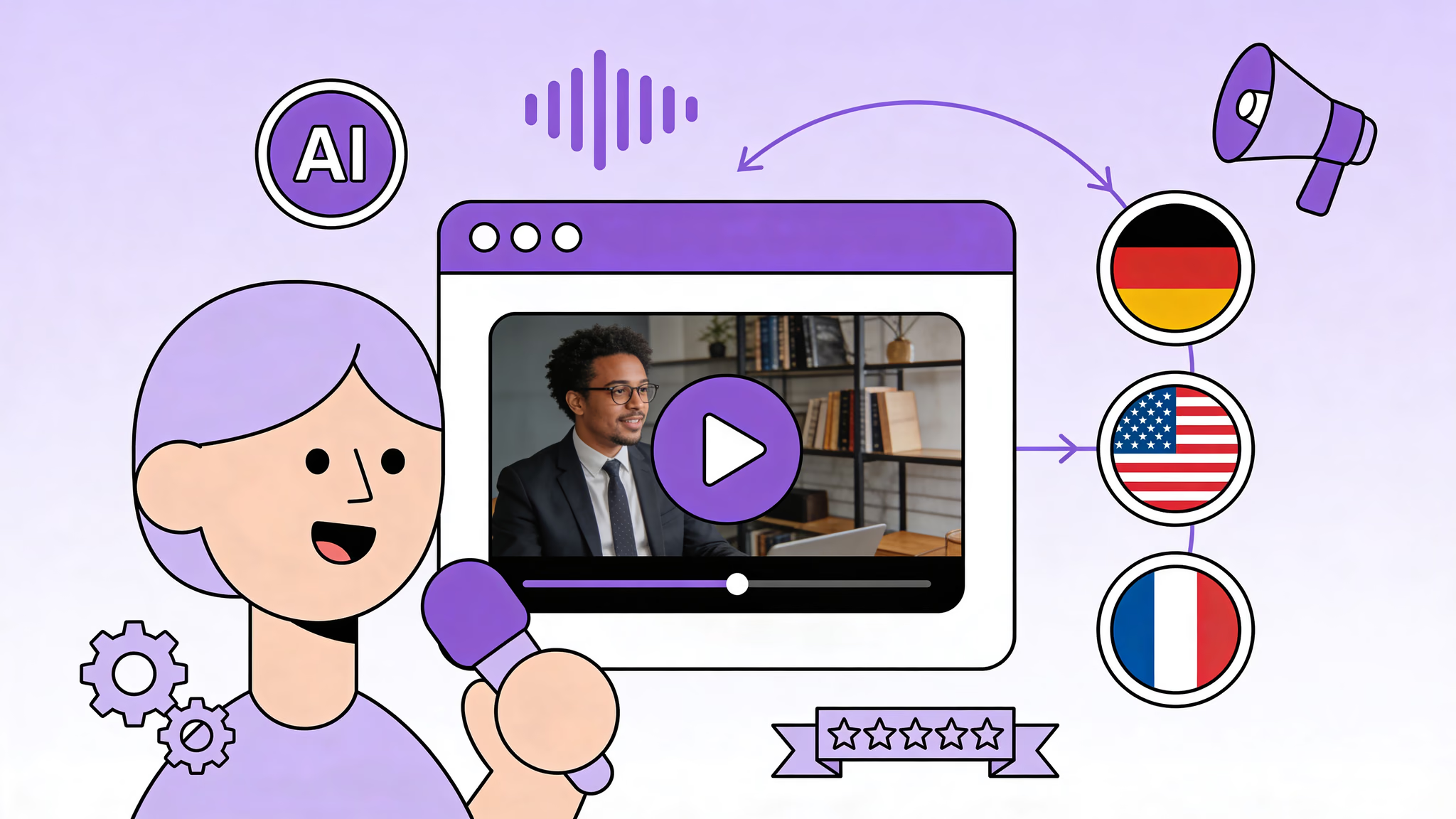
AI dubbing is a technology that automatically translates and replaces the original audio in videos with a new language — while preserving the speaker's unique voice characteristics and syncing with their lip movements. Instead of hiring voice actors and booking studio time, AI does the heavy lifting: transcription, translation, voice cloning, and lip sync in one pipeline.
That last part is key. Not a robotic voice. Not a generic narrator. The actual speaker — in a language they might not even speak.
For video creators, businesses, and educators looking to localize content at scale, this changes the math completely. A process that used to take weeks and cost thousands now takes minutes. And the quality gap between AI and studio dubbing? It's closing faster than most people realize.
This guide covers how the technology works, where it makes sense (and where it doesn't), and what to look for when choosing a dubbing tool.
Key Takeaways
- AI dubbing translates and re-voices video using voice cloning and lip sync, preserving the original speaker's identity
- Costs roughly €5/minute vs. €80/minute for traditional dubbing — a 94% cost reduction
- Outperforms subtitles in engagement, retention, and accessibility
- Key criteria for choosing software: voice quality, lip sync, translation control, data privacy, scalability
What Is AI Dubbing?
Dubbing has been around as long as film itself. A voice actor re-records dialogue in a new language while matching lip movements and timing. Casting, direction, recording studios, revision rounds — it adds up fast. We're talking around €80 per finished minute of content (Source: VDS). For a 10-minute video in 5 languages, that's €4,000. Before anyone's even reviewed the first take.
AI dubbing replaces most of that with generative AI. The technology transcribes the original audio, translates it, and synthesizes a new voice track using voice cloning — the process of replicating a speaker's unique vocal characteristics including tone, pitch, and emotional delivery. The result is a dubbed video that sounds like the original speaker, not a replacement.
How AI Dubbing Differs from Earlier Approaches
If you've tried text-to-speech tools from a few years ago, forget what you know. Modern voice dubbing combines three technologies that didn't exist together until recently: neural machine translation for accurate scripts, voice cloning for authentic sound, and lip synchronization that adjusts the speaker's mouth movements frame-by-frame. That lip sync piece is what makes the difference between "clearly AI" and "wait, is that really the same person?"
A Fast-Growing Market
The numbers reflect the shift. According to Grand View Research, the voice and speech recognition market is projected to grow at 14.6% CAGR through 2030, reaching $53.67 billion (Source: Grand View Research) — driven largely by demand for video localization. Businesses that previously couldn't justify hiring voice actors for smaller markets can now dub a video into multiple languages for a fraction of what a single studio session used to cost — reaching international audiences that were previously just too expensive to serve.
How Does AI Dubbing Work?
Four steps. That's it. The complexity is under the hood — from your perspective, it's remarkably straightforward.
- 1
Upload Video
Transcription + automatic speaker detection
- 2
Translate
Neural translation into different languages
- 3
Voice Dubbing
Voice cloning preserves the speaker's voice
- 4
Lip Sync
Frame-by-frame lip synchronization
Step 1: Upload Video and Detect Speakers
You upload your video or audio file to the dubbing tool. The system transcribes the speech, identifies individual speakers through automatic speaker detection, and assigns each person a separate voice profile. Two people in a conversation? The AI knows who's who.
Step 2: Translate into Different Languages
The transcribed text gets translated into one or more different languages using neural machine translation. Not word-for-word — the AI considers context, sentence structure, and how things are actually phrased in the target language. Professional dubbing tools let you fine tune the translation before anything gets synthesized. You can adjust terminology, fix brand names, tweak tone.
This is where glossaries become your best friend. Set up your brand terms and technical vocabulary once, and they stay consistent across all available languages.
Step 3: Voice Dubbing and Synthesis
Here's where it gets interesting. Instead of using a stock voice, the system clones the speaker's voice and generates the translated audio in that exact voice. The AI doesn't copy the accent — it produces native pronunciation in the target language while keeping the speaker's own voice characteristics.
At Dubly, we see this consistently: a German creator dubbed into English sounds like they've spoken English their entire life. Not like a German speaker reading an English script. That distinction matters more than people expect.
Step 4: Match Lip Movement to Translated Audio
The most advanced AI dubbing tools include generative lip synchronization — adjusting the speaker's mouth movements frame-by-frame to match the translated audio. Only the lips change. The rest of the face stays untouched.
Without this step, something feels off. Viewers can't always pinpoint what's wrong, but they sense it. With it, the dubbed video looks as natural as the original video.
Side Profile Demo
The entire dubbing process runs in minutes, not weeks. As a rough guide, one minute of lip sync takes about two minutes to process — so a typical 5-minute video is done in around 10 minutes per language. That's fast enough to dub a video into five or ten languages in a single afternoon.
Go deeper: How AI Dubbing Works — a full technical breakdown with details on each step.
AI Dubbing vs. Traditional Dubbing
AI dubbing reduces video localization costs by approximately 94% compared to traditional studio dubbing. That's not a marginal improvement — it's a different category entirely.
| Factor | Traditional Dubbing | AI Video Dubbing |
|---|---|---|
| Cost | ~€80/min (casting, studio, revisions) | ~€5/min (automated pipeline) |
| Turnaround | Days to weeks per language | 10–20 minutes per language |
| Voice Consistency | New voice actor per language | Speaker's voice preserved across languages |
| Scalability | Linear cost increase per language | Same flat rate every time — no re-negotiating per market |
| Lip Sync | Manual timing by actor | Frame-by-frame generative AI |
| Edit Flexibility | Expensive re-records for changes | Re-generate in minutes |
The scalability difference is what changes the math. Traditional dubbing costs grow linearly — 5 languages means 5x the budget, and each one needs its own studio booking and voice actor. With AI video dubbing, you pick all your target languages upfront in a single step — scaling to 10 languages doesn't mean 10x the manual work, just 10x the output.
When Traditional Dubbing Still Makes Sense
We're not going to pretend AI solves everything. Highly emotional content — screaming, crying, extreme vocal dynamics — still challenges AI voice dubbing. The technology handles conversational speech brilliantly, but raw human emotion at the extremes? Not quite there yet.
And for tentpole feature films where a single dub will be watched by millions, some studios still prefer human voice talent. Fair enough. But for corporate communications, training, marketing, creator content? Automatic dubbing is already indistinguishable from studio work. The edge cases are narrowing every quarter.
AI Dubbing vs. Subtitles
AI dubbing outperforms subtitles in viewer engagement, information retention, and accessibility. That's not opinion — the data is consistent across studies.
Subtitles have been the default for decades. They're cheap, they're fast. But they ask the viewer to do something unnatural: read and watch at the same time.
Why Dubbed Videos Outperform Subtitles
Viewers retain more information from dubbed videos. They watch longer. They're more likely to finish. For training videos and educational content, the gap is even wider — people learn significantly better when they hear information in their own language rather than reading it off the bottom of a screen.
Then there's accessibility. Subtitles don't work for viewers with reading difficulties. They don't work on mobile when you're walking. They don't work in noisy environments. They don't work for podcasts.
Where subtitles still make sense: when the original speaker's voice performance is central to the content. Think film. Think a keynote from a famous CEO. But increasingly, the smart move is offering both — a dubbed audio track plus auto subtitles — giving your worldwide audience maximum flexibility.
Full comparison with data: AI Dubbing vs. Subtitles.
Voice Dubbing vs. Voiceover
Voice dubbing fully replaces the original audio track. Voiceover layers a translated narration on top — you still hear the original speaker faintly underneath. Different tools, different results.
Why Full Dubbing Delivers Better Results
With AI voice dubbing, the dubbed video sounds like the original speaker. Not a narrator. Not an interpreter. The speaker, in another language, keeping their own voice. Add lip synchronization, and viewers genuinely can't tell it's not the original.
Voiceover can't do that. It will always feel like a translation.
That said, voiceover has its place. Documentaries, news segments, content where you intentionally want the original language audible in the background. But for marketing videos, product demos, training videos, creator content — full voice dubbing wins every time. The viewer forgets they're watching something translated. That's the whole point.
Detailed breakdown: AI Dubbing vs. Voiceover.
AI Dubbing Use Cases
The technology is versatile, but some industries moved faster than others. Here's where the ROI hit first.
Content Creation and YouTube
Creators use AI dubbing to break out of their language bubble. YouTube's Multi-Language Audio feature lets you upload dubbed audio tracks that global audiences can switch between — one channel, worldwide reach.
A pattern we see consistently: most creators start with a single language pair — say, German to English — and within three months expand to three or more languages. Once you see the audience response, it's hard to stop.
Buycycle went from producing every language version in a studio to running five YouTube channels from a single recording.
We used to produce every language version separately in a studio — now one recording is all it takes to run five channels worldwide. Thanks to Dubly, we save massively on time and cost — and still sound like ourselves in every language.

Buycycle
Case study
Marketing and Video Advertising
One brand video, dozens of languages, consistent brand voice. Glossary features lock in terminology across all versions. Teams at agencies managing international channels, like HAVAS Social, use dubbing tools to create multilingual content without multiplying the production budget.
Training Videos and E-Learning
This is a massive use case that doesn't get enough attention. Multinational companies need educational content in every language their workforce speaks. AI video dubbing lets you internationalize an entire LMS without reshooting a single video.
New Com Academy saved over 85% in localization costs while maintaining precision on complex technical terminology. That's not a small number.
Podcasts and Audio Content
AI dubbing isn't limited to video. Creators produce multilingual podcasts from a single recording — reaching listeners in different languages without re-recording episodes. The dubbed audio preserves the host's voice, which is everything in a format built on personality.
Enterprise Communication
CEO messages. Town halls. Crisis communication. Content that needs to reach international audiences in their language, fast. Not next week. Now.
Automatic dubbing delivers in minutes what hiring voice actors and booking recording studios takes weeks to produce.
Explore solutions for your use case: Creators · Marketing · E-Learning · Enterprise
See how AI dubbing works. Try 1 minute free, no credit card required.
What to Look for in an AI Dubbing Tool
The five most important criteria when choosing an AI dubbing tool are voice quality, lip sync capability, translation control, data privacy, and scalability. Most dubbing tools nail one or two. Few deliver on all five.
1. Voice Quality and Speaker's Voice Preservation
The dubbing tool should preserve the speaker's voice — not just roughly, but convincingly. Tone, pace, emotion. Ask for samples in your specific language pair before committing. A tool that sounds great for English-to-Spanish may fall apart with English-to-Japanese. The best tools let you fine tune pronunciation and pacing after the initial generation.
2. Lip Synchronization
Lip sync is binary. It either looks natural or it doesn't — there's no "pretty good" in lip sync. A serious AI dubbing tool should handle multiple speakers, different camera angles, and partially occluded faces. Frame-by-frame generative AI is the gold standard. Anything less, and your viewers will notice.
3. Translation Accuracy and Control
Can you edit before it goes live? That's the minimum. Professional dubbing tools let you review, adjust, and approve translations before voice synthesis happens. Custom glossaries for brand terms are essential to ensure the original meaning actually carries through.
4. Data Privacy and Compliance
If you're uploading proprietary video content — training videos, internal communications, marketing assets — you need to know exactly where that data goes. GDPR compliance, German server infrastructure, and clear data processing agreements aren't nice-to-haves. They're requirements.
This is consistently the number one topic in our enterprise sales conversations. Not price. Not features. Data privacy.
5. Scalability for Longer Videos and Bulk Processing
Can you dub a video in bulk? Is there an API for automation? Can multiple team members access the platform without per-seat charges? For anything beyond occasional one-off translations, these questions determine whether a dubbing tool actually saves you time — or just moves the bottleneck.
Software comparison and feature matrix: AI Dubbing Software.
Consent and Legal Considerations
AI dubbing of videos featuring real people requires consent to translate and distribute their voice and likeness in other languages. This isn't a gray area. If someone's face and voice are in a video, they need to agree to the dubbed versions.
AI voice clones are safe and legal when used responsibly. But "responsibly" means having clear agreements in place. Reputable dubbing tools process all content in compliance with data protection regulations and ensure that rights remain fully with the content owner. No exceptions.
Why Dubly.AI Was Built for Professional Video Dubbing
We built Dubly because the existing tools weren't good enough. Not for professional use.
The voice cloning was mediocre. The lip sync — if it existed at all — looked artificial. And data privacy? Most platforms were running on US infrastructure with vague terms about how your content might be used. That wasn't going to work for the enterprise clients we talked to.
So we built something different. Dubly's Lip Sync 2.0 handles multi-speaker scenes, dynamic head movements, and occluded faces. The speaker's voice is preserved across roughly 38 available languages with native pronunciation — the AI doesn't transfer accents, it generates natural speech in each language.
On privacy: Dubly runs on German server infrastructure. Fully GDPR-compliant. TÜV-certified. We do not use customer data for AI training. Uploaded video and audio files stay in isolated sandbox environments. For enterprises, this isn't a feature — it's the reason they chose us over US-based competitors.
On control: every translation is editable. You can fine tune wording before voice synthesis. Custom glossaries keep brand terminology consistent across different languages. Unlimited users per account. No per-seat pricing games.
Try it completely free — 1 minute of video dubbing with all features including voice cloning, no credit card required.
Conclusion
AI video dubbing works. Not "it's getting there" — it works, today, for the vast majority of professional video content.
It won't replace voice actors for everything. Blockbuster films will still use human talent. Highly emotional scenes still challenge the technology. But for the other 90% of video that businesses, creators, and educators produce every day? The dubbed results are already indistinguishable from studio work.
The cost argument is settled: €5/minute vs. €80/minute. The quality argument is settling fast. And the generative AI behind dubbing improves with every model generation.
If you're producing video content that could reach a worldwide audience in other languages — and let's be real, that's most video content today — the question isn't whether to dub. It's which dubbing tool to use.
AI dubbing is one piece of the broader AI video translation landscape. Combined with AI lip sync technology, it represents the most complete approach to video localization available today.
About the author

Simon Pieren
Co-Founder | Marketing & Sales