AI Dubbing
June 10, 2026
How AI Dubbing Works: The Technology Behind Automated Video Translation
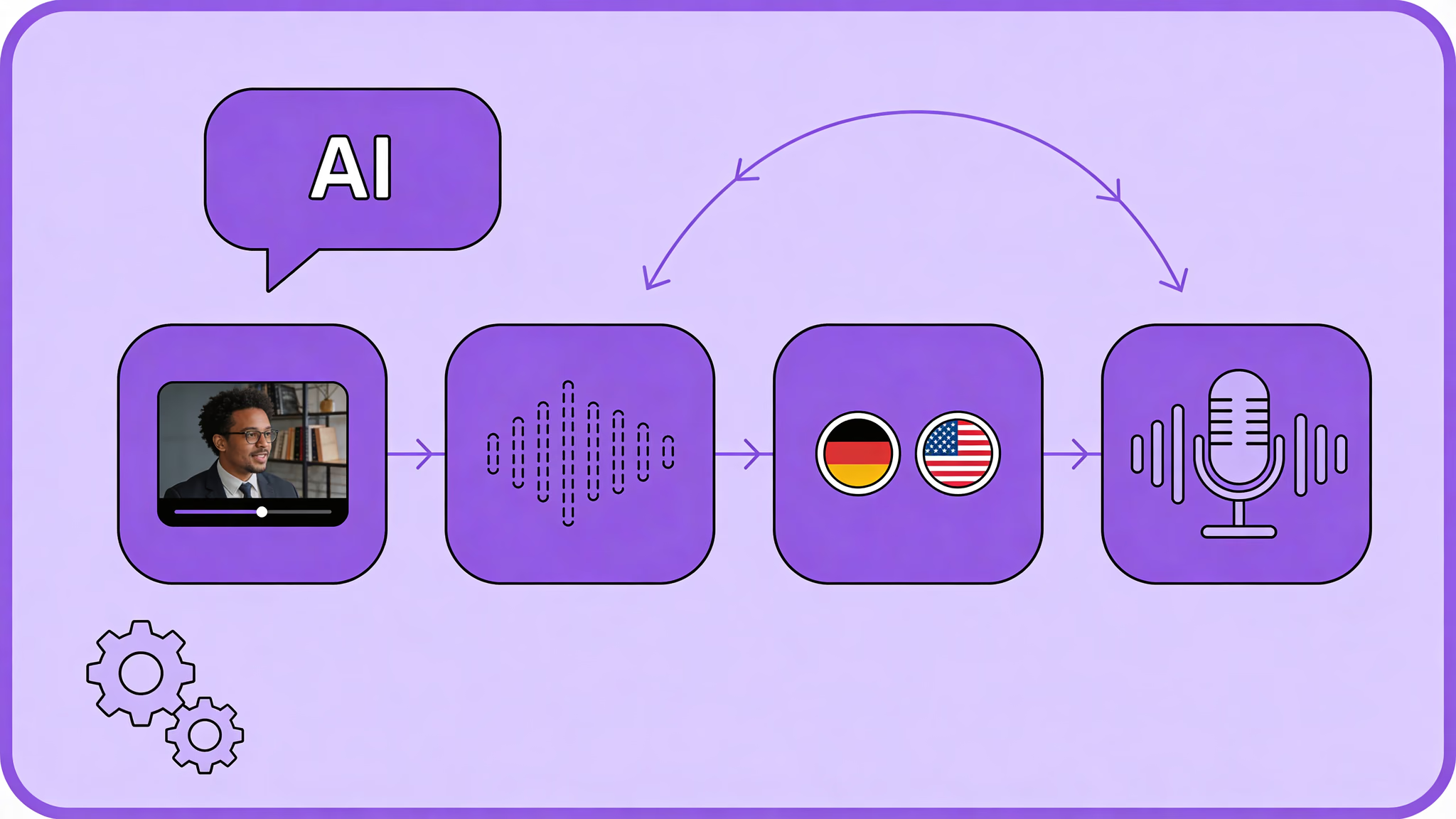
Artificial intelligence dubbing works by running video content through a four-stage pipeline — speech recognition, neural translation, voice cloning, and lip synchronization — to produce a fully dubbed version that preserves the original speaker's voice and matches their mouth movements. The entire dubbing process happens automatically, typically in minutes rather than the weeks traditional dubbing with voice actors requires.
What makes this possible isn't any single breakthrough. It's four AI technologies that matured independently and now work together in a way that didn't exist before 2023. Each stage feeds the next, and the quality of the final output depends on every link in the chain.
This article breaks down what actually happens at each stage — the engineering, the trade-offs, and the details that separate good AI dubbing technology from bad. Whether you're a creator trying to reach global audiences, a media company scaling video dubbing, or an enterprise team localizing training material — understanding the pipeline helps you break through language barriers and get better results.
Key Takeaways
- The AI dubbing process runs through four stages: speech recognition → neural translation → voice cloning → lip synchronization, each building on the previous
- Dubbed AI voices preserve the speaker's identity but generate native pronunciation — the dubbing technology doesn't transfer accents
- Input quality is the biggest factor in output quality — clean audio produces the best dubbing results
- Human control at key checkpoints (translation review, glossaries, custom pronunciations) is what separates professional dubbing from a fully automated process
The AI Dubbing Pipeline — Four Stages, One Output
Every AI video dubbing system follows the same fundamental sequence: understand the speech, translate it, recreate the speaker's audio, sync the lips. Skip a stage or get one wrong, and the whole thing falls apart.
The order matters more than people realize. Translation needs accurate transcription to work from. Voice cloning needs properly timed scripts. The visual layer needs the final audio track to align against. It's a pipeline, not a parallel process — each stage of the dubbing workflow builds on the output of the one before it.
- 1
Speech Recognition
Transcription + timestamps + speaker profiles
- 2
Neural Translation
Context-aware translation with timing constraints
- 3
Voice Cloning
Speaker's voice recreated in target language
- 4
Lip Sync
Frame-by-frame mouth movement adjustment
Stage 1 — Speech Recognition and Speaker Detection
The dubbing process starts with automatic speech recognition (ASR). The system converts spoken audio into text, word by word, with precise timestamps for every segment. Modern ASR engines powered by machine learning achieve word error rates below 5% on clean audio (Source: AssemblyAI, https://www.assemblyai.com/blog/how-accurate-speech-to-text) — that's better than most humans can transcribe.
But transcription alone isn't enough. The system also performs speaker diarization: identifying who is speaking when. Two people in a conversation? Separate profiles. A panel with four speakers? Four profiles. If the dubbed voices aren't distinct, the whole thing sounds like one person having a conversation with themselves.
This is where input quality makes a real difference. Clean audio with minimal background noise gives the ASR engine more to work with. Heavily compressed video files, echoey rooms, or overlapping speech all increase error rates — sometimes dramatically.
Stage 2 — Neural Machine Translation
The transcribed text goes through neural machine translation (NMT) — and this is nothing like the word-for-word voice translation engines from ten years ago. Modern NMT systems understand context. They restructure sentences to sound natural in a different language, not just technically correct.
This matters for AI video dubbing more than for written text. A German sentence that takes 4 seconds to speak might produce an English translation that takes 6 seconds. Two extra seconds doesn't sound like much — until you realize the dubbed audio track needs to fit the same timing window as the original, or the lip sync has nothing to work with. Good NMT for dubbing considers speech duration constraints alongside linguistic accuracy. Most basic video translator tools don't even try.
One real limitation at this stage: automated systems can miss idioms, humor, or cultural references that don't translate literally. A German pun doesn't work in English. A reference that resonates in Japan falls flat in Brazil. The AI handles linguistic accuracy well, but cultural nuance still needs human judgment.
Here's where human control becomes essential. Professional dubbing tools let you review and fine tune translations before they go to voice cloning. You see the text, you adjust it, you approve it. Full control, no surprises.
Glossaries are the unsung hero of this stage. Define your brand terms, product names, and technical vocabulary once — they stay consistent across every language, every dubbing project, every AI video. At Dubly, we see a clear pattern: customers who set up glossaries before their first dub spend significantly less time on revisions afterwards. It's one of the highest-leverage steps in the entire workflow — especially for enterprises producing large volumes of video content.
Stage 3 — Voice Cloning and Speech Synthesis
This is the stage that separates AI dubbing from everything that came before. Instead of picking a stock sound from a library, the system analyzes the speaker's unique voice characteristics — pitch, timbre, cadence, emotional delivery — and builds AI voices that sound like that specific person speaking in a different language.
Here's what surprised us when we first built this: voice cloning doesn't transfer accents. A German speaker dubbed into English won't sound like a German speaking English. They'll sound like a native English speaker — who happens to have the same vocal identity. The artificial intelligence produces native pronunciation in the target language. Completely native. That wasn't obvious to us going in, and it's not obvious to most people until they hear it.
That distinction is everything. It's the difference between "clearly a translation" and "I had no idea this wasn't the original."
And then there's emotional depth. The dubbing process doesn't just match words — it carries over intonation, emphasis, the original tone. A speaker who gets excited stays excited. Someone delivering bad news keeps that gravity. That's what makes dubbed voices convincing rather than flat.
Where does it fall short? Extremes. Screaming, crying, singing, whispering at the very edge of audibility. These push current models hard. For conversational speech, presentations, tutorials, interviews? Indistinguishable from the original. But we're not going to pretend the technology handles everything equally well. Ultra-high-emotion content is the frontier, not the solved problem.
Stage 4 — Generative Lip Synchronization
This is my favorite part of the pipeline — and the hardest to get right. Generative lip synchronization adjusts the speaker's mouth movements frame-by-frame to match the dubbed audio track. Only the lips change. The rest of the face, the expressions, the head movements — untouched. Video quality stays identical to the original.
Three inputs get analyzed simultaneously: the original mouth movements, the phonetic profile of the new audio (which sounds need which mouth shapes), and the visual context — camera angle, face position, lighting. From these, the system generates new frames where the speaker's lips match naturally.
Skip this step, and something always feels off. Viewers can't pinpoint what's wrong, but they sense it. The audio says one thing, the mouth says another. With proper synchronization, that disconnect vanishes completely.
We pushed this further with Lip Sync 2.0 — cutting edge technology that handles multi-speaker scenes, dynamic head movements, and occlusion (when a hand, microphone, or coffee cup covers part of the face). That last one was a harder problem than we expected. Processing speed improved by 90% over our previous generation while maintaining quality.
Occlusion Demo
Real-world benchmark: one minute of dubbing with synchronization takes about two minutes to process. So a 5-minute AI video? Done in around 10 minutes per language. You can dub content into ten languages in a single afternoon. Try getting that from traditional dubbing with voice actors. You'd be looking at weeks. Maybe months.
What Makes Modern AI Dubbing Different from Text-to-Speech
If you tried text-to-speech five years ago and wrote off AI audio — fair. But that was a different era. TTS converts text into spoken audio using a generic sound. AI dubbing technology does something fundamentally more ambitious — it replaces the original audio track while keeping the speaker's identity intact across multiple languages.
Here's why this only became possible recently. Three technologies had to mature independently before video dubbing with artificial intelligence became viable:
Neural machine translation needed to reach a point where translated scripts actually sounded natural — not just grammatically correct, but idiomatically right. That happened around 2020-2022 with transformer-based models and machine learning breakthroughs.
Voice cloning needed to move beyond "sounds vaguely similar" to "sounds exactly like the person." Early systems required hours of training data. Modern platforms need minutes — sometimes seconds — of reference audio. The quality leap happened between 2022 and 2024, producing lifelike voices that carry emotional depth.
Generative lip synchronization is the newest piece. Frame-by-frame manipulation that looks natural, not glitchy. This went from research papers to production-ready tools in roughly 2023-2025.
None of these alone solves the problem. All three together, in a coordinated dubbing pipeline with proper timing synchronization? That's what makes a modern AI video translator work. And it's why the technology essentially didn't exist in its current form before 2023.
| Factor | Basic Text-to-Speech | Professional AI Dubbing |
|---|---|---|
| Speaker | Generic stock sound | Original speaker's own voice, cloned |
| Mouth Sync | None | Frame-by-frame generative synchronization |
| Translation | Separate step, no timing | Integrated with duration constraints |
| Multi-Speaker | Not supported | Automatic detection and separation |
| Emotion | Flat, monotone delivery | Preserves original intonation and dynamics |
| Edit Control | Text input only | Full translation review, glossaries, custom pronunciation |
| Data Privacy | Varies widely | GDPR-compliant, German servers |
Translate Your First Video
Results in just a few minutes
No credit card required
Best translation quality worldwide
Processing Speed and Quality Factors
AI dubbing is fast. Genuinely fast. But "fast" doesn't mean "instant and always perfect." The video quality of your dubbed output depends entirely on what you feed the system.
What Affects Output Quality
Source audio clarity is the single biggest variable. A well-recorded video with a directional microphone produces dramatically better dubbing results than a phone recording in a noisy café. Background music, ambient noise, echo — all of these force the ASR to work harder and introduce potential errors that cascade through the entire dubbing pipeline.
Speaking speed matters too. Very fast speech compresses the timing windows available for voice translation, which can force awkward phrasing in the target language. Normal conversational pace works best.
Number of speakers affects complexity. Two speakers in an interview? Clean and straightforward. A chaotic panel where people talk over each other? That's where current AI technology genuinely struggles. Clear speaker transitions produce the best diarization results.
Language pair plays a role. Some pairs — like German to English or Spanish to English — have massive training data and produce excellent results. More distant language pairs or low-resource languages may show lower quality, though this gap narrows with every model generation. Most AI dubbing tools support common formats and various languages, but quality isn't uniform across all of them.
Honest Limitations
Not every video file works well with AI dubbing. Singing? Difficult. Heavily accented dialects? Tricky. Extreme emotional content, significant background noise, game characters with exaggerated vocal performances, entertainment industry content with rapid-fire overlapping dialogue? All push the current dubbing technology to its edges. We could pretend otherwise, but that doesn't help anyone plan realistic workflows.
There's also the broader question of ownership. Using synthetic speech to clone someone raises legitimate concerns about consent, data privacy, and the potential displacement of human talent. Responsible language services require clear agreements with the original speakers — and reputable platforms ensure that all rights remain with the content owner.
The pragmatic approach: test with a representative clip before committing to a full project. One minute is enough to judge whether the result meets your quality bar for a specific type of video content.
How AI Dubbing Handles Multiple Speakers
Here's a reality of professional video content: most of it has more than one speaker. Interviews, panel discussions, training dialogs, YouTube videos with hosts and guests. The dubbing AI needs to keep every person distinct across languages.
The system handles this through speaker diarization: algorithms that segment the audio into "who spoke when" blocks. Each person gets their own profile, their own dubbed voice, their own output. Speaker A sounds like Speaker A in every language. Speaker B sounds like Speaker B. No crossover.
The sweet spot: clearly separated speakers with distinct characteristics and clean turn-taking. A two-person interview is nearly trivial for modern dubbing systems.
The hard part: overlapping speech, very similar speakers, or rapid back-and-forth where everyone's interrupting. The dubbing tool has to guess where one person ends and another begins — and it doesn't always guess right. We improved multi-speaker handling significantly with Lip Sync 2.0 by detecting and processing multiple faces in the same frame independently. But separating overlapping audio? Still an active frontier. For the entire industry, not just us.
The Role of Human Control in AI Dubbing
"Fully automated" doesn't mean "no human involvement." And honestly, you wouldn't want it to. The best results come from AI handling the heavy lifting while humans maintain full control over quality and accuracy.
Professional dubbing platforms build control into the pipeline at key checkpoints:
Translation review — before synthesis, you see the translated text. Adjust brand names the system didn't catch. Fine tune a phrase that's technically correct but tonally wrong. Add context the machine couldn't infer. This step alone prevents the majority of quality issues.
Custom glossaries — define how specific terms should be translated. "Lip Sync 2.0" stays "Lip Sync 2.0" in every language. Your product name doesn't get localized. Industry jargon gets the right technical term, not a consumer-facing approximation.
Custom pronunciations — for names, brands, and terms that standard models get wrong. Define it once, applied across all languages.
Post-generation review — listen to the output, flag sections that need adjustment, regenerate specific segments without reprocessing the entire file. This matters because AI models can occasionally generate phrases not present in the original script or mispronounce technical terminology. Catching these before publication is non-negotiable.
The pattern we see at Dubly: global teams that invest 10 minutes setting up glossaries and reviewing translations before synthesis spend far less time on corrections afterward. The automation handles scale. The human handles nuance.
Thanks to Dubly.AI, we were able to internationalize our Academy without reshooting a single minute. Even complex technical terminology was translated with precision — and we saved over 85% in costs.

Michael Kibele
CEO, New Com Academy
That result — 85% cost savings with precision on complex terminology — is what happens when the human control layer works as designed.
See the full AI dubbing pipeline in action — try 1 minute free with voice cloning and lip sync, no credit card required.
What This Means for Your Content Strategy
OK, enough about the engineering. Why should you care how the dubbing pipeline works?
Because it changes the math. Traditional dubbing with voice actors forced a binary decision: invest thousands per language or don't localize at all. Most content never got dubbed. The economics killed it before anyone evaluated the quality. AI dubbing removes that constraint. When you can produce dubbed content in multiple languages at fast speed for marginal cost, your global content strategy stops being theoretical.
We see this shift with our own customers. Content creation teams plan for global audiences from day one now — not as an afterthought, but as part of the production workflow. YouTube videos, training material, marketing campaigns — all candidates for dubbing that would have been unthinkable at traditional prices. And they're reaching diverse audiences across social media platforms in their native language, not with subtitles, but with dubbed AI voices that carry the original tone.
The results: new revenue streams in markets that were previously too expensive to serve. A wider audience. More engagement. For creators, more algorithmic visibility. For enterprises, the key consideration is data security — making sure proprietary content stays protected when running it through language services.
This is the shift from "we translate our top 3 videos" to "we dub everything." And honestly, it's happening faster than most teams realize. Back to the full guide on AI dubbing.
Conclusion
AI dubbing isn't magic. It's engineering. Four technologies, one pipeline, each stage solving a specific problem. Speech recognition captures the words. Translation converts them. Voice cloning preserves the speaker. Synchronization makes it look real.
What surprises most people is how fast the dubbing technology matured. Research demo in 2022. Production-ready dubbing tool in 2026. And the pace isn't slowing — every component improves with each model generation, producing increasingly lifelike dubbed voices.
But here's what I tell every customer: quality in, quality out. Clean audio, clear speech, good camera angles. These fundamentals determine your dubbing results more than any feature comparison. Understand the pipeline. Set up glossaries. Review translations before synthesis. That's it. That's how you get professional results — whether you're dubbing one video or localizing large volumes for global audiences.
Back to the complete guide: AI Dubbing — How It Works, Tools & Use Cases
Translate Your First Video
Results in just a few minutes
No credit card required
Best translation quality worldwide
About the author

Maximilian Engler
Co-Founder | Product