AI Video Translator — Your Video into any Language
Upload any video, pick your languages, and get a fully dubbed version in minutes — with cloned voices and perfectly synced lips.
Translated with Dubly.AI in just 2 minutes
1,200+ market leaders and publishers use Dubly.AI to take their video content global.
















„Thanks to Dubly.AI, we were able to internationalize our Academy without reshooting a single minute. Even complex technical terminology was translated with precision — and we saved over 85% in costs.For us, it was a game changer in making our core product globally scalable.

Michael Kibele
CEO, New Com Academy
What Makes Dubly the #1 AI Video Translator
With Lip Sync 2.0, Dubly.AI is the most advanced AI video translator on the market. See how we compare to every alternative — side by side, same video, same speaker.
Why you should use an AI video translator
Produce Once
Fast, easy, and cost‑effective
Every reshoot for a new market costs you budget, time, and sanity. Dubly turns that equation on its head: upload your finished video, select your target languages, and get broadcast-ready versions back in minutes. Same production value, every language — without ever booking another studio day.
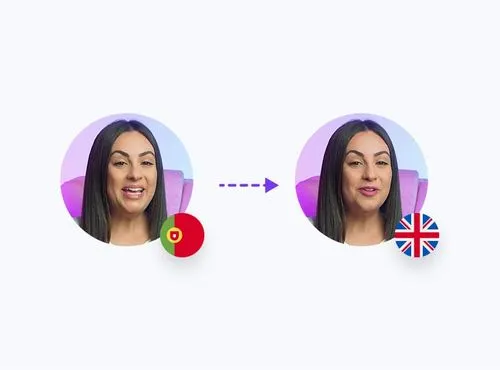
Lip Sync
Hollywood-level tech delivers perfectly natural lip movements — without compromising video quality.
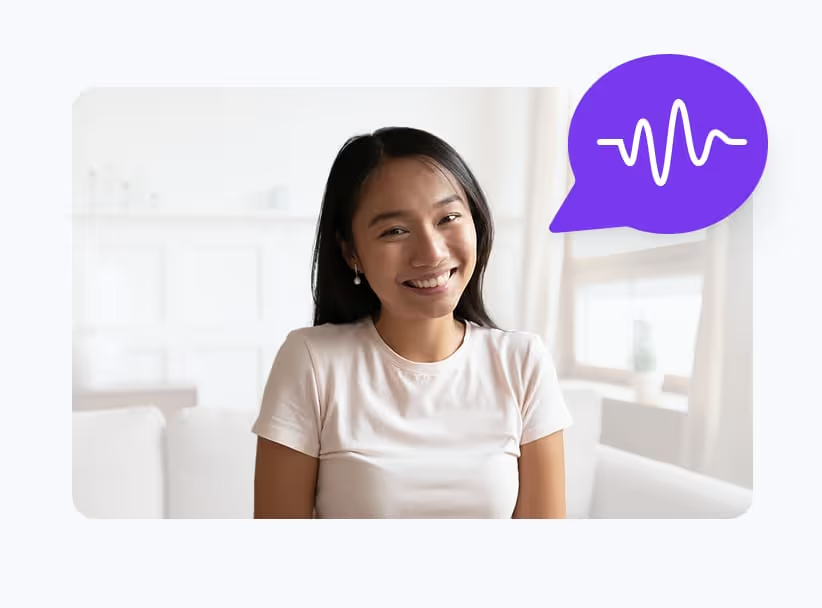
Voice Cloning
Whether soft and silky or loud and energetic — voices always sound just like the original video.
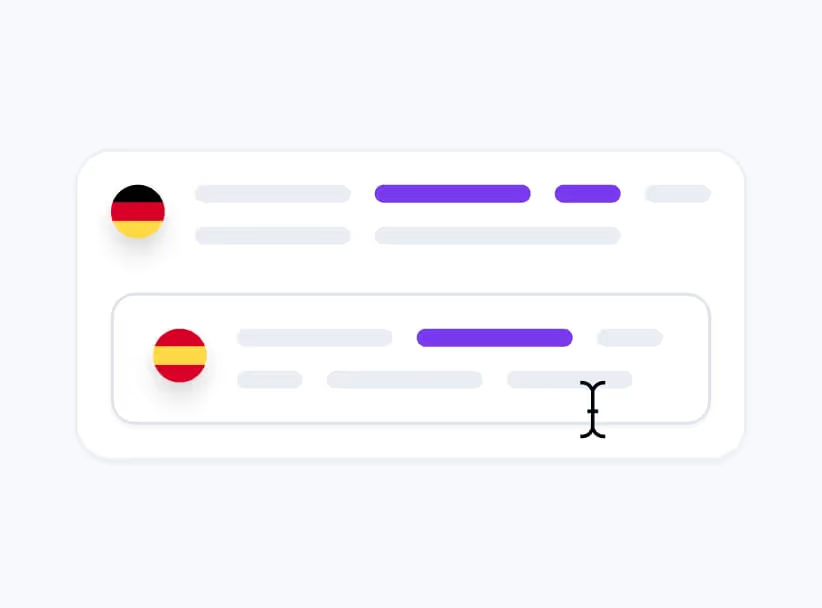
Customizable translations
A word wasn't translated the way you wanted? No problem — just adjust it for free.
Context and tone preservation
Whether it's a stock tutorial or a social media clip, the AI understands the tone and delivers translations that feel just right.
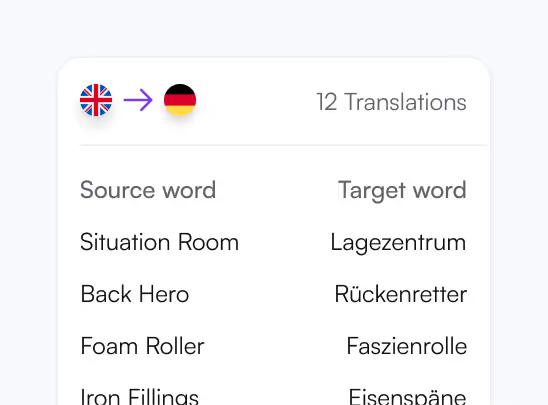
Glossary for brand-specific terminology
You can store company-specific terms in a fixed glossary to ensure consistent and accurate translations every time.
Global Reach
Expand your global reach
You’ve already created videos that convert, explain, and inspire — they just only work in one language. Dubly unlocks their full potential. Subtitles get skipped; dubbed content gets watched.
 Book a demo
Instant results
Translate any video in 4 steps
Upload your video file here
Upload

Upload your video
Upload any video in our AI video translator. Dubly detects speakers and language automatically — your first translation is ready in minutes.
Choose from 40+ languages
Select target language
Pick from 40+ target languages. Our AI translates, clones the original voice, and generates perfect lip sync — in one click.
Adjust individual words
Review the translation
Read through the translation and change whatever does not fit. Select a word, pick an alternative, done — as often as you like, at no extra cost.
And download the result
Turn on lip sync
Switch on lip sync so the mouth movements match the new language. Then download the finished video in full resolution.
Car Maniac takes e-mobility content global
Car Maniac is using Dubly.AI to open his content to an international audience — without having to produce content multiple times.
Read case study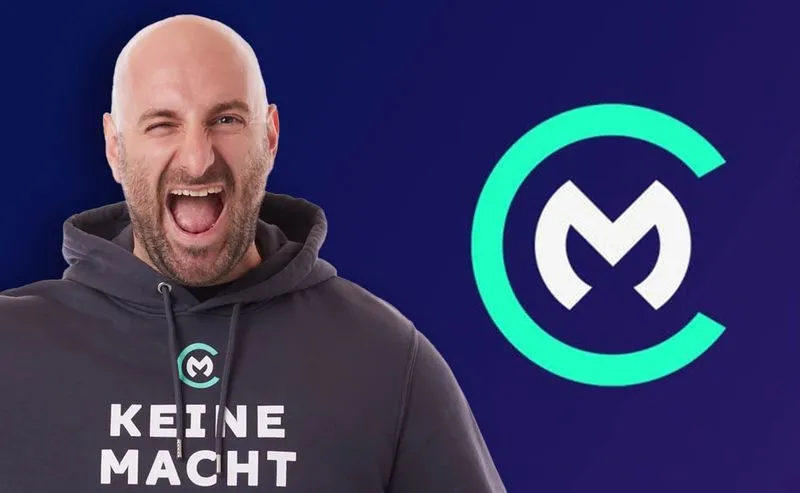
An AI video translator that saves you 90% — and your audience won't know it's translated
Traditional Translation
1 video, 1 language
5000€ per dubbed version
Months until go-live
Dubbed voices never sound like the real person
No control once the agency delivers
AI-Powered Translation with Dubly.AI
Same video, 40+ languages
90% less per language
Ready in minutes
Voice cloning so real, even the speaker can't tell
Edit every word, tone, and term yourself
Book a demoInstant results
Built for Companies Who Think Global
Most AI video translators produce robotic voices, broken lip sync, and translations that miss the point. Dubly.AI is different. Built in Germany with the highest data security standards, our platform delivers translations that sound native — with voice cloning that preserves every speaker's identity, and Lip Sync 2.0 that handles even the most complex scenarios. Whether you need to scale e-learning across languages, localize marketing campaigns for global markets, grow your content internationally, or power enterprise-wide video communication — Dubly replaces months of agency work with a 5-minute workflow. Fully GDPR-compliant. No training on your data. Enterprise-ready from day one.
How Leading Brands Use AI Video Translation with Dubly


Dive Deeper: How AI Video Translation Actually Works
An AI video translator does something fundamentally different from any translation tool you've used before. It doesn't just translate words — it translates the entire video: the spoken audio, the voice, the lip movements, and the subtitles, all at once, into multiple languages simultaneously.
The result isn't a dubbed video that sounds artificial. It's a version of your video that feels like it was originally recorded in that language.
To understand why this matters, it helps to look at how video translation used to work — and where every previous approach breaks down.
The Old Way: Why Traditional Video Translation Doesn't Scale
For decades, translating a video meant one of two things: you either paid a dubbing studio, or you gave up.
A professional dubbing studio costs thousands of euros per language per video. You hire voice actors, book studio time, sync the audio manually, and wait weeks for delivery. The result is high quality — but completely unaffordable if you want to translate a video into five languages, let alone thirty. And every time you update the video, you start over.
The alternative was subtitles. Cheaper, faster — but subtitles don't make your video feel native to a new audience. A German viewer watching an English-language tutorial with German subtitles still experiences it as foreign content. The speaker's voice, tone, and energy don't carry across. Subtitles reduce the barrier; they don't remove it.
Then came tools like Google Translate. Useful for text — but completely useless for video. Google Translate processes written language. It has no concept of audio tracks, spoken rhythm, or lip movements. Pasting a transcript into Google Translate and then re-recording it manually isn't video translation — it's just a workaround that creates more work.
Early AI video translation tools tried to bridge the gap, but introduced their own problems: robotic AI voices that sounded nothing like the original speaker, broken lip sync where the mouth movements never matched the translated audio, and no ability to edit the output if something was wrong. The technology existed, but it wasn't ready for professional use.
That's changed.
What Modern AI Video Translation Actually Does
Today's AI video translators handle the entire translation workflow in a single pipeline. You upload your video file. The AI detects the language automatically, identifies every speaker, clones each voice individually, generates a translated script, re-synthesizes the audio in the target language using the cloned voice, and syncs the lip movements frame by frame to match the new audio.
At the same time, it generates accurately translated subtitles, timed to the new audio track.
The whole process takes minutes — not weeks.
What you get is a video that sounds native. The original speaker's voice, accent, and personality carry through into the translated version. Viewers watching the Spanish version don't hear a generic AI voice reading a translation. They hear the same person, speaking Spanish.
This is what separates a modern AI video translator from everything that came before it.
The Hardest Problems in AI Video Translation — and How Dubly Solves Them
AI-powered video translation has existed for several years. But until recently, a small number of genuinely hard technical problems prevented translated videos from looking and feeling truly authentic. Most tools on the market today still haven't solved them.
Here's an honest breakdown of each problem — and how Dubly's Lip Sync 2.0 addresses it.
Problem 1: Lip Movements That Don't Match the Translated Audio
This is the most visible problem in AI video translation, and the hardest to solve.
Every language has a different phoneme structure, word length, and speech rhythm. When you translate a video from English to German, the German audio is longer. When you translate to Japanese, the mouth shapes are completely different. The original lip movements in the video were recorded for one specific language — they simply don't match any other.
Older AI video translators either ignored this entirely (leaving a visible mismatch between audio and lips) or applied basic lip animation that looked unnatural and robotic. The result was videos that were immediately identifiable as dubbed — which undermines credibility and viewer trust, especially for professional video content.
Dubly's Lip Sync 2.0 solves this at the pixel level. The model reconstructs lip movements frame by frame to match the translated audio precisely — including complex scenarios like occlusions, dynamic movements, and fast speech. The lip sync is accurate enough that viewers don't notice they're watching a translation.
Problem 2: AI Voices That Sound Nothing Like the Original Speaker
Early AI video translation tools replaced the original speaker's voice with a generic AI voice. The translation might be accurate, but everything that made the original video compelling — the speaker's energy, warmth, authority, or personality — was completely erased.
For brands, this is particularly damaging. A CEO interview, a product demo, a training video — all of these depend on the credibility and presence of the person speaking. A generic AI voice destroys that.
Modern voice cloning technology has changed this. Dubly clones the original speaker's voice from the source video and uses that cloned voice to synthesize the translated audio. The result preserves the speaker's individual vocal characteristics — their tone, cadence, emotion, and accent — across every language the video is translated into. The translated version sounds like the same person. Because it is.
Problem 3: Multiple Speakers Break the System
Most AI video translation tools are built around a single-speaker assumption. One video, one voice, one translation.
Real-world video content is rarely that simple. Interviews have two speakers. Panel discussions have five. Webinars have a host and multiple guests. Corporate training videos often feature multiple presenters.
When older tools encountered multiple speakers in a single video file, they either merged all voices into one, only processed one speaker and ignored the rest, or failed entirely.
Dubly's multispeaker detection identifies each speaker separately, clones each voice individually, and applies the correct cloned voice to the correct speaker in the translated output — automatically.
Problem 4: Language Barriers That Cut Off Global Audiences
Over 75% of internet users don't speak English as their first language. The majority of people on earth will never watch a video in a language they're not fluent in — regardless of how good the content is. Language is the single largest barrier between your video content and a global audience.
For companies that produce video content — whether for e-learning, marketing, internal communication, or YouTube — this means the vast majority of potential viewers never see it. Not because the content isn't relevant to them, but because it exists in only one language.
A professional AI video translator removes this barrier entirely. One existing video becomes 30 videos, each one feeling native to its target audience. The same production value, the same speaker, the same message — delivered in the language your audience actually thinks in.
Problem 5: No Control After the AI Delivers
Most online video translator tools operate as black boxes. You upload your video, the AI produces a translated output, and that output is what you get.
The problem is that AI translation isn't perfect. Brand-specific terminology gets mistranslated. Technical terms are wrong. The tone in one paragraph is too formal, another too casual. A key phrase that works in English doesn't work in the target language.
Dubly's editor gives you full control over every element of the translated output. You can edit the translated script word by word, adjust the tone of any sentence, add brand-specific terms to a fixed glossary that applies consistently across all translations, and fine-tune subtitle timing. Unlimited revisions are included at no extra cost.
What to Look For in an AI Video Translator
If you're evaluating AI video translation tools for the first time — or switching from a solution that hasn't delivered — here's what actually matters.
Lip Sync Quality
Lip sync is the single most important technical differentiator between AI video translators. When evaluating any tool, don't rely on the provider's showcase videos. Upload your own video file — ideally one with close-up shots of the speaker's face — and assess the output honestly. If the lip sync breaks down in your test video, it will break down in production.
Voice Cloning Authenticity
Listen to the translated audio with the original video muted, and ask yourself honestly: does this sound like the same person? Pay attention to the speaking pace, the emotional range, and the natural pauses. For any content where the speaker's credibility matters, voice cloning quality directly affects how the translated content is perceived.
Full Editorial Control
Can you edit the translated script after the AI generates it? Can you adjust individual sentences without regenerating the entire video? Can you add brand-specific terminology to a glossary that applies automatically to future translations? The more control the platform gives you, the faster your production workflow will be.
How Many Languages — and How Well
The number of supported languages matters less than the quality per language. Some tools support 50+ languages on paper, but deliver acceptable quality only in the five or six most widely spoken ones. If your strategy targets specific markets, test the tool specifically in those languages before committing.
Data Security and GDPR Compliance
When you upload a video file to an AI platform, you're uploading real people. Confirm: Is the platform GDPR-compliant? Where is your data processed and stored? Is your content used to train AI models? Dubly is built in Germany with enterprise-grade data security. Your data is never used for model training. GDPR compliance is built in from day one.
Time to First Result
A modern AI video translator should deliver a complete translated video — with lip sync, cloned voice, and synchronized subtitles — in minutes. When the cost drops by 90% and turnaround drops from weeks to minutes, video translation becomes a standard part of your workflow.
Frequently Asked Questions
Everything you need to know about scaling your brand with the world’s most advanced AI Video Translator. If your question isn’t covered, just drop us a message.
An AI video translator automatically translates spoken language in videos using artificial intelligence. Unlike simple subtitle tools, Dubly combines AI-powered translation with voice cloning and lip sync to create fully dubbed videos that look and sound natural in any target language.
Yes. Dubly is a German company with servers in Germany. We are 100% GDPR-compliant, offer a Data Processing Agreement (DPA), and never train AI on customer data. ISO 27001 certification is in progress.
Lip sync technology adjusts the speaker's mouth movements to match the translated audio, so the video looks natural in the new language. Dubly's Lip Sync 2.0 is industry-leading and handles even difficult scenarios like side profiles, face occlusions, and fast speech — making the dubbed video virtual indistinguishable from the original.
Dubly plans start at €89/month for 25 credits (1 credit = 1 minute of audio translation OR 1 minute of lip sync). Yearly plans offer significant savings. Enterprise unlimited plans are available for high-volume needs.
Dubly focuses exclusively on video translation with industry-leading lip sync (Lip Sync 2.0), unlike competitors that treat dubbing as a secondary feature. Key differentiators: best-in-class lip sync, GDPR compliance with German servers, Custom Vocabulary, unlimited revisions, and dedicated human support.

Got any questions left?
We’d be happy to give you a personal demo of Dubly.AI and discuss your specific use cases.
Compare AI Video Translators: Dubly vs. Alternatives
Detailed side-by-side comparisons with other AI video translation tools.