AI Dubbing
June 1, 2026
Multilingual AI Dubbing: How to Scale Video Content Across Languages
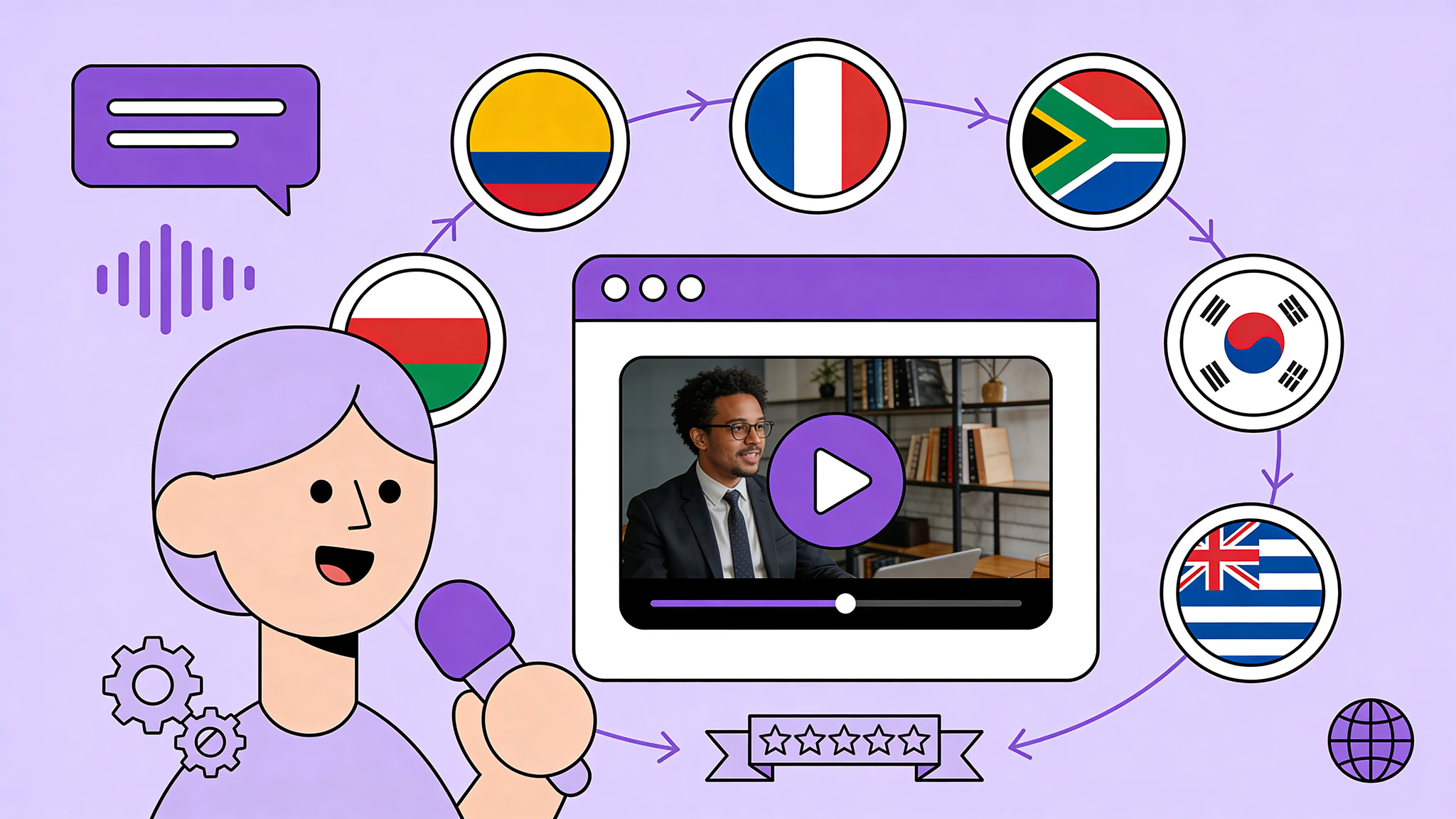
Multilingual AI dubbing translates a single video into multiple languages simultaneously — preserving the original speaker's voice in each one with native pronunciation and lip synchronization. One recording, ten languages, same person in every version. That's the shift from "we localize our top content" to "everything we produce is global from day one."
The technology makes it possible. But scaling across languages introduces challenges that single-language dubbing doesn't: terminology consistency, quality variation between language pairs, workflow management, and the question of which languages to prioritize first.
This guide covers how multilingual dubbing works at scale, what the practical workflow looks like, and the decisions that determine whether your multilingual strategy actually succeeds.
Key Takeaways
- Multilingual AI dubbing translates one video into multiple languages simultaneously with native pronunciation and consistent voice
- You pick every target language upfront in one step — scaling to more languages doesn't multiply the manual effort the way it does with traditional dubbing
- Glossary consistency is the single most important factor for multilingual quality
- Not all language pairs produce equal quality — start with your top markets, validate, then expand
- At scale (100 videos × 10 languages), AI dubbing costs 94% less than traditional localization
Why Multilingual Dubbing Changes the Strategy
Traditional localization forced a triage decision. You had budget for three languages. Maybe five if it was a major launch. Every additional language meant more voice actors, more studio time, more coordination. The cost scaled linearly, so you picked your biggest markets and ignored the rest.
AI dubbing breaks that model. The global AI video translation market is expected to reach $33.4 billion by 2034, growing at 28.7% CAGR (Source: Market.us, https://market.us/report/ai-video-translation-market/) — largely driven by multilingual dubbing demand. You upload once, pick every target language you need, and get every version back — there's no sequential rebooking, recasting, or rescheduling per language. The economics flip from "localization is expensive" to "NOT localizing is the expensive choice" because you're leaving audience on the table.
A pattern we see consistently: companies start by dubbing into their top 2–3 markets. Within a quarter, they're doing 8–10 languages. Within six months, they're dubbing everything into every language their audience speaks. The unlock isn't the technology. It's the realization that scaling to more languages doesn't multiply your effort — it's the same upload-and-select step whether you need 2 languages or 20.
How Multilingual Dubbing Works
The pipeline is the same as single-language dubbing — transcription, translation, voice cloning, lip sync — but multiplied across languages. What changes is the management layer.
Parallel Processing
Professional dubbing platforms process multiple languages simultaneously. You don't dub into English, then wait, then start Spanish, then wait. You submit one video, select ten languages, and the system processes all of them in parallel. A 5-minute video dubbed into ten languages completes in roughly the same time as dubbing into one — around 10–15 minutes total.
Glossary Consistency Across Languages
This is the single most important factor for multilingual quality. Your brand terms, product names, and technical vocabulary need to stay consistent not just within one language — but across ALL languages.
A glossary that defines "Lip Sync 2.0" ensures it doesn't get translated into "Lippensynchronisation 2.0" in German, "Sincronización Labial 2.0" in Spanish, or anything else. The term stays universal. Same for product names, industry jargon, and brand-specific vocabulary.
At Dubly, we manage glossaries centrally. Define your terms once — they apply across every language, every video, every project. Fifteen minutes of setup. Weeks of corrections saved. We've watched teams learn this lesson the hard way; don't be one of them.
Quality Variation Between Language Pairs
Not all language pairs produce equal quality. Worth being upfront about this.
Tier 1 — Excellent results: Major European languages (German, English, Spanish, French, Italian, Portuguese), Japanese, Korean, Mandarin. Massive training data. The output is indistinguishable from native content.
Tier 2 — Strong results: Most other supported languages. Slight quality variations possible. Still professional, still usable, but worth testing your specific content before committing to volume.
The honest take: A tool that claims equal quality across 150 languages is either lying or using a very generous definition of "quality." We support ~38 languages because we'd rather deliver excellent results in fewer languages than mediocre results in many.
Scaling Strategies That Work
Start with Your Top Markets
Don't try to launch in 20 languages on day one. Pick your 2–3 biggest audience gaps. German to English is the most common starting point for European companies. English to Spanish is common for US-based teams targeting Latin America.
Validate quality in these languages first. Build your glossary. Refine your workflow. Then expand.
The "Hub and Spoke" Model
Many companies use English as a hub language. All content gets dubbed into English first (if it isn't already), then from English into other languages. This simplifies quality control — you only need to verify one translation layer deeply, then the subsequent translations build on a validated English base.
Prioritize by Audience Data
Let data drive your language priorities. YouTube Analytics, website traffic by country, sales pipeline geography — these tell you where your actual audience lives. Dubbing into Hindi because it has a large population isn't a strategy. Dubbing into Hindi because your analytics show growing engagement from India is.
With Dubly.AI and YouTube Multi-Language Audio, we're able to reach audiences beyond the DACH region for the first time — without compromising on tone, quality, or authenticity. It's the perfect entry point into the international market.

Michael Graf
Head of Video, Webedia GmbH / GameStar
Translate Your First Video
Results in just a few minutes
No credit card required
Best translation quality worldwide
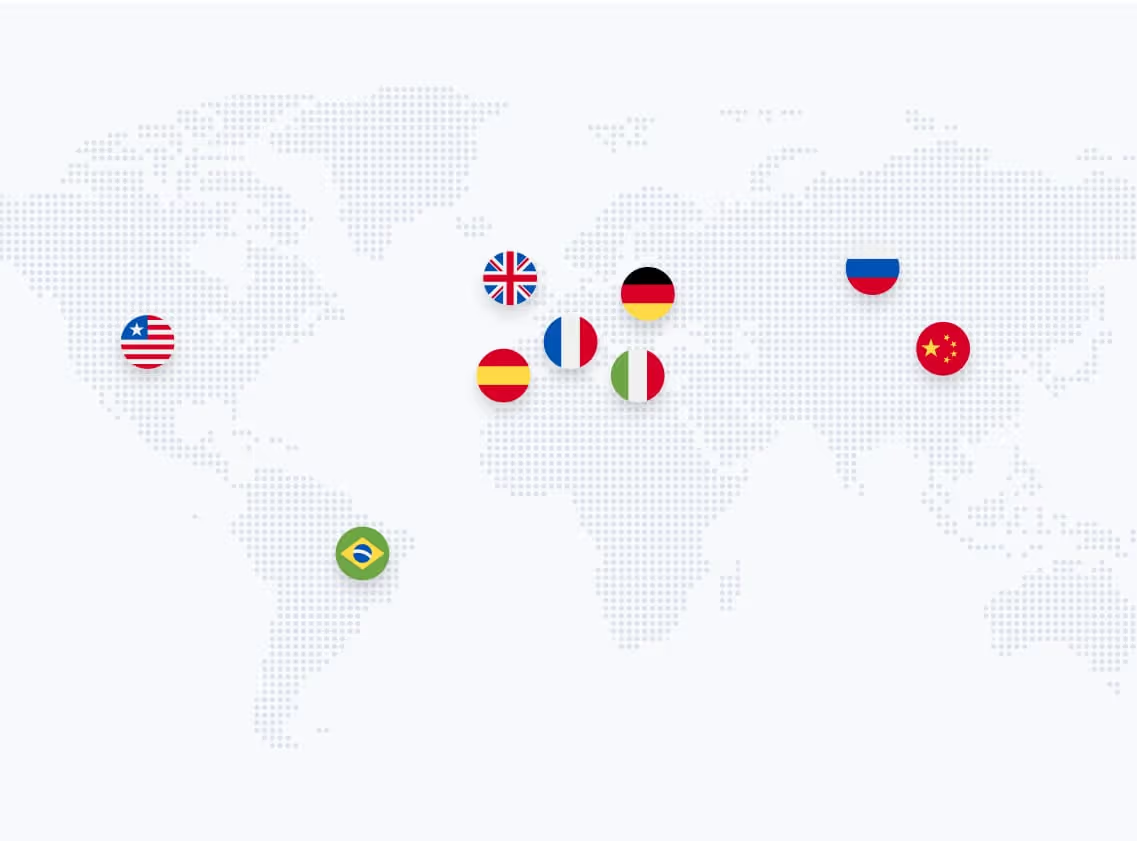
Multilingual Use Cases
YouTube Multi-Language Audio
YouTube's Multi-Language Audio feature was built for this. Upload dubbed audio tracks in multiple languages, and viewers automatically hear their preferred language. One video, one URL, global reach.
Creators who adopt multilingual dubbing early see compounding algorithmic benefits. More languages mean more total watch time. More watch time means better recommendations. Better recommendations mean more viewers — who then watch in more languages.
Liebscher & Bracht expanded to 8 languages and reached 43.8 million views internationally. One health channel, one content library, eight language versions.
Enterprise Training Libraries
A multinational company doesn't localize training content into two languages. They need ten, fifteen, sometimes twenty. Onboarding, compliance, product training, safety — all in every language their workforce speaks.
AI dubbing makes this feasible. Not just affordable, but actually fast enough that you can update a training video on Monday and have the multilingual versions ready by Tuesday. Try that with traditional localization.
Marketing Campaigns Across Markets
Global product launches. Regional ad campaigns. Localized landing page videos. Marketing teams need to hit multiple markets simultaneously with consistent brand voice.
Multilingual dubbing produces all versions from a single source video. Same speaker, same energy, same brand tone — in Spanish, Japanese, Portuguese, French, and everything in between. No more hiring different voice actors for different markets and hoping the brand personality survives.
Solutions for marketing teams: Marketing
Managing Multilingual Quality
The Review Problem at Scale
Real talk: you can't fluently review content in 10 languages. You speak English and German. How do you verify the Japanese version? You don't. Not line by line. So what do you do instead?
Approach 1 — Trust the pipeline. Set up glossaries, validate the first outputs in languages you speak, then trust the system for languages you don't. This works for most internal content.
Approach 2 — Sample-based review. Have native speakers in your team spot-check outputs in their language. Not full review — just listening to a 60-second sample and flagging anything that sounds off.
Approach 3 — Full review for key markets. Your top 2–3 markets get full human review. Everything else runs through the automatic pipeline with glossary-driven consistency.
Most companies use Approach 3 — intensive review for key markets, automated quality for the rest. It's the pragmatic balance between quality and velocity.
Consistency Signals
How to tell if your multilingual dubbing is staying consistent:
- Brand terms sound identical in every language (glossary working)
- The speaker's voice is recognizable across all versions (voice cloning working)
- Lip movements match in all versions (lip sync working)
- No untranslated fragments or random language switches (pipeline working)
If any of these fail in a specific language, it's usually a language-pair issue, not a system issue. Test that specific language pair separately.
The Cost Math
The cost model for multilingual dubbing is fundamentally different from traditional localization.
| Scenario | Traditional Dubbing | AI Dubbing |
|---|---|---|
| 1 video, 1 language | ~€400 (5 min × €80) | ~€25 (5 min × €5) |
| 1 video, 5 languages | ~€2,000 | ~€125 |
| 1 video, 10 languages | ~€4,000 | ~€250 |
| 10 videos, 10 languages | ~€40,000 | ~€2,500 |
| 100 videos, 10 languages | ~€400,000 | ~€25,000 |
The cost difference grows exponentially with scale. At 100 videos in 10 languages, AI dubbing costs 94% less than traditional methods. That's the math that turns "we can't afford to localize" into "we can't afford not to."
Pricing details: Dubly Pricing
Conclusion
Multilingual AI dubbing isn't a feature. It's a capability shift. The technology lets you treat every video as global content from the moment it's produced — not as something that might get localized later if the budget exists.
The practical steps: start with 2–3 languages, build your glossary, validate quality, then expand. The per-language cost is marginal once the pipeline is set up. The audience you reach by going from 3 languages to 10 is not.
The companies that figure this out first get a structural advantage. More languages mean more audience. More audience means more data on what works. More data means better content decisions. It compounds. And once a competitor starts producing in 10 languages while you're still debating whether to add a third, the gap is hard to close.
Back to the complete guide: AI Dubbing — How It Works, Tools & Use Cases
Translate Your First Video
Results in just a few minutes
No credit card required
Best translation quality worldwide
About the author

Simon Pieren
Co-Founder | Marketing & Sales