The Sync Labs Alternative That Delivers the Whole Video
Sync Labs moves the mouth, and does it well. Dubly delivers the whole video: translated, voiced, lip-synced, processed in Germany, and one company answers for it.
 Book a demo
Instant results
Sync Labs sells a lip sync model. You build translation, voices and review yourself. Dubly sends back finished video. Pick Sync Labs if you only need the mouth and already own translation, terminology and review — free tier, API, 95+ languages. Pick Dubly for the finished video: 96.4 against 54.8 in an independent lip sync benchmark, processed in Germany, a written no-training promise, and a named person, not an AI reply. From €69 a month on the annual plan.
















What Sync Labs is built for
What it does well, and where its job ends.
Built for lip sync, and built well
Sync Labs builds lip sync models, and that is the whole company. Their current model works around a hand in front of the mouth, handles profile shots, runs from a still image as well as video, and lip-syncs audio in 95+ languages. They are genuinely good at it.
It is more than the developer API people describe: a web Studio you can upload to, voice cloning, several speakers, plugins for Premiere and DaVinci Resolve. You can start free without a card, and the smallest paid plan is $5 a month. If your team writes code, that is a serious offer.
What it does not do is everything either side of the mouth. The dubbing step passes your audio to ElevenLabs, the only provider their parameters document, with no glossary and no way to correct the text first. On data they publish nothing: no security page, no data processing agreement, no list of sub-processors. We process in Germany and put it in writing. What that means in practice.
- Built for
- Lip sync — API, Studio, editor plugins
- Languages
- 95+ languages & dialects
- Plans
- Hobbyist: $5/mo + $0.08325/sec on lipsync-2-pro · Growth: $49/mo + $0.07925/sec on lipsync-2-pro + $25/seat
- Free tier
- 3 generations a month, 20 seconds — 15 with sync-3, watermarked
- Data processing
- United States — no provider disclosed
Where the two tools actually differ
Three rows go to Sync Labs, one is a tie. They stay — you would find them anyway.
Dubly.AI
Translate one video free Sync Labs
What a real month costs on each
Sync Labs' plan includes no video: it unlocks the platform, and every second you generate is billed on top — at a rate the model sets, not the plan. Their plan cards quote $0.0475/sec, which is lipsync-2, their cheapest current model. This month is priced on lipsync-2-pro, the model Sync Labs itself calls its highest quality, at their published Growth rate of $0.07925 a second — the closest thing they sell to what we deliver. The rest of the ladder is in the box below. Dubly bills credits — one credit is a minute of dubbing, two with lip sync. Our euro figures are net of VAT and come from our pricing page; dollar figures are converted at 0.864 USD/EUR, the ECB reference rate of 2 September 2026.
25 product videos of 3 minutes — 75 lip-synced minutes, 4,500 seconds of output
- Monthly plan
- €489/mo€359/mo on the annual plan
- Growth
- $49/moplus $25 per extra seat
- Usage on this volume
- $356.634,500 output seconds × $0.07925
- Total for the month
- $405.63/mo
Sync Labs has five models and the model decides the bill. On Growth, this same month costs $262.75 with lipsync-2 (about €227), $405.63 with lipsync-2-pro (about €350) and $618.70 with sync-3 (about €534), the model they set as the default for every account. Per lip-synced minute that is €3.03, €4.67 and €7.13, against €6.52 here or €4.79 on the annual plan. So on lip sync alone they are cheaper: lipsync-2 costs less than half our rate a minute, and even the model priced beside us lands twelve cents under our annual plan. What none of those figures buys is the translation, the voices, the glossary or anyone answering for the result. One more variable: the rates are charged per output frame and quoted at 25 fps, so the same month shot at 30 fps is $476.95. We bill per minute, whatever the frame rate.
What the smaller subscription does not include
- The translation and the voices themselves — Sync Labs bills those separately, per dubbed output minute, at a rate they do not publish
- A written promise your footage never trains a model — their terms say the opposite
- Video processed in Germany, under German and EU law
- A named contact on every plan: a person, not an AI reply
- A glossary for your brand terms, and the text before it is spoken
- A monthly number you can budget, instead of a meter that invoices itself
- Purchase orders, payment terms and vendor onboarding
- Unlimited users, with reviewers who do not cost a seat
The plan is $49. The month is $405.63 — about €350, or €4.67 per lip-synced minute. Ours is €6.52 on the monthly plan and €4.79 on the annual one. Against the annual plan that is the same money, and it does not buy the same thing: their figure is the mouth alone. Sync Labs bills the translation and the voices separately, through ElevenLabs, per dubbed output minute, at a rate they publish nowhere — so €4.67 is a floor, not a price, while €4.79 already contains the translation, the voices, the glossary and a person who answers. And their Creator plan at $19 lands twelve dollars below this one: at Sync Labs the plan is never the bill.
What our lip sync does when the shot stops cooperating
Not a head-to-head: Sync Labs builds lip sync for a living and ships new models often. Watch what ours does on the four shots that usually break, and hold it against what you use today. How the score is measured.
The translation comes back finished — and you can still change every line of it
Text, voice, timing and lip movement already work together when the video comes back. For the moments where that is not quite enough, the visual editor lays the translation out as a timeline: every spoken line is its own block, and you hear each change before it reaches the finished video.

The visual editor: the translated video as a timeline. Every spoken line is a block you can move, stretch, split or re-voice — with lip movement on its own track underneath.
Put a line exactly where it belongs
Drag a block until the sentence lands on the cut, or only starts once something appears on screen. Nothing snaps into place; only the neighbouring lines limit you.
Set the speaking pace
Pull a block by its edge, or set the pace with a slider. It only goes as far as the voice still sounds natural, and shows you how long the line runs as you drag.
Split, add, leave out
Divide a long block in two. Write a new line into a gap and have Dubly speak it in the same cloned voice. Or drop a passage the target market has no use for.
Lip movement per moment, not per video
A second track shows where lip movement applies. Switch it on where someone is speaking on camera, and leave it off over product shots and slides.
Rewrite one line and hear it back
Change the source text, the translation, the pace or the voice for a single line, regenerate it and listen right away — nothing else in the video moves.
Nothing ships until you approve it
Your finished video stays untouched while you work. Every step can be undone, and the bar at the bottom leaves two ways out: re-render, or discard.
When a single moment is off, the usual fix is to change the text and render the whole video again. Here you change the moment — its position, its pace, its voice, its lip movement — and the rest of the translation stays exactly as it was.
Four things Sync Labs does not give you
None of this is about their lip sync, which is good. It is what you hit once the video carries your name.
Their terms take a perpetual licence over your footage
Sync Labs' own terms take a “perpetual, and irrevocable license” on what you upload, expressly “to develop and improve the Service”. No plan lets you opt out. With Dubly your footage is processed, returned, and never used to train anything — in the contract. What that means in practice.
Nothing in writing for your legal team
No security page, no trust centre, no data processing agreement, no list of sub-processors. Their privacy policy is dated 27 May 2024 and never says GDPR. That is silence, not a finding — but a works council cannot file silence. Ours fits on one page, DPA on request. Read it.
The translation is yours to build, not to steer
Sync Labs' dubbing call takes a provider — ElevenLabs is the only one their parameters document — a language code, and nothing else: no glossary, no pronunciations, no sight of the text before it is spoken. You can have all of that by wiring ElevenLabs and a language model together yourself, which their own tutorial shows how to do. That is the trade: the control exists, you just have to build it and keep it running. Dubly holds your terms in a glossary and shows you the text first.
The bill is a variable, not a number
Their own billing FAQ asks whether the subscription includes credits for video generation, and answers “No.” Every second is metered, priced per model, and invoiced automatically once it passes $50. Growth carries three seats; every colleague after those is $25 a month. Dubly charges credits and nothing else: one number you pick up front, unlimited users.
Four things you get here and nowhere else
96.4 lip sync score
Against 54.8 for Sync Labs — 1,000 test clips on the same footage, judged blind by real viewers in an independent benchmark.
Processed in Germany
A German company on German servers, with no transfer to a third country. Our infrastructure has passed a TÜV SÜD penetration test.
A person, not an AI reply
A named contact on every plan, from the first euro — someone who knows your material and answers in German or English.
Never trains a model, in writing
Your footage is processed and returned. It never becomes training data, on any plan, and that sits in the contract.
Switching, without the part everyone dreads
Nothing to migrate. Just a person who makes sure the first ten videos come out right.
A named person, not a ticket queue
One contact who stays with you through the changeover and knows your material.
A test run on your own footage
Send a video you already ran through Sync Labs and compare the two results. That decides it, not us.
Support for larger volumes
Back catalogues, bulk processing and API access — plus help planning it if you are mid-contract elsewhere.
Procurement on your terms
Purchase orders, payment terms, vendor forms and an NDA — handled individually, not through a checkout page.
There is nothing to migrate. Sync Labs holds no credit balance that expires, so the only thing left behind is an open usage invoice — clear it before you cancel. Built a pipeline on their API? Tell us what it does; most of it you will not need.
So which one should you buy?
Sync Labs is the better choice if you…
- Only need the mouth, and want it as a component in a pipeline you own
- Already own translation, terminology and review, and want to keep them
- Want to lip-sync a still image or a synthetic voice, with no video
- Work in Premiere or DaVinci Resolve and want it inside the timeline
- Need lip sync on audio in a language we do not translate into — their model takes 95+, we translate into 40+
- Want a permanent free tier, or a $5 plan to experiment
Dubly is the better choice if you…
- Want a finished video, not a component, with one company responsible
- Want an API as well — ours is included on every plan at no extra cost, and it hands back the finished video
- Need the translation to use your terms, and to be correctable
- Have to say where the video is processed — ours stays in Germany
- Need that in writing, for a works council, a DPO or procurement
- Want a monthly number you can budget, not a self-invoicing meter
- Want a person on the other end: a named contact, not an AI reply
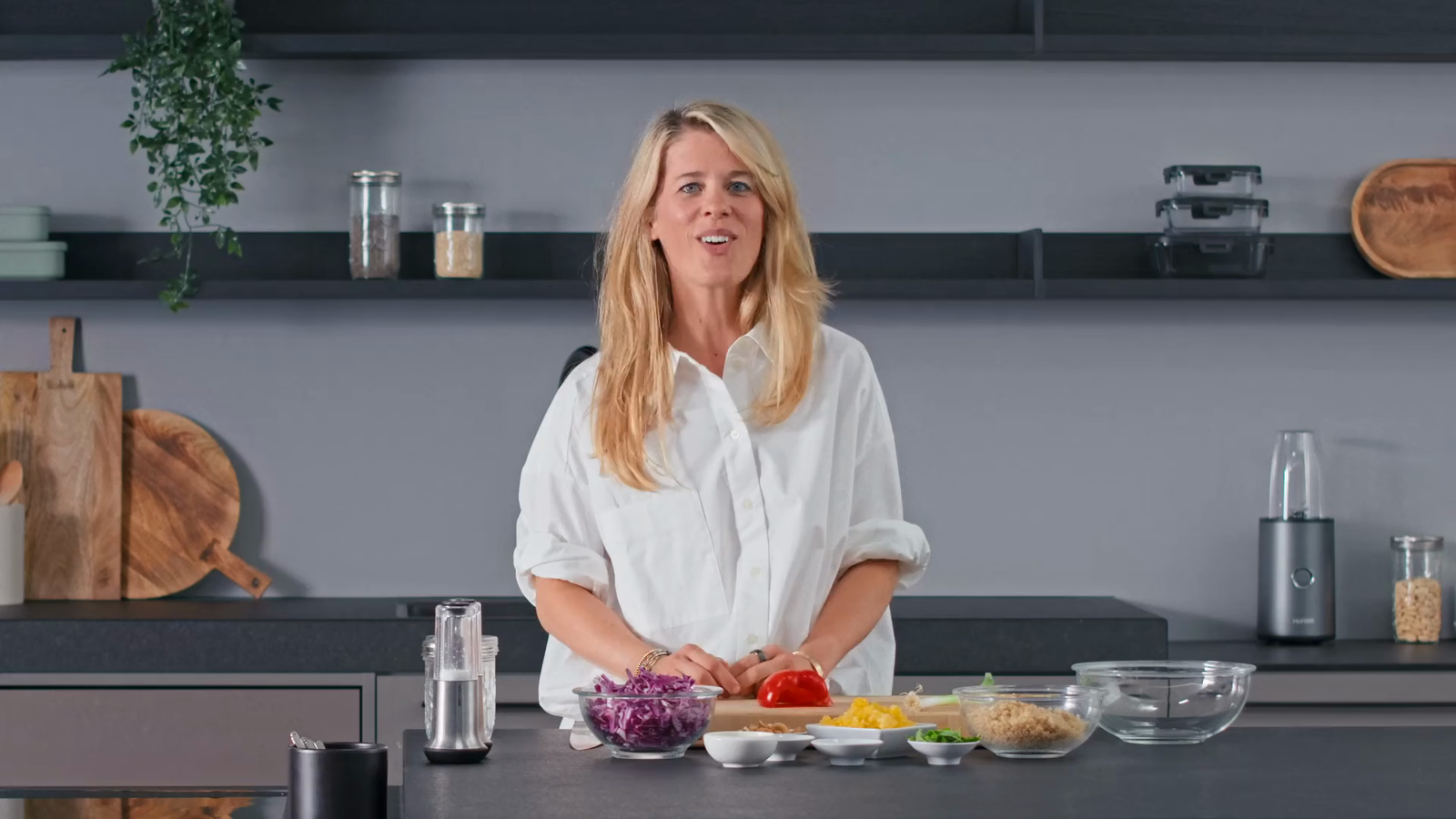
7hauben put a Michelin-level cooking school into four languages
“For a cooking course that runs several hours, subtitles aren't enough. Our standard is that every viewer gets the same experience, no matter which language they learn in.”
 Markus AuzingerHead of Production, 7hauben
- Localized videos in the catalog
- 578
- Localized videos in the catalog
- Less production time per course
- 60%
- Less production time per course
- Home cooks learning with 7hauben
- 100,000+
- Home cooks learning with 7hauben
Book a demoInstant results
Questions people ask before switching
Including the ones where the answer is not in our favour.
Scope. Sync Labs replaces the mouth: you bring the video and the audio, and translation, terminology, review and delivery stay yours to organise. Dubly returns the finished video — upload the file, pick the languages, and one company answers for the result.
Dubly scores 96.4 against Sync Labs' 54.8 in an independent lip sync benchmark across 1,000 test clips on the same footage. One caveat: Sync Labs is a specialist and ships new models often, so a single score is a snapshot. Test both on your own footage.
Yes, on every plan and at no extra cost. You post a video and the target languages and get the finished, translated, lip-synced file back — one call instead of transcription, translation, text-to-speech, lip sync and stitching wired together yourself. Back catalogues run through the same route.
Yes, in one pass. Panels, interviews and two-handers are handled per speaker, each keeping their own voice and their own sync. Sync Labs supports this too, through segments and automatic speaker detection. The difference is setup: with Dubly there is none.

Got any questions left?
We’d be happy to give you a personal demo of Dubly.AI and discuss your specific use cases.
Last checked: 02 September 2026
The figures for Sync Labs come from their own public pricing, product and policy pages. Ours come from the price list on our pricing page, and the lip sync score from an independent benchmark across 1,000 test clips.