AI Video Translation
June 18, 2026
What Is AI Video Translation? Definition, Benefits, and Real Limitations
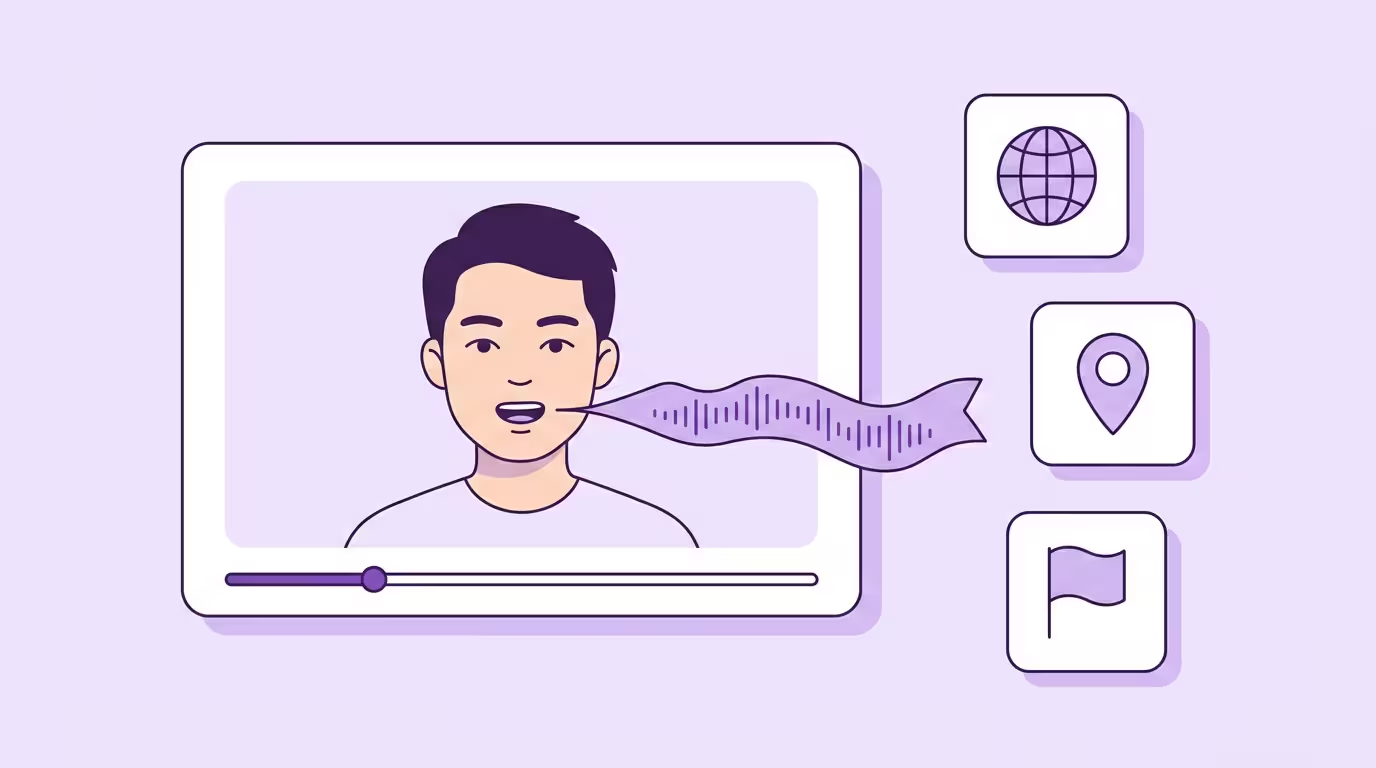
AI video translation converts a video's spoken dialogue into one or more new languages — replacing the original audio with a voice-cloned, lip-synced version that sounds and looks like the original speaker. It goes far beyond subtitles. The speaker's voice, tone, and even mouth movements carry over into the translated video. That's what an ai video translator actually does.
When you translate from video using modern AI, you're not adding text to the bottom of the screen. You're creating a translated video that sounds native in Spanish, Japanese, or whatever your target language is — as if it had been recorded that way from the start. For a comprehensive overview of the entire field, including tools, workflows, and use cases, see our complete guide to AI video translation.
The technology behind every serious platform combines four AI systems working in sequence: speech recognition transcribes the original language dialogue, neural machine translation converts it, voice cloning regenerates the audio in the speaker's own voice, and — in the most advanced tools — generative lip sync adapts the mouth movements frame by frame. Each layer adds authenticity. Skip one, and the result feels off.
For the full technical breakdown of each step: How AI Video Translation Works — From Upload to Final Output →
Key Takeaways
- AI video translation replaces the full audio track with a voice-cloned, lip-synced version — not just subtitles
- The technology combines four AI systems: speech recognition, neural machine translation, voice cloning, and generative lip sync
- Cost reduction is real: 94% lower than traditional dubbing — translate in minutes, not weeks
- The workflow is simple: upload, select languages like Spanish or French, download
- Scripted drama and regulated content still benefit from human review, while chaotic multi-speaker footage is exactly where Dubly's single-pass speaker separation keeps each voice clean
- Video localization is accelerating — businesses that translate now build a structural advantage that compounds
Why Translating From Video Matters More Than Ever
Video Is the Default — Language Is the Barrier
Video runs the internet. According to Wyzowl's 2026 State of Video Marketing report, 91% of businesses now use video as a marketing tool — a joint all-time high across twelve years of tracking (Source: Wyzowl, 2026, https://wyzowl.com/video-marketing-statistics/). YouTube videos, TikTok clips, Instagram Reels, LinkedIn thought-pieces, internal training platforms — video content is how information moves.
But here's the problem: most video content exists in exactly one language. A German creator with 500,000 subscribers is invisible to global audiences who don't speak German. An e-learning company with 200 hours of training video can't make that content accessible to Spanish-speaking or Japanese-speaking teams without starting over. The content exists. The language barrier is what stops it from reaching a wider audience — and until recently, the only way past it was expensive, slow, and impractical for most organizations.
That's what makes the ability to translate a video with AI different from a nice-to-have. It removes language barriers at scale — the missing piece between "we have great content" and "our content reaches global audiences in their native language."
Dubbed Content Wins Attention
Subtitles have their place. But when viewers can choose between subtitles and a fully translated video, dubbed content consistently outperforms. Viewers don't split attention between reading and watching — they just watch. Completion rates reflect this, particularly in markets with strong dubbing traditions like Spanish-speaking Latin America or German-speaking Europe.
Regional preferences confirm the pattern. An analysis by Preply across 20 countries found a striking 50/50 global split — 10 countries prefer dubbing, 10 prefer subtitles (Source: Preply, 2024, https://preply.com/en/blog/subbing-vs-dubbing-by-country/). Germany leads in Europe with 61% of Netflix content consumed in dubbed form. France, Spain, and Italy follow a similar pattern. For any business targeting Spanish, French, or German-speaking audiences worldwide, subtitles alone leave engagement on the table.
A pattern we see consistently at Dubly: creators who start by translating one video into English expand to three or more languages — often adding Spanish and French — within three months. Once they see the engagement data from their first translated video, the question shifts from "should we translate more videos?" to "how fast can we scale?"
Five Key Benefits When You Translate From Video With AI
Your Voice Stays Yours
Voice cloning is what separates modern AI video translation from the dubbed TV shows of the 1990s. The technology captures your vocal fingerprint — timbre, pace, emotional range — and generates natural sounding ai voices in the target language. Current platforms support roughly 30 to 40 languages this way, with Dubly.AI covering around 38 — including Spanish, French, Japanese, Portuguese, and Arabic.
One detail that surprises most people: voice cloning doesn't transfer your accent. It produces native speaker pronunciation in each language. Translate a video from German to Spanish, and the speaker won't sound like a German person struggling through a foreign language — the translated speech sounds fluent, like a native speaker with the original voice characteristics intact. That's a feature, not a limitation. Spanish-speaking audiences want to hear Spanish, not an accent.
Lip Sync Creates Visual Trust
Your brain processes lip movements before it processes words. When what you see doesn't match what you hear, trust evaporates — often within the first few seconds. That's why lip sync isn't cosmetic. It's the difference between something that feels native and something that feels obviously dubbed.
Most tools on the market struggle once the camera angle exceeds roughly 30 degrees from center, or when faces are partially covered. Dubly's Lip Sync 2.0 was built to solve exactly that: it handles multi-speaker scenes, side profiles, partially occluded faces, and dynamic camera movements — scenarios where older models give up. It processes 90% faster than first-generation models while producing results that are difficult to distinguish from the original at normal playback speed.
One thing we've learned building this: frontal shots still deliver the absolute best results — as with any camera-based technology. But the point where quality drops off is significantly further with Lip Sync 2.0 than with anything else on the market.
Minutes Instead of Months
Traditional dubbing is a project. Casting voice actors, booking studios, coordinating schedules, running approval loops. A single 10-minute corporate video might take three to six weeks to translate into just one language — Spanish, for example. Need that same video in French, Japanese, and Portuguese? Multiply the timeline.
AI powered video translation compresses that to minutes. Rough benchmark: 1 minute of lip-synced content takes approximately 2 minutes to process. A 5-minute file is done in about 10 minutes per language. Upload once, translate into Spanish, French, and Japanese, and download all three within the hour. That's not an incremental improvement — it's a different category.
94% Lower Cost
Professional voice over dubbing costs approximately €80 per finished minute when you factor in voice talent, studio time, direction, and revision cycles. An ai video translator with lip sync? Roughly €5 per minute. That's a 94% cost reduction — and it's not theoretical.
New Com Academy needed to translate their e-learning video content — multilingual courses for international teams — and saved over 85% compared to their previous production workflow. As their CEO Michael Kibele put it:
Thanks to Dubly.AI, we were able to internationalize our Academy without reshooting a single minute. Even complex technical terminology was translated with precision — and we saved over 85% in costs. For us, it was a game changer in making our core product globally scalable.

Michael Kibele
CEO, New Com Academy
For organizations sitting on hundreds of hours of video content, the math is compelling enough to change strategy overnight.
One Recording, Dozens of Languages
The economics of traditional dubbing are linear: each new language costs roughly the same as the first. AI video translation breaks that model. Translate into Spanish — then adding French, Portuguese, Japanese, and Italian costs almost nothing extra. The marginal cost of language number 12 is virtually identical to language number 2.
Buycycle went from producing every video version separately in a studio to running five YouTube video channels worldwide from a single recording. One original video, five translated videos, a fraction of the time and budget.
Who Should Use AI Video Translation — And Who Shouldn't
Where It Delivers the Most Value
Content creators and YouTubers are the fastest-growing segment. YouTube's multi-language audio feature has made multilingual publishing frictionless — and creators who translate their YouTube content see global reach multiply. Not incrementally. Multiplicatively. Marius Quast saw a 590% increase in international reach after translating his outdoor filmmaking content into 9 languages — overcoming language barriers that had locked out most of his potential audience.
Corporate training and e-learning is where the ROI case is most clear-cut. Companies with multilingual workforces spend fortunes re-recording training material. Translate once, and every team from São Paulo to Tokyo gets multilingual content in their native language — without a single reshoot. That's video localization at a fraction of what it used to cost.
Marketing teams going global benefit from consistent brand voice across diverse audiences. The glossary feature ensures that product names, taglines, and terminology stay identical across languages — a detail that matters more than most teams realize until they've dealt with the alternative. Record once in the original language, generate localized content in Spanish, French, and Portuguese, and your brand sounds the same to a wider audience everywhere.
Media and news organizations need speed above all else. When a story breaks, waiting three weeks for dubbed versions isn't an option. BILD's Lagezentrum uses AI dubbing to make complex news formats accessible to global audiences — translating German broadcasts into English within hours, not weeks.
When Traditional Methods Still Win
We're not going to pretend AI solves everything.
Scripted drama and film — where a voice actor's interpretation is part of the art — still benefits from human dubbing. A character's whispered confession or sarcastic aside carries emotional weight that current AI handles competently but not brilliantly. If your video content is primarily emotional performance, traditional dubbing is worth the investment.
Highly regulated content — medical instructions, legal disclosures, pharmaceutical documentation — often requires certified human translators for compliance reasons. AI dubbing can draft accurate translations, but a human must sign off. That's not a technology limitation. It's a regulatory reality.
And chaotic multi-speaker environments, think panel discussions where five people talk over each other, are where most tools blur the speakers together. Dubly handles them with single-pass speaker separation that tracks each person independently, so overlapping speech stays clean even when the conversation does not.
Translate Your First Video
Results in just a few minutes
No credit card required
Best translation quality worldwide
AI Video Translation vs. Subtitles vs. Traditional Dubbing
| Factor | Subtitles | Traditional Dubbing | AI Video Translation |
|---|---|---|---|
| Speed | Hours | 3–6 weeks per language | Minutes per language |
| Cost per minute | ~€2–5 | ~€80+ | ~€5 |
| Voice preservation | N/A (text only) | No (new voice actor) | Yes (voice cloning) |
| Lip sync | N/A | No | Yes (frame-by-frame) |
| Viewer engagement | Lower (split attention) | High | High |
| Scalability | High | Low (linear cost) | High (marginal cost drops) |
| Best for | Budget content, accessibility | Film, premium scripted content | Business, creators, training, marketing |
If you only need to translate subtitles for accessibility, subtitles remain the right choice — fast and cheap. Traditional dubbing still wins for premium scripted entertainment where vocal performance is artistic. AI powered video translation is the clear choice for everything in between — which covers most content produced today. It's also the foundation of professional video localization, where companies adapt content for global markets beyond just translating the audio — creating fully localized content that reaches a wider audience in their native language.
How to Translate a Video With an AI Video Translator
The technology behind ai powered video translation is complex. Using it isn't. Most platforms have reduced the workflow to three steps — upload, translate, download. Here's what that looks like in practice.
Upload Your Source Material
Start by uploading your file — MP4 and MOV are universal formats. Some platforms also accept an audio file separately if you only need to translate audio without visuals. Dubly.AI supports uploads up to 5 GB at resolutions up to 4K with no limit on length.
Quality matters at this stage. The clearer the original language audio, the more accurate the transcription. If the source has clean speech without heavy background noise, the system can transcribe and translate more precisely — which means better results downstream.
Select Languages and Review the Translated Script
Choose your target languages — Spanish, French, Japanese, Portuguese, or any of the supported options. Most platforms let you translate into multiple languages from a single upload. Select Spanish and French, and both versions are processed in parallel rather than sequentially.
Before the final audio is generated, you can review and edit the translated script. This is where glossary features come in: define how your brand name, product terms, or technical vocabulary should translate — whether the output is English text, Spanish, or Japanese — and the platform applies those rules consistently. You can also translate subtitles alongside the dubbed audio — many tools generate both from the same translated text.
The auto translate output is accurate enough to ship for most content. But for brands that need precise localized content, the ability to fine-tune the translated text before audio generation is essential.
Download the Finished Result
Once processing is complete, download in the original format and resolution. The output includes the voice-cloned audio track and — if you selected lip sync — adjusted mouth movements that match the translated speech in the chosen language. Most platforms also let you export the audio file separately, grab translated subtitles as SRT, or download the translated script as text in different formats.
A 5-minute upload translated into Spanish with full lip sync is typically ready in about 10 minutes. Run that same source through five languages, and everything is done within the hour. Upload, translate, download — no studio, no voice actors, no scheduling. For a side-by-side comparison of the best ai video translator tools, see our full breakdown.
Three Misconceptions That Still Persist
"It's Just Auto-Generated Subtitles"
This one comes up constantly. Auto generated subtitles and AI video translation share exactly one thing: both start by transcribing the original language audio. After that, the paths diverge completely. Subtitles add translated text to the screen. AI video translation replaces the entire audio track with a voice-cloned version and adapts the lip movements to match. The core product is localized content with dubbed audio — not a text overlay. Calling it "subtitles" is like calling a self-driving car "cruise control."
"AI Voices Always Sound Robotic"
Five years ago? Fair criticism. Today? It depends entirely on the platform. Basic text-to-speech engines still sound mechanical. But advanced ai voice cloning — the kind used in professional AI dubbing — produces natural sounding ai voices that most listeners can't distinguish from human speech in a blind test. Translate something into Spanish with a good tool, and the result sounds like a native Spanish speaker — not a robot reading a script. The technology has crossed the uncanny valley for spoken content. Not in every scenario — but consistently enough for professional use.
"It Works Perfectly Every Time"
It doesn't. And anyone who tells you otherwise is selling something.
High-emotion content like screaming, crying, and singing is where generic AI voices flatten out and lose the performance. Dubly's voice cloning preserves the speaker's emotional tone and energy so the delivery still carries. Clear, well-recorded source audio always produces the most accurate result. And cultural adaptation, like jokes, idioms, and references that don't cross borders, still benefits from human judgment.
The gap between "works well" and "works perfectly" is real. But for the vast majority of business, educational, and creator content, the technology delivers translated videos indistinguishable from human-produced work — at a fraction of the cost and time. The question isn't whether the translation is perfect. It's whether the result is good enough to ship. And in most cases, it is.
Ready to hear what your content sounds like in Spanish, French, or Japanese? Try Dubly free — 1 minute, all features, no credit card required. Or explore the best AI video translation software to find the right platform for your workflow.
Conclusion
AI video translation is the full replacement of a video's audio track, not a text overlay. It combines four AI systems, speech recognition, neural machine translation, voice cloning, and generative lip sync, to recreate the speaker's voice in a new language and adapt their mouth movements frame by frame. The result sounds and looks native, because voice cloning produces native pronunciation rather than carrying the original accent across, and lip sync keeps what you see matched to what you hear. For creators, training and L&D teams, marketers, and media organizations, that turns one recording into dozens of languages in minutes instead of weeks, at a fraction of traditional dubbing cost.
Back to the complete guide: AI Video Translation
Translate Your First Video
Results in just a few minutes
No credit card required
Best translation quality worldwide
About the author

Simon Pieren
Co-Founder | Marketing & Sales