AI Video Translation
June 18, 2026
How AI Video Translation Works — From Upload to Final Output
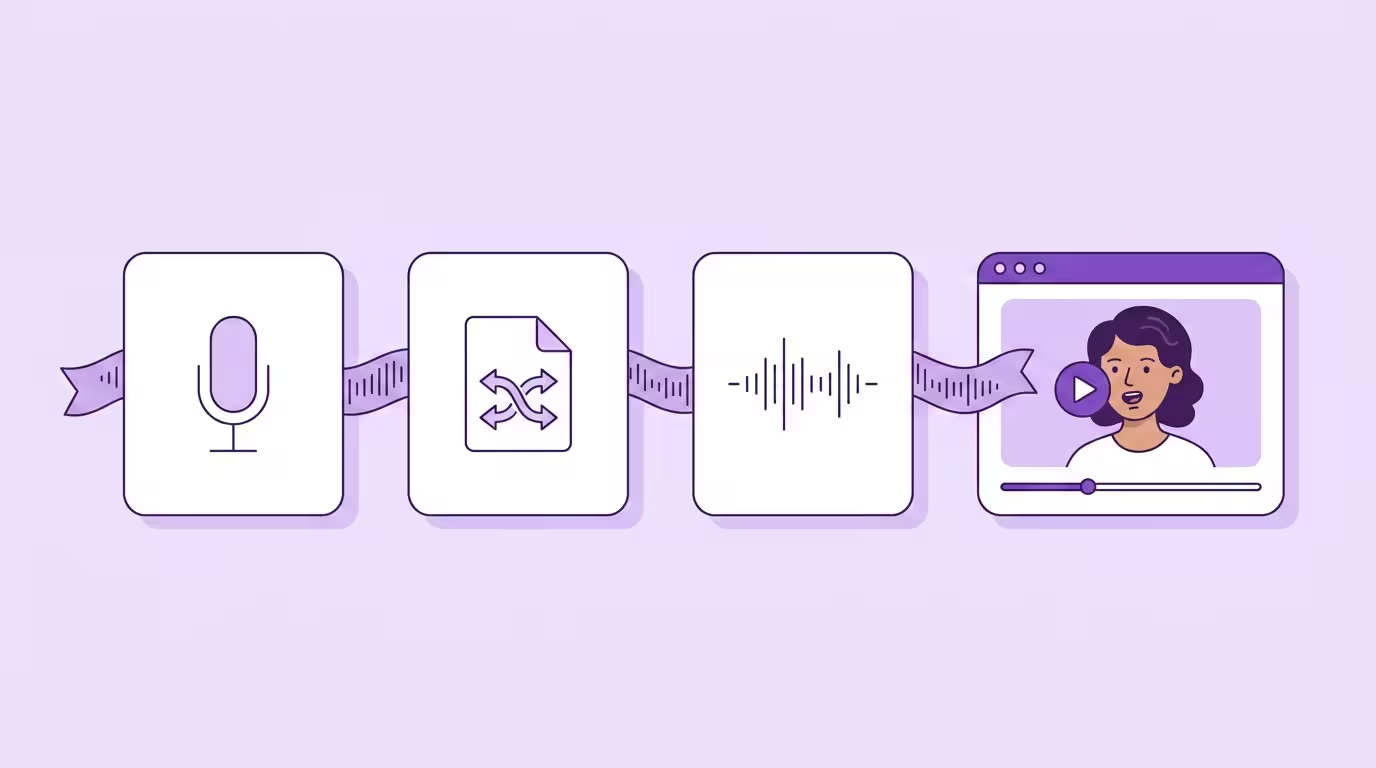
AI video translation works through a four-stage pipeline: speech recognition transcribes the spoken dialogue, neural machine translation converts it into the target language, voice cloning regenerates the audio in the original speaker's voice, and generative lip sync adapts the mouth movements frame by frame. Each stage builds on the previous one. Skip any of them, and you lose quality that the next stage can't recover.
That's the high-level answer. But understanding what actually happens at each stage — where the quality comes from, where it breaks down, and why some tools produce dramatically better results than others — is what separates informed decisions from guesswork. For a broader overview of the field, including tools and use cases, see our complete guide to AI video translation. For a definition-level introduction: What is AI video translation?
This article explains the engineering behind the technology.
Key Takeaways
- AI video translation runs through four sequential stages: speech recognition, neural machine translation, voice cloning, and lip sync. Quality depends on the weakest link.
- Voice cloning preserves the speaker's identity but produces native pronunciation — no accent transfer. That's a feature, not a limitation.
- Lip sync is the most computationally expensive stage and the biggest quality differentiator. Without it, the audio-visual mismatch is immediately noticeable.
- Glossaries and editable translations give humans control over the automated pipeline — the AI does the heavy lifting, the human ensures accuracy.
- Multi-speaker scenes and high-emotion delivery are where tools diverge most: Dubly's single-pass speaker separation and voice cloning keep quality high where generic tools flatten out.
The Four-Stage Pipeline
Modern AI video translation isn't one model doing everything. It's four specialized AI systems working in sequence, each handling a different aspect of the translation. Think of it as an assembly line where each station has a narrow job and does it extremely well.
The pipeline runs in this order:
Speech Recognition
audio becomes text
Neural Machine Translation
text becomes translated text
Voice Cloning & Speech Synthesis
translated text becomes spoken audio in the original voice
Generative Lip Sync
the speaker's face is adapted to match the new audio
Each stage feeds its output into the next. The quality of the final video is only as good as the weakest link — a flawed transcription produces a flawed translation, which produces a flawed voiceover, which no amount of lip sync can fix.
Stage 1 — Speech Recognition and Transcription
Everything starts with turning spoken words into text. Automatic Speech Recognition (ASR) listens to the audio track and generates a written transcript, including speaker identification and timestamp alignment.
This sounds simple. It isn't. The ASR model needs to handle accents, background noise, overlapping speakers, domain-specific terminology, and the kind of informal speech patterns that appear in natural conversation but rarely in training data. A CEO who says "um" twelve times per minute, a podcast host who talks over their guest, a training video with machine noise in the background — these are everyday scenarios that push ASR models hard.
Modern ASR systems handle most of this well. The breakthrough came with transformer-based architectures that process entire sequences rather than word by word. Instead of guessing each word in isolation, the model uses context from the surrounding sentence to disambiguate — which is why "their" vs. "there" or "to" vs. "too" rarely trips up modern systems anymore.
Multi-speaker detection happens at this stage too. The system identifies distinct voices and segments the transcript accordingly. This matters because each speaker will need their own voice clone in Stage 3 — if the ASR merges two speakers into one, the downstream result is a single cloned voice speaking both parts.
Stage 2 — Neural Machine Translation
Once the speech is text, it gets translated. This is where neural machine translation (NMT) comes in — and where the quality leap of the last decade has been most dramatic.
Traditional machine translation worked with rules: if you see word X in language A, replace it with word Y in language B. The results were grammatically correct but often stilted, missing idioms, cultural context, and the natural flow of human language.
NMT changed the approach entirely. Instead of translating word by word, transformer models — the architecture introduced by Vaswani et al. in 2017 (Source: "Attention Is All You Need", https://arxiv.org/abs/1706.03762) — process the entire sentence as context. The model weighs which parts of the source sentence are most relevant for each word in the target sentence. That's why modern translations capture meaning, not just vocabulary.
For video translation, NMT has an additional constraint that doesn't exist in text translation: timing. The translated sentence needs to fit roughly into the same time window as the original. German sentences run approximately 20% longer than English equivalents. Japanese is more compact. The NMT model in a video translation pipeline accounts for this — it's not just translating for accuracy, it's translating for speakability.
This is also where glossaries become critical. Without one, the NMT model will translate "Grounding" (a Dubly feature name) into whatever the target language's literal equivalent is. With a glossary, the model knows to preserve specific terms. At Dubly, customers who use the glossary function report significantly fewer correction cycles — the translation gets it right the first time because the model has explicit guidance on brand-specific vocabulary.
Translate Your First Video
Results in just a few minutes
No credit card required
Best translation quality worldwide
Stage 3 — Voice Cloning and Speech Synthesis
The translated text now exists. But reading it out loud with a generic text-to-speech voice would sound robotic and impersonal — like a GPS navigator reading a news script. Voice cloning is what makes the output sound human.
Here's how it works: the system analyzes the original speaker's voice — not just pitch and speed, but the subtler characteristics that make a voice recognizable. Timbre, cadence, the way emphasis falls on certain syllables, the micro-pauses between thoughts. From this analysis, the model builds a voice profile that can generate new speech in any supported language while retaining those characteristics.
What gets preserved: the speaker's vocal identity, emotional tone, and speaking rhythm. A calm explainer sounds calm. An energetic presenter sounds energetic. The personality carries through.
What doesn't get preserved — and this is important: the original accent. Voice cloning produces native pronunciation in the target language. If a German speaker is translated into Spanish, the result sounds like a native Spanish speaker with the German speaker's vocal quality. Not a German person speaking accented Spanish. That's by design. Audiences in Spain don't want to hear a foreign accent — they want to hear fluent Spanish that sounds like the person they're watching.
For multi-speaker content, each identified voice from Stage 1 gets its own clone. A panel discussion with four speakers produces four distinct voice profiles, each translated independently. The system then reassembles the translated audio with the correct speaker assignments and timing.
Stage 4 — Generative Lip Sync
This is the stage that separates basic AI dubbing from truly convincing video translation. Without lip sync, you have translated audio playing over a face that's visibly speaking different words. The viewer's brain catches the mismatch instantly — and once you see it, you can't unsee it.
Generative lip sync solves this by regenerating the speaker's mouth movements to match the new audio. Not overlaying a filter. Not stretching or morphing the existing mouth. Actually regenerating the lip region frame by frame based on the phonetics of the translated speech.
The model analyzes three inputs simultaneously:
- The original lip movements — what the mouth was doing in the source video
- The translated audio — the phonetic targets the mouth needs to hit
- The facial context — head angle, lighting, surrounding facial structure
From these inputs, it generates new mouth movements that look natural for the new language while preserving everything else — the eyes, the expressions, the head movement, the background. Only the lips change.
This is computationally the most demanding stage. At Dubly, our benchmark is approximately 2 minutes of processing time per minute of lip-synced video. A 5-minute video takes roughly 10 minutes per target language.
The technology handles complexity that would have been impossible two years ago. Multiple speakers in the same frame. Speakers who turn their heads or move while talking. Partially occluded faces — a hand in front of the mouth, a microphone blocking part of the chin. Dubly's Lip Sync 2.0 model was specifically built for these real-world conditions, not just the clean, frontal talking-head shots that early lip sync models required.
Occlusion Demo
Where Tools Differ Most
Not every tool handles the hard cases the same way. This is where the gap between them shows, and where Dubly was built to hold up.
High-emotion content. Screaming, crying, and whispering at extreme intensity are where generic AI voices flatten out and lose the performance. Dubly's voice cloning preserves the speaker's emotional tone and energy, so the delivery still carries across every language.
Multi-speaker scenes. A roundtable with six people talking over each other is where most tools get noisy and let voice clones bleed into each other. Dubly tracks and processes each speaker independently in a single pass, so overlapping speech stays clean.
Source audio quality. Every model works best on clear, well-recorded speech. For the most accurate transcription, start from a clean source recording in a standard language variety, since heavy background noise or strong regional dialects make any model's job harder.
None of these are permanent. Every model generation narrows the gap — and it narrows fast. But in 2026, they're real constraints worth knowing about before you commit to a production pipeline.
How Dubly's Pipeline Differs
Most video translation tools bolt together third-party models for each stage — one vendor's ASR, another's NMT, a generic TTS for voice, and maybe a lip sync model that only works on frontal shots. The result is functional but inconsistent. Each handoff between systems loses information.
Dubly runs an integrated pipeline where each stage is optimized to feed the next. The ASR output is formatted for our NMT model. The NMT output is optimized for speakability, not just accuracy. The voice cloning model knows what the lip sync model needs. Everything is designed to work together.
Key technical differentiators:
- Lip Sync 2.0 — multi-speaker detection, dynamic head movement, occlusion handling, 90% faster processing than our first-generation model
- Editable translations — review and modify the NMT output before voice synthesis. No extra cost, no re-processing of earlier stages
- Glossary and custom pronunciations — control how specific terms are translated and spoken across every video
- GDPR compliance on German servers — the entire pipeline runs on infrastructure in Germany. No data leaves the EU. No customer data is used for model training
For a side-by-side comparison of platforms and which pipeline stages they cover, see our AI video translation software comparison.
With Dubly.AI, we were finally able to make our instruction-heavy content accessible to French-speaking customers — lip-synced, precisely translated, and fully on-brand. For us, it was the key to successfully serving the French market.

Flavio Holstein
CEO, Augletics
See case study: Augletics →
Back to the complete guide: AI Video Translation
Translate Your First Video
Results in just a few minutes
No credit card required
Best translation quality worldwide
About the author

Maximilian Engler
Co-Founder | Product