Video Localization
July 3, 2026
Video Localization Workflow: A Step-by-Step Guide to Going Global
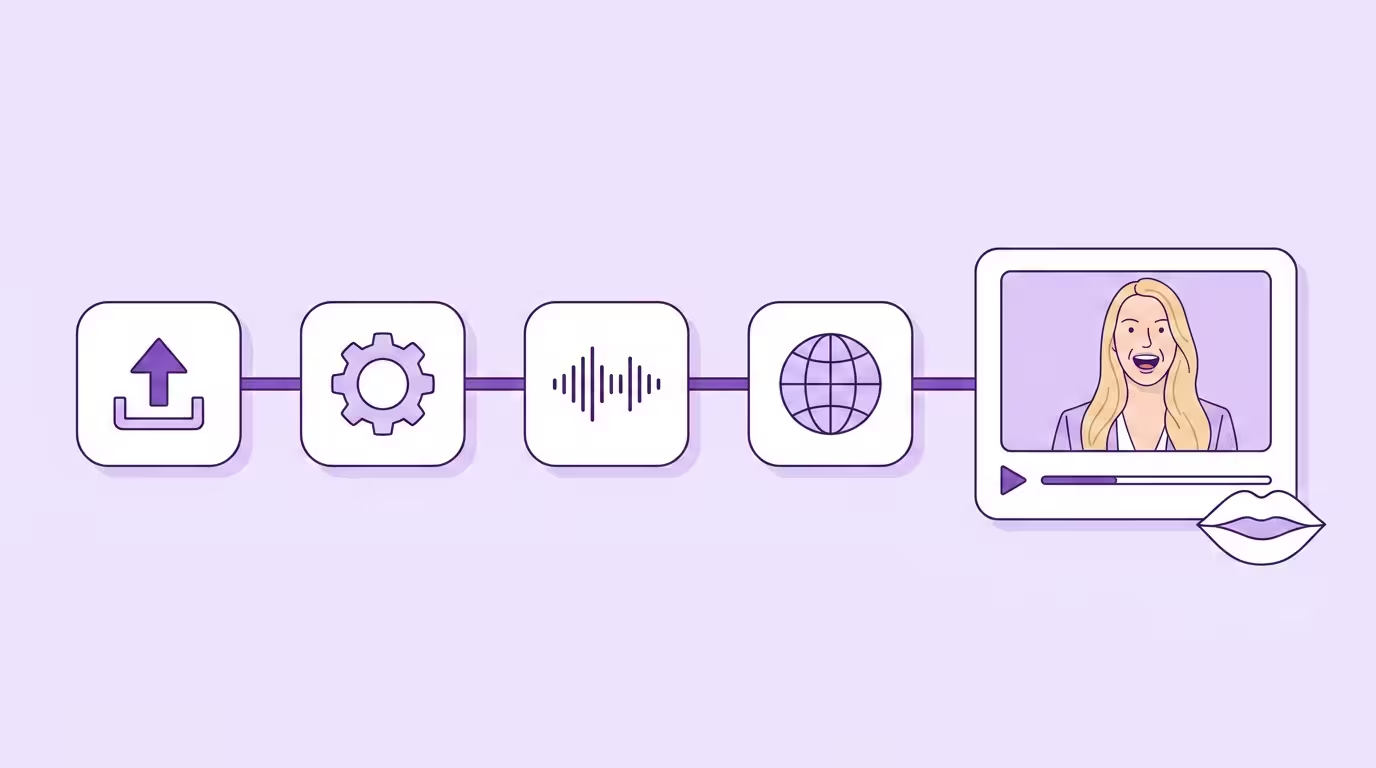
A large share of social video gets watched with the sound off — which means the subtitle track and the on-screen text are the actual audio for a big part of your audience — get the order of operations wrong, and you'll redo half your work every time you add a language.
A video localization workflow is the end-to-end process of adapting video content for a specific target audience — content audit, script prep, translation, voice production, visual adaptation, quality assurance, publishing. The difference between a workflow that scales and one that collapses at three languages is the sequence, not the tools. And the business case is settled: 76% of consumers prefer content in their native language, 40% won't buy from brands that don't offer it, proper localization lifts engagement by roughly 47–50%, and 80% of consumers are more likely to buy after watching a video in their language.
Most teams don't lose on localization because the translation is bad. They lose because they rushed in without a clear sequence — no glossary, no style guide, no approval chain — and spent six weeks cleaning up the first batch of five videos. Search engines only reward you for content that actually speaks the local language, so a broken process doesn't just hurt engagement. It buries the video in the markets you were trying to reach. We've watched this process work across hundreds of projects — from creators shipping their first localized video for a global audience to enterprise teams breaking language barriers across video content in 20+ different languages.
Key Takeaways
- Front-load preparation — glossary and terminology management save more time than any video localization tools
- Start with 5-10 high-performing evergreen videos, not your entire video content library
- The method depends on what the target audience sees: face on screen → lip sync matters
- Build three quality assurance layers: technical, linguistic, and native in-market review
- Track target audience engagement per language and iterate — video localization is a continuous process, not a one-time project
- Implement best practices early: a localization strategy built for your first three languages scales to thirty
Why Your Workflow Matters More Than Your Tools
Most teams start their video localization journey by shopping for tools. They compare translation platforms, evaluate pricing, run trials. And then they localize their first batch of videos in a disorganized sprint — no glossary, no style guide, no approval process.
The result is predictable. Translations drift across localized video versions. Brand terms get translated three different ways in the same quarter. Someone catches a cultural reference that doesn't work for the target audience, but only after the localized video content is already public. The tone shifts between videos because nobody documented the voice guidelines. The second batch takes just as long as the first because nothing was systematized.
A good video localization strategy front-loads the decisions. You define your terminology once, set approval chains once, establish quality standards once — and then every new localized video flows through the same pipeline. The process itself becomes the product. At Dubly, we see this across regions and industries: teams that spend 2 days on preparation before localizing anything end up moving 3x faster by the fifth video than teams that dove straight into production. In our enterprise base, 80% of the rework we see traces back to prep gaps — missing glossary entries, undefined formality rules, no transcript review. Not translation quality. Planning localization early is the single biggest lever for saving time and money, and it costs nothing.
What follows isn't theoretical. It's the video localization process we've watched catch problems early, survive new hires, and actually get faster as teams scale from three languages to thirty.
The 7 Phases of a Video Localization Workflow
Here's the sequence we run with customers, phase by phase. And if you want to know which one teams skip most often: it's Phase 2. Every time.
Content Audit
Catalog and prioritize by longevity, performance, and strategic value
Preparation
Script, glossary, style guide, text expansion, regionalization
Translation
Linguistic translation plus cultural adaptation, editable before voice
Voice Production
Subtitles, voice over, AI dubbing, or dubbing plus visual sync
Visual Localization
Lip sync, on-screen text, thumbnails, and metadata
Quality Assurance
Technical, linguistic, and in-market review layers
Publish, Measure, Iterate
Distribute per platform, track per language, refine
Phase 1 — Content Audit and Prioritization
Not every video deserves the same video localization treatment. A five-year-old product demo with 200 views doesn't need dubbing in twelve languages. Your flagship explainer video with 500,000 views does. And training videos for international teams have different requirements than promotional videos for social media platforms.
Start by cataloging your existing video content against three criteria:
Longevity — Evergreen video content first. Product tutorials, brand films, and educational series have a long shelf life. Event recaps and seasonal campaigns don't. Focus your video localization efforts on content that will deliver ROI for months or years.
Performance — Videos with proven target audience engagement in your primary language are the safest bets. High view counts, strong completion rates, and conversion attribution all signal that audiences in other languages would respond similarly.
Strategic value — Some videos punch above their view count. Onboarding content that reduces support tickets across multiple languages. Sales enablement videos that shorten deal cycles in new markets. Training videos that replace in-person sessions for international teams. These are often the highest-ROI video localization candidates.
Here's what we tell every enterprise customer who asks where to start: don't localize everything. The teams that succeed pick 5-10 videos, prove the process, then expand to new regions. The ones that try to localize 200 videos in month one usually stall at 50.
Phase 2 — Preparation: Script, Glossary, and Style Guide
Skip this phase and you'll pay for it in every video that follows. I'm not being dramatic. This is the number one reason localization projects stall at scale. Define your target markets, your languages, your goals, and your glossary before a single video gets touched — that's the whole of "best practices" in one sentence.
Transcription and script extraction. Before anything gets translated, you need clean video scripts with accurate audio transcription. Transcription involves converting the original audio into a text script with timestamps, which serves as the source document for all subsequent translation work. Automated tools get you 90% of the way — the remaining 10% is fixing speaker attribution, technical terms, and timestamps. Every error here multiplies across every target language.
Glossary. Define how your brand terms, product names, and industry jargon should be handled in each language. Should "Lip Sync" stay in English or become "Lippensynchronisation" in German? Does your product name get translated? These decisions need to happen exactly once. At Dubly, customers who use the glossary feature from the start have significantly fewer revision cycles than those who add it later.
Style guide. Formality varies dramatically across markets and audience expectations. German business audiences expect the formal "Sie." French audiences require a certain register in professional videos. Japanese localization involves entirely different speech levels depending on context. Document these rules for each target language — what works for one regional audience won't work for another.
Text expansion planning. Translated text is rarely the same length as the original. English to German expands by up to 35%. English to French or Spanish by 20–25% (Source: Eriksen Translations, https://eriksen.com/language/text-expansion/). For video translation, this means dubbed audio will often run longer than the original — your process needs to account for timing adjustments, especially when synchronizing mouth movements to translated speech.
Regionalization. Language isn't the only thing that changes across different regions. Currencies, date formats, measurement units, phone number formats, even legal disclaimers shift per market. A training video that shows "$49/month" or "April 5, 2026" needs to swap both for a German viewer. Decide in this phase which of those variables your videos include — and which ones you'll handle in on-screen text versus voiceover versus accompanying landing pages. Getting that right once is infinitely cheaper than catching it in QA on every batch.
Phase 3 — Translation and Cultural Adaptation
This is the phase where most video localization projects quietly fail. Not because the translation is wrong — but because it's too right. Machine translation produces perfectly accurate word-for-word conversions that sound like nobody actually talks that way. Successful localization requires going beyond literal script translation.
Good video localization has two layers, and most teams only do the first.
Linguistic translation — professional native-speaking translators convert the source script into the target language with correct grammar, terminology, and register while preserving the original tone. An AI translation tool gets you most of the way there for straightforward video content — modern neural machine translation is genuinely good now, good enough to translate videos at near-human quality in most business domains. Technical scripts or anything emotionally nuanced? You want native speakers reviewing the output to ensure the localized audio actually sounds natural.
Cultural adaptation — and this is the part people underestimate. Cultural adaptation means rewriting the references, swapping the graphics, and rethinking anything visual that won't land the same way abroad. A case study about an American retailer doesn't land with a Japanese audience. "Football" means entirely different sports depending on the cultural context. Currency, date formats, measurement units, humor — all of it needs rethinking for each target market and its specific cultural differences.
The key quality gate here is editability. Any process that treats video translation as a black box — content goes in, something comes out, no one reviews it — is a process that produces embarrassing results. Editable translations let your team catch issues before they reach production. At Dubly, every translation is reviewable and editable before voice synthesis begins. No surprises in the final output.
For a deeper look at how AI powers this phase: How AI Video Localization Works.
Phase 4 — Voice Production
This is where your method choice has the biggest impact on quality, cost, and timeline. Pick wrong and the math gets ugly fast — traditional voice production can eat more budget than the next three phases combined.
| Method | Best For | Timeline | Cost | Speaker Voice |
|---|---|---|---|---|
| Subtitles only | Budget-limited, text-heavy content | Hours | Lowest | Original preserved |
| Voice over | Documentaries, news, narrated content | Days | Medium | Generic narrator |
| AI dubbing | Scale, consistency, fast turnaround | Minutes per language | Low-medium | Cloned original voice |
| AI dubbing + visual sync | Speaker-on-camera, training, marketing | Minutes per language | Medium | Cloned voice + matched lips |
The decision isn't just about budget. It's about what the viewer sees. If the speaker's face is visible, subtitles create a disconnect — the audience reads instead of watches. Voice over is better, but viewers still hear two voices competing. Realistic voice cloning keeps the speaker's identity intact — you clone voices once, then use that profile to generate dubbed audio across every target language with native pronunciation locked in. That's what makes translated content feel native instead of dubbed. And with visual synchronization, the speaker genuinely appears to be speaking the target language. That's the difference between translated content and content that actually lands.
One thing we've learned building this technology: voice production is where most traditional processes bottleneck. Booking voice actors, scheduling studio time, managing retakes — that's weeks per language per region. A voice cloning platform compresses this to minutes. You clone your voice once from a short reference sample, then use that synthetic voice profile to dub videos into every target language in the queue — same speaker identity, native pronunciation, the cloned voice carrying the original emotional delivery into each localized audio track. A five-minute video, fully dubbed with voice cloning, is typically done in about ten minutes per target language. The cost delta is just as sharp: AI-driven workflows routinely cut $5,000+ off the per-video localization bill compared to studio dubbing, and teams that switch see output jump 5–10x with the same headcount.
For the full comparison of dubbing approaches: AI Dubbing — A Complete Guide.
Phase 5 — Visual Localization
The original audio is only half of a localized video. Every visual element the target audience sees also needs attention — and this is where the process gets genuinely comprehensive.
Lip synchronization. If your speaker is on camera and the mouth doesn't match, everyone knows. Instantly. Accurate lip sync is what separates professional video localization from obviously-dubbed content. Generative lip sync adjusts facial movements frame-by-frame to match the translated audio — handling timing differences, phonetic shifts, and the natural rhythm of different languages. Good lip sync tools re-render the mouth per frame rather than stitching generic mouth shapes on top. See how it works: Lip Sync 2.0.
On-screen text. Titles, lower thirds, captions, annotations, call-to-action overlays — any screen text burned into the original video needs to be replaced or overlaid in the target language. Account for text expansion: a 20-character English label might need 30 characters in German. And the subtitle track IS the audio for most of your audience (see the intro stat). Subtitles are the fastest and most affordable way to localize video content for a target audience — they translate spoken dialogue into on-screen text without altering the original audio, which makes them the default starting point for reaching diverse audiences and hitting accessibility requirements.
Thumbnails and metadata. YouTube thumbnails with text, video descriptions, tags, chapter markers — these visual cues are part of the viewing experience. Localized thumbnails consistently outperform untranslated ones in click-through rate. And don't forget chapter markers and end screens — they drive engagement in localized video content just as much as in the original.
One caveat, and we tell customers this up front: visual localization of burned-in screen text and graphics is still the most manual part of the video localization process. AI handles audio brilliantly. But redesigning a title card for Arabic right-to-left layout or ensuring regional compliance for on-screen disclaimers? That still needs a human designer. Plan for it.
Phase 6 — Quality Assurance
I'll be blunt: quality assurance is the phase that gets cut first when deadlines hit. And it's the one that causes the most expensive problems downstream. A mistranslated product name in a localized video that goes live to 50,000 viewers doesn't get fixed quietly. Test before you ship. Every time.
Three layers of quality assurance, and you need all of them:
Technical QA. Audio sync, resolution, encoding, subtitle timing. Does the lip sync hold up at full screen? Are the audio levels consistent across the original audio and the localized version? Does the export format match your target platform requirements?
Linguistic QA. Is the translation accurate? Does the glossary and terminology management match across all localized video content? Does the localized audio preserve the original tone and cultural nuances? Native speakers are essential here — this is where a lightweight human review pass by local experts catches cultural appropriateness issues that no automated tool can flag.
In-market review. The most effective quality gate — and the most overlooked. Have someone who actually lives in the target region watch the localized video. They'll catch cultural missteps, awkward phrasing, and tone issues that linguistic QA alone misses. Enterprise teams build this into their video localization process as a standard phase.
Budget-conscious teams often combine linguistic and in-market review by hiring native-speaking freelancers who handle both. What matters isn't headcount — it's that someone who understands the local culture and target audience's expectations actually watches the output before it goes live.
Phase 7 — Publish, Measure, Iterate
Most teams treat publishing as the finish line. It's not. It's where you find out if your process actually worked.
Platform-specific distribution. YouTube Multi-Language Audio tracks. Separate channels per language. Localized landing pages. Each platform has different mechanics for multilingual content — configure them wrong and your analytics become useless. Search engine visibility is the other payoff here: a localized marketing video with translated titles, descriptions, and tags ranks in markets your original video would never reach, and the SEO lift compounds over time.
Performance tracking per language. Completion rates by language tell you where your localization quality holds up and where it falls apart. If your German-speaking audience drops off at the same point every time, that's a localization issue, not a content issue. Compare audience engagement metrics across all language versions against your source language baseline. Proper localization lifts engagement by roughly 47–50% over an un-localized version, and 80% of consumers say they're more likely to purchase after watching a video in their language — so the numbers you track here are the numbers that show up in revenue. With video making up over 80% of global web traffic, ensuring your translated content performs in multiple languages isn't optional — it's where the audience is.
Iteration. The first localized batch is never perfect. Collect feedback from native reviewers, refine your glossary, update your style guide with cultural notes. Every round should produce better localized content than the last. Concrete example: after your first German batch, you might realize that your glossary needs entries for informal product terms that the AI translated too formally. The tone feels off, the audio phrasing is too stiff. Add the corrections. Batch two will be cleaner. By batch five, your German output barely needs review. The teams that treat this as a continuous process — not a one-time project — are the ones that reach 10+ languages without quality slipping.
How to Choose the Right Method for Each Video Type
Once the workflow is running, the next question is method selection. Your strategy should match method to video type — not every original video in your library needs the same treatment. Here's the decision framework:
| Video Type | Recommended Method | Why |
|---|---|---|
| Talking-head / training | AI dubbing + visual sync | Speaker visible, authenticity essential |
| Narrated explainer | AI dubbing (voice cloning) | No face visible, voice consistency key |
| Product demo (screen recording) | Subtitles or voice over | Minimal speaker visibility |
| Brand film / commercial | AI dubbing + visual sync + native review | Highest quality bar, tone essential |
| User-generated / testimonials | AI dubbing + visual sync | Authenticity is the whole point |
| Internal comms / town halls | AI dubbing | Speed matters, lower quality bar OK |
The deciding factor is almost always: is a face on screen? If yes, visual synchronization matters. If no, voice cloning alone gets you most of the way there.
Five Localization Mistakes That Cost Teams Months
Before you run the workflow, know where it usually breaks. These five patterns come up in almost every post-mortem we sit in on.
Localizing everything at once. The impulse to "just do it all" leads to quality shortcuts in your video localization strategy. Start with your top 5-10 videos. Prove the localization process. Then scale to new target markets.
Skipping the glossary. Every team thinks their terminology management is obvious. It isn't. "Dashboard" has different translations depending on cultural context. Define it once or fix it in every localized video.
Translating literally instead of adapting culturally. Machine translation of an American idiom for a Japanese target audience doesn't just fail to land — it confuses. Cultural adaptation is essential, not optional. Best practices require native speakers to review every localized video for cultural appropriateness.
No in-market review. Linguistic QA catches grammar. Native in-market review catches cultural context and local preferences. Without both, you'll publish localized video content that's technically correct and culturally tone-deaf.
Ignoring performance data. If your French localized video has a 30% lower completion rate than your English original video, something is wrong. Track target audience engagement per language. Fix it. Iterate.
Scaling from One Language to Fifty
The workflow above handles one batch. Scaling multiplies the stakes. Scaling is harder than it sounds — but the jump from one target language to three is harder than the jump from three to twenty. The first three languages force you to build the systems — glossary, style guide, approval flow, QA checklist. After that, every additional language and every new localized video is incremental.
We see it with creators on Dubly all the time: they start with one language pair — typically their native language to English. Within three months, most expand to three or more different languages. By that point, the video localization process is muscle memory. The glossary exists. The style rules are set. Adding Spanish or French is a Tuesday afternoon, not a localization project.
Enterprise is a different beast. Teams that adopt AI-driven video tools in their localization workflow consistently produce 5–10x more content with the same headcount — but that multiplier only kicks in if the infrastructure underneath it is real. Scaling to 20+ languages is where four things either exist or the whole process falls apart:
API integration. Nobody is uploading videos manually at scale. You need automated pipelines that trigger localization as part of your publishing process — new video published, localization kicks off, regional reviewers get notified. Manual handoffs at this scale are a full-time job for someone who should be doing something else.
Bulk processing. One video at a time works for five languages. For fifty, you need batch operations that process entire libraries overnight.
Team management with real permissions. Reviewers in Tokyo shouldn't be able to approve German content. Usage budgets per department prevent runaway costs. This sounds like boring infrastructure until the month you get a surprise invoice.
Scalable data privacy. Data privacy and GDPR compliance stop being a nice-to-have the moment enterprise legal gets involved. Voice data, transcripts, and translated scripts all count as processing. A scalable workflow means the tooling you pick supports EU-hosted processing, clear data retention controls, and no training on customer data — so the process doesn't get blocked the first time a customer voice sample hits a compliance review.
The market for AI-powered video translation is projected to grow from $2.68 billion in 2024 to $33.4 billion by 2034 — a 28.7% annual growth rate (Source: Market.us, https://market.us/report/ai-video-translation-market/). The teams that have their workflows figured out now will capture that growth. The ones still debating tool choices will spend 2027 catching up.
How Dubly Fits Into Your Localization Workflow
Every platform calls itself a "solution." Most are black boxes with a login screen. We built Dubly because the existing tools all make the same bet: upload your video, wait a few days, cross your fingers. That's a gamble, not a localization strategy. A customer once told me they'd scrapped three weeks of work because a competitor platform mistranslated their CEO's name across twelve videos and offered no way to fix it before dubbing. That's the problem we set out to solve.
Dubly handles phases 3 through 5 — video translation, voice production, and visual localization. The difference is control. You upload your original video, and instead of waiting days for a result you can't edit, you get a full translation you can review and adjust before a single word is synthesized. Apply your glossary for terminology management across different languages. Fix the awkward phrasing the machine translation chose. Then generate dubbed audio and lip sync on the version you actually approved.
AI compresses what used to be weeks of transcription, translation, and dubbing into minutes. A five-minute video with voice cloning and lip sync is typically ready in about ten minutes per target language.
And because every enterprise customer we talk to asks about this within the first five minutes: everything runs on German server infrastructure. Not "European." German. TÜV-certified data processing. No AI training on customer data. Full editorial control at every step of the video localization process.
For a side-by-side look at platforms and which phases they cover, see our video localization software comparison.
Dubly radically simplified our localization workflow.

Moritz Hausdoerfer
Head of Content Marketing, HAVAS Social
Try it free — 1 minute of video with all features, no credit card required.
Back to the complete guide: Video Localization
Translate Your First Video
Results in just a few minutes
No credit card required
Best translation quality worldwide
About the author

Simon Pieren
Co-Founder | Marketing & Sales