Video Localization
July 3, 2026
Video Localization for Marketing: Turn One Campaign into a Strategy That Wins Local Markets
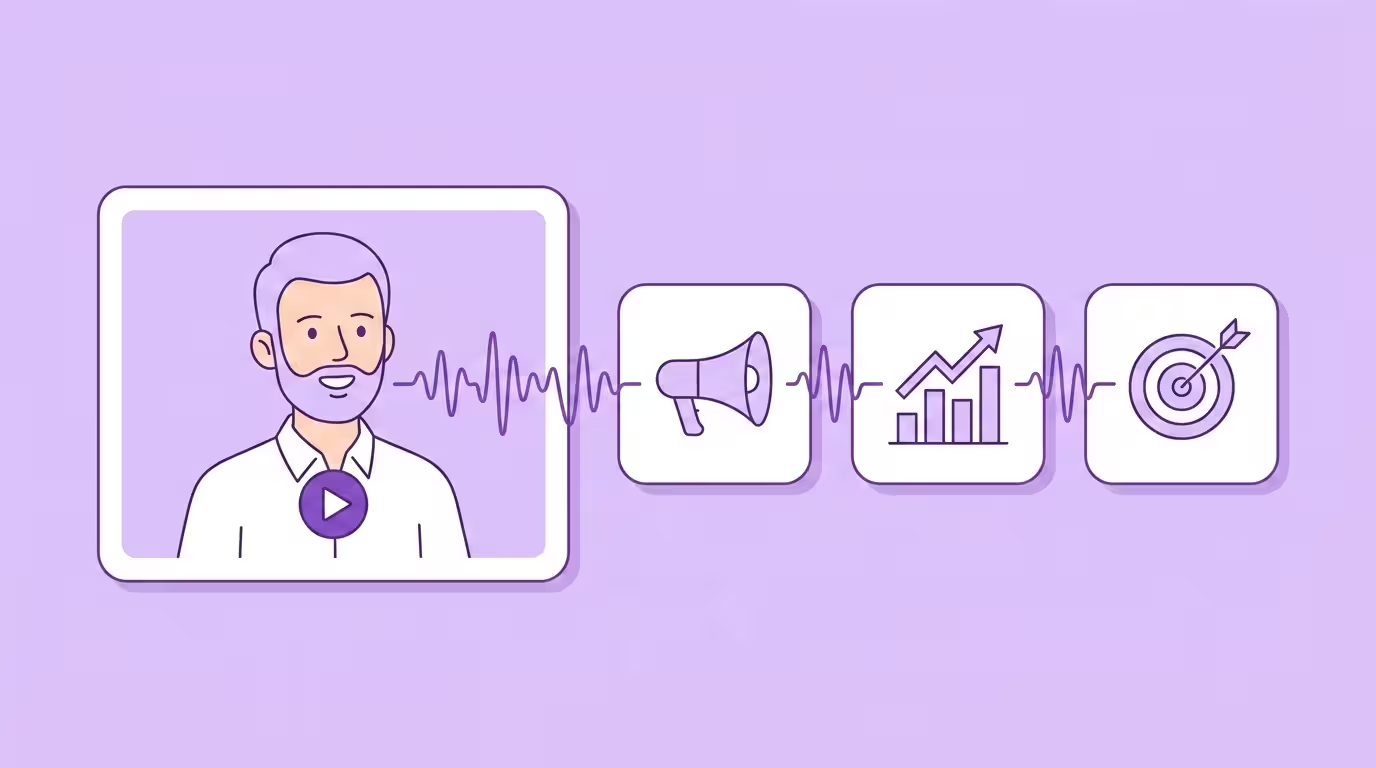
Most marketing teams I talk to in 2026 have the same pattern. A global hero video signed off by the CMO. One region asks for subtitles, another wants a full dub, a third ships their own rough cut with the wrong price overlay and a cultural reference that misses. Three weeks later, the brand lead is chasing consistency across eight markets and every marketing channel the business runs on. That spiral is what drives half the localized marketing strategy conversations we have — and it's why more marketing teams are now choosing to focus on localization as a core discipline rather than a side project.
Video localization for marketing is the process of adapting marketing videos — audio, on-screen text, visuals, cultural references, and platform format — so every localized version connects with the local market instead of being dropped into it.
The ROI case isn't subtle. Localized marketing lifts conversion rates by up to 300% and drives 20% higher engagement than running a single standardized campaign globally. That's the floor, not the ceiling. Treat localization as a downstream add-on and those numbers stay theoretical.
CSA Research's 29-country "Can't Read, Won't Buy" study found that 76% of consumers prefer content in their native language, and 40% of consumers won't buy at all from a website in a foreign language (Source: CSA Research, https://csa-research.com/Featured-Content/For-Global-Enterprises/Global-Growth/CRWB-Series/CRWB-B2C). The brand that speaks people's language wins the click, the trust, and the purchase. The brand that doesn't, loses them before the second frame.
This guide covers what video localization for marketing actually is, why localized marketing outperforms a standardized global approach, the four layers that have to work, how to build a localized video marketing campaign step by step, and where AI-powered localization still needs a human in the loop. It's written for CMOs, brand leads, performance marketers, and agency strategists running multi-market campaigns.
Key Takeaways
- Localized marketing adapts audio, visuals, cultural references, and platform format per market — not just the translated script. Every layer has to feel built for the local audience.
- Trust is the mechanism — CSA Research's 40% non-buy number is the gap between localized and non-localized campaigns.
- The build has seven steps: audience research, glossary, script prep, translate + adapt, voice + visual sync, in-market QA, launch and measure. Each step is a gate — don't start the next one until the last one holds up.
- AI-powered localization cuts per-minute cost by roughly 10× — and keeps the brand voice consistent across every market. Focus the budget on cultural adaptation and in-market review, not voice production.
What Video Localization for Marketing Actually Is
Most "localized" marketing videos we get sent for review are just dubbed. Same visuals, same on-screen text, same cultural beats — audio swapped, nothing else touched. That's translation with extra steps.
Real video localization for marketing adapts video content for a specific target audience and culture. You translate the audio, swap on-screen text, replace culturally loaded examples, adjust imagery and colors, and align units, currencies, and legal references so every localized version fits the target audience it's meant for. The goal is always the same: reach a wider audience without losing the brand identity along the way. Roughly 75% of the global internet population communicates in languages other than English, so a single-language marketing strategy caps the addressable audience well below half the market.
Translation and localization aren't the same thing. A subtitled ad forces a viewer to read through sales copy in a language that isn't theirs. A translated-but-not-localized campaign uses scenarios that feel imported: a New York office backdrop for a Tokyo audience, a dollar sign where a viewer expects a yen. Skip cultural adaptation and the campaign dies on contact — brands have to understand local customs, cultural taboos, and regional buying habits deeply enough to produce marketing content that feels built for that audience.
Marketing localization adapts landing pages, ad copy, SEO metadata, product packaging, and every touchpoint on the path to purchase. It's the step that decides whether the localized marketing campaign speaks to the target audience or just reaches them. Roughly 72% of consumers say they spend most of their time on sites in their own language, and 56% say the ability to get information in their own language is more important than price. Transcreation sits alongside: rewriting a line or a scene so it lands in a new culture where a literal translation would die.
Translation shrinks the language barrier. Localization removes it.
Why Localized Marketing Outperforms a Standardized Global Approach
Localized marketing beats standardized global campaigns on the metrics that actually move the needle. Conversion rates lift up to 3× versus generic global campaigns. Customer engagement rises roughly 20% across paid media and organic channels. CTR on localized ads runs 8–15% higher than English-only creative. Brand-awareness scores track the same curve.
The reason is simple. Consumers expect the brand to speak their language and show that it understands cultural context. A standardization-first playbook delivers neither.
International buyers reward campaigns that feel culturally relevant to their specific country and penalize the ones that feel imported. The brands that earn local trust do it by building marketing strategies around how buyers in each region actually decide. And trust converts.
We see this directly. In our own customer base, repeat purchase rates in localized markets run 15–25% higher, and CAC-to-LTV ratios improve by a similar margin.
One automotive brand we work with ran identical paid social in DACH and France for six months — same creative, only the subtitles changed. France converted at 38% of the German rate. They relaunched with dubbed, culturally re-shot assets and the gap closed within a quarter. That's what the failure looks like on a P&L.
The business cost of getting it wrong shows up as wasted impression spend. The success case shows up as CAC that drops in every new country you open.
The "one global spot" model still gets pitched in board decks. It rarely holds up against data. Localized content improves SEO rankings significantly because search engines prioritize local-language content — every localized landing page earns its own organic surface area for the local business. Localized campaigns display prices in local currency and proper date, address, and phone formats, which removes friction at the exact moment a potential customer decides whether to act. Different geographical markets favor different communication channels and marketing tactics, and the brand that adapts to those channels wins local audiences faster and more cost-effectively than the one that doesn't.
At Dubly, we watch this play out every week with marketing teams in our customer base. Teams used to ask whether they could afford one new language this year. Now they ask which six markets launch on day one. One clear trend across our pipeline in the last twelve months: the buying committees that say yes fastest are the ones whose brand values translate across markets without needing to be rewritten, because the core positioning already respects local customs instead of assuming the home market sets the template for every other country.
That flip is the whole point. One language is the cheap default. Six is the plan.
So where do localized campaigns actually break? Four places.
The Four Layers of a Localized Marketing Video
Those four places — audio, visuals, cultural adaptation, and platform format — are where most localized marketing campaigns actually break. Skip one and the campaign reads as translated, not local. Focus on getting all four right before you scale the program.
Audio — Voice-Over, Voice Cloning, and Native Speakers
Audio is where most marketing localizations break first. A badly dubbed testimonial undoes six months of brand work in thirty seconds. Most people watch videos with sound on at least part of the time, which means audio quality is what the majority of the target audience actually experiences — and three approaches carry most of the work.
Subtitles keep the original audio and overlay translated text. Fastest and cheapest, and the right call when the video content is a secondary asset — a blog header, a silent autoplay loop, a social feed clip. For anything sales-driven or product-led, subtitles leak attention. Subtitles are useful for capturing the potential audience that browses with the sound off, but they rarely deliver the trust signal a full dub does.
Voice-over lays a translated narration on top of ducked original audio. Documentary-style marketing videos, corporate overviews, and executive introductions sit here comfortably. Still feels imported, but the tone lands.
Dubbing replaces the original audio with a voice in the target language. For anything where the brand voice matters — founder-led campaigns, customer testimonials shot as video, product launches with a personality at the center — dubbing keeps the asset feeling like your brand rather than a translated substitute. Realistic voice cloning changed the math. The clone learns the brand voice or the founder voice from a short reference sample of the original video and speaks 30+ languages in it with native pronunciation, preserving tone, pacing, and energy. One myth worth killing upfront: the cloned voice doesn't carry the source accent into the target language. A Berlin founder still sounds like themselves in Spanish, but speaks Spanish the way a local would. One reference sample scales to every market. That's the $40,000–$100,000 voice-talent budget turned into a one-time setup.
Visuals — On-Screen Text, Graphics, and Lip Sync
Audio is only half of the localized video. Translated text typically runs 20–35% longer than English — English to German expands up to 35%, English to French or Spanish by 20–25% (Source: Eriksen Translations, https://eriksen.com/language/text-expansion/). Ad creatives and social media cut-downs built with tight copy in English break in the second language, and on-screen text needs room to breathe.
Localization includes adapting visuals, design, and colors to match local market preferences. Imagery that signals aspiration in one market reads as unserious in another. Color schemes carry cultural weight: a palette that feels premium in Western Europe reads as funereal in parts of East Asia. Right-to-left languages like Arabic and Hebrew require mirrored layouts — subtitle placement shifts, UI screenshots need to be re-rendered in the local locale, and button alignment flips across the whole ad unit.
Mouth synchronization used to be out of reach for marketing budgets. Modern generative lip sync re-renders the speaker's mouth movements to match translated audio automatically in 1–3 minutes of processing per minute of video, handling multi-speaker scenes and moderate camera angles. Accurate lip sync is binary: mouths match or they don't. Most mouth-sync engines stay stable only up to roughly 30° of head rotation and then break down, which is exactly the problem Dubly's Lip Sync 2.0 was built to solve: it handles extreme angles and side-on movement without drift or distortion, so on-camera speakers stay convincing where other tools fail. When the lip synchronization lands on a founder's testimonial, the viewer stops seeing a dub. They see the founder talking to them.
Multi-Speaker Demo
Cultural Adaptation — Examples, Tone, and Local Customs
A punchline written for a US product launch dies in Japan. A customer testimonial referencing US health insurance means nothing in Germany. A casual "hey folks" opener reads as disrespectful to business people in formal markets across much of Asia. Cultural adaptation is the layer most marketing teams underestimate, and it's where the translated-not-localized pattern shows up hardest. Examples, humor, cultural references, scenarios, imagery, and the level of directness in the tone all need rethinking for each target market — every asset has to be tailored to meet local buying norms rather than recycled from the home-market master.
Done well, cultural adaptation also adjusts the tone — formal vs. informal address, direct vs. indirect product claims, humor vs. restraint. Localization requires considering local customs, cultural taboos, and regional buying habits to ensure the marketing campaign lands instead of offending. Content adaptation preserves cultural resonance through local slang, symbols, and imagery, and transcreates the scenes that a literal translation would kill based on the target market's aesthetic and narrative preferences. The goal is a piece of marketing content that audiences share with other people in their market, not a translated asset that quietly sits on a regional landing page. The difference between a video people scroll past and one they send to a colleague is cultural fit. Translation gets you to tolerable. Adaptation gets you to shareable.
Platform and Format — Social Media, Paid Ads, Website
Marketing channels don't map 1:1 across countries. A campaign that ships on Meta, TikTok, YouTube, and LinkedIn in one region might run on WeChat, Kakao, or LINE in another — different paid media stacks, different creator ecosystems, different SEO realities. Marketing localization means the full path from ad to purchase feels local — not just the video, but the landing page, the email, the metadata, and the way SEO meta-tags are written for each regional search engine. The content strategy has to create assets for each channel based on local customer preferences instead of recycling one global master across them all. In China alone, video ad spend topped $40 billion in 2024 and runs almost entirely through domestic platforms — a global marketing strategy that ignores them leaves the world's second-largest ad market on the table.
Format matters as much as platform. A 60-second brand story cuts to a 15-second Reel for social media, a 6-second bumper for YouTube, and a 30-second connected-TV spot — each one needs localized audio, localized overlays, and an aspect-ratio redesign. A scalable localized video marketing program treats every platform as its own cut rather than trying to stretch one global master across them. Your local business also has to be discoverable on the platforms your buyers actually use, which means localized metadata, titles, descriptions, and tags on every asset. YouTube Multi-Language Audio lets a single channel serve dubbed tracks per language without splitting the subscriber base — a cost-effective way to test new markets before committing to separate regional channels.
Whether you're shipping two markets or twenty, the sequence is the same.
How to Build a Localized Video Marketing Campaign — Step by Step
Marketing teams that scale to ten markets without doubling headcount have the same thing in common: they built a system once. Decide once, apply everywhere — not a series of one-off scrambles. Skip the setup and you pay on every campaign. The localization strategy you build in month one is the one you live with for the next two years. For the broader sequence across e-learning and product, see our video localization workflow guide.
Audience and market research
Catalog markets by commercial opportunity, cultural fit, and competition
Brand guidelines and glossary
Lock brand terms, claims, and the do-not-use list per market, once
Script prep
Lock taglines and claims, flag lines that misfire on a literal read
Translate and adapt
First-draft AI translation plus human cultural adaptation
Voice and visual sync
Localized audio, generative lip sync, and swapped on-screen graphics
In-market review and QA
Local reviewers verify accuracy, cultural fit, and ad-law compliance
Launch, measure, iterate
Ship per platform, track per-market performance, feed data back
Step 1 — Audience and market research. Catalog target markets against three criteria: commercial opportunity, cultural fit, competitive intensity. Pick five markets based on the commercial case, prove the playbook, scale. Teams that try to localize everything in month one stall at four campaigns — we've watched it happen every time. In 2024, roughly 40% of multinational brands listed "localization complexity" as a top-three barrier to new-market entry. Market expansion into new markets requires localization beyond translation. Making research-backed choices about which trends actually matter in each country saves you from tailoring assets to fads that never hit. Build the audience picture before you build the creative.
Step 2 — Brand guidelines and glossary. Skip this and every other step multiplies in cost. Define how brand terms, product names, product claims, and regulated language get handled in each target language to ensure consistency across the campaign portfolio. Your style guide needs the do-not-use list per market too — that's what keeps campaigns out of regulatory trouble before they run. Decisions happen once, apply to every campaign. In Dubly's own customer base, marketing teams that build a glossary from day one see significantly fewer revision cycles than those who add it later. A team that builds the glossary on campaign five is paying the price on campaigns one through four.
Step 3 — Script prep and transcription. Lock taglines, claims, and product names before the translation team touches anything. Flag every line that will misfire on a literal read — those errors multiply across every language and every cut. The worst scripts we see are the ones where someone tried to "fix" the source in the target language. That's the wrong place to make changes.
The setup ends at Step 3. From here, the pipeline produces localized content.
Step 4 — Translate and culturally adapt. AI-powered translation tools give you the first draft; Translation Memory reuses previously translated segments, cutting cost and turnaround by 30–50% as the campaign portfolio grows. Human review matters here — a local-language reviewer should be able to correct AI output and ship the edited version rather than starting from scratch. This is where the local team or the agency partner swaps examples, rewrites humor, adapts scenarios to regional customer preferences, and calls in a professional translation or transcreation specialist for the lines where a direct translation would kill the concept.
Step 5 — Voice production and visual sync. Generate localized audio via AI voice synthesis or voice-over, apply generative lip sync on close-up talent shots, and swap on-screen graphics for the local market based on the regional creative brief. Goal: a localized version where the presenter appears to speak the target language the way a local would, and where the visual storytelling matches local aesthetic preferences.
Step 6 — In-market review and QA. Non-negotiable. Human review by local-language reviewers in the target market verifies linguistic accuracy, cultural appropriateness, and brand consistency. Localized campaigns must comply with local regulations and legal requirements, and in-market reviewers are usually the first line to catch product claims that don't clear local advertising law. Roughly 80% of the rework we see in our enterprise base traces back to QA skipped at this step — not translation quality, not voice quality. Skipped QA.
Step 7 — Launch, measure, iterate. Ship on the platforms each region actually uses, track per-market performance, feed the data back into the next round. Watch completion rates, click-through rates, and conversion rates per language. When we see a 40% gap between the source market and a localized version, it's almost always a localization issue — not audience interest. Build your audience segments around real regional preferences, not assumptions carried over from the home market. The teams that skip this step end up running the same flawed creative for two quarters before someone notices.
That per-market discipline also answers a question most global marketing leads eventually hit: how local is too local?
When Global and Localized Marketing Work Together
The brands that win run both global and local. Consistent global identity, locally adapted execution. The best marketing strategies don't treat that tension as a compromise. They treat it as the design.
Global brands must maintain core identity while adapting messaging to local contexts. Standardization keeps the brand uniform across markets; localization adjusts the parts that need to speak differently per region. Strategists call it "glocal."
The canonical example is Coca-Cola's Share a Coke. Identical global idea. Local execution every time.
The company replaced the Coca-Cola logo on personalized bottles with local names — starting with 150 names in Australia in 2011 — and rolled the concept out in 70 countries, adapting the names, the phrasing, and in some markets the entire creative treatment per region (Source: The Coca-Cola Company, https://www.coca-colacompany.com/about-us/history/how-a-campaign-got-its-start-down-under). Coca-Cola's business depends on consumers in every country seeing the product as theirs — so the execution is local every time. And it drove more revenue than any other Coca-Cola program that decade.
Netflix runs the same play across its original programming slate. The production is global, the brand identity is uniform, but on-screen subtitles, dubbing tracks, poster artwork, and trailer edits are localized per market to match local viewer preferences. McDonald's menu localization — the McArabia, the McSpicy Paneer, the Teriyaki Burger — adapts the product itself to local market preferences while the brand identity stays locked across all its marketing channels. None of these marketing campaigns work as pure translation. All of them work because the teams treated localization as a marketing strategy, not a downstream translation task, and built the product and the creative around each local market from the start. The content strategy and the product strategy moved together.
Localization supports easier market entry and creates a competitive advantage over non-localized competitors. Every international market rewards the brand that speaks the language first — and the brands whose success in country after country compounds are the ones that treat localization as core strategy, not as a services line item tacked onto the main campaign.
Common Pitfalls in Localized Video Marketing
Knowing what works is half the job. Knowing where campaigns still fall apart is the other half. These six failures account for most of the rollouts that stall or pull back mid-launch. Ignoring localization risks offending audiences, damaging reputation, and triggering costly rebranding — and most of the damage traces back to the same handful of mistakes.
Translating without adapting. The most common failure. A word-for-word dub with the exact same visuals, same scenarios, same cultural references. Technically localized, practically useless. Roughly one in three multi-market campaigns we see still ship with a pure-translation approach. The fix is to focus on cultural adaptation before voice production, not after — the message has to be rebuilt for each target audience, not just restated. The insights from in-market review consistently show that the experience a buyer has with a translated-only ad feels closer to noise than to communication.
Ignoring local regulations. Advertising law is not uniform. Pricing claims, comparison claims, health claims, product claims, and data-handling disclosures differ market by market. We've seen a six-figure product launch pulled off French media within 48 hours because a comparison line cleared legal in Germany and tripped Article L.122-1 in France. The fix took weeks; the credibility hit took longer. Localized marketing campaigns have to clear local rules before they run, not after a takedown. A scalable content strategy builds compliance review into every localized asset rather than treating it as an afterthought.
Cutting the global ad with no structural change. A global brand film trimmed to 30 seconds per market is still a global brand film. Real localized video marketing adapts the script, the shot selection, and the call-to-action per region. The moment the campaign is supposed to connect with the customer has to feel built for that customer, not imported.
Breaking brand consistency. The other direction of the same failure. Local teams rewrite everything, and the brand shows up as fifteen different personalities across fifteen markets. We've seen one SaaS brand with tagline A in the US, tagline B in Germany, and a third variant in Latin America — each one technically on-strategy, collectively unrecognizable. The fix is the glossary plus centralized brand guidelines to ensure every market executes on the same core identity, not turning the local team into translators.
Baked-in on-screen text. If your titles, logos, or calls-to-action are burned into the footage rather than kept as a separate layer, swapping them per market means a re-edit — not a swap. Keep graphics as overlays from day one.
Voice cloning without consent. We require explicit consent from any founder, spokesperson, or external talent whose voice gets cloned. For campaigns using external talent, this is a contract question before it's a technical one.
Traditional vs. AI-Powered Localized Video Marketing
| Comparison Factor | Traditional Agency Workflow | Dubly.AI Localized Video Marketing |
|---|---|---|
| Time to launch per market | 4–12 weeks per language including voice talent booking, studio recording, and post | Days for the same asset in the same language, QA included |
| Cost per language | $2,000–$10,000 driven by voice talent and studio time | Starting around $3 per minute; New Com Academy saved over 85% |
| Brand voice consistency | New voice actor per language; the localized version sounds like someone else | Voice cloning keeps the founder, spokesperson, or brand voice intact across 30+ languages |
| Mouth-sync quality | Mouth animation is expensive; most marketing videos ship without lip sync | Generative lip sync matches mouths to translated audio, staying stable through movement and off-angle shots |
| Scaling to new markets | Re-book talent, re-record, re-mix per language — linear cost growth | One reference sample scales to every market; Translation Memory compounds savings |
| Data handling | Content travels between studios, voice actors, and post houses in multiple countries | European platform with GDPR-compliant processing and enterprise data controls |
Translate Your First Video
Results in just a few minutes
No credit card required
Best translation quality worldwide
For the full cost math across your portfolio, see our pricing page.
How Dubly Approaches Video Localization for Marketing
We watched one agency try to ship a 30-market product launch on a creator-focused platform with a two-minute cap per video, no brand glossary, and voice consistency dropping every scene break. Three weeks in, they had thirty inconsistent cuts and a CMO asking why the founder's voice sounded different in every region. That's the exact failure mode we built Dubly to stop.
The existing tools were a mess for marketing. Generic voice synthesis that couldn't hold a brand tone. Lip sync that only processed one face at a time. And no data story for European enterprise buyers. Our customers needed to ship brand films, product launches, and paid social in six markets without the founder turning into a different person and the claims breaking local advertising law. Dubbing is one method of video localization, and AI dubbing is how the platform approaches it specifically for marketing work.
Three things matter for marketing people, and all three are why we built the product instead of wrapping someone else's API. First: voice cloning keeps the brand voice as the brand voice — no source accent bleeding into Spanish, no tone shift between regions. Second: generative lip sync runs as the last step and stays accurate through movement, profile shots, and multi-speaker scenes — however the spokesperson asset was filmed. Third: everything runs on European infrastructure with GDPR-compliant processing. For enterprise marketing buyers that's the first procurement question, not the tenth — and the first signal to the business-side stakeholders that the tool is ready for regulated content.
Dubly.AI fully translates and lip syncs all video content into new languages — saving us costly productions, countless revisions, and a lot of stress. The results feel impressively authentic.

Moritz Hausdoerfer
Head of Content Marketing, HAVAS Social
We didn't build a creator tool and call it brand-ready. The platform handles full-length brand films, multi-asset campaigns, and regulated marketing where the product claims and the creative live in the same project. Agencies like HAVAS Social use it to kill the production bottleneck on multi-market campaigns. Personal brands like Liebscher & Bracht hit 43.8 million views in eight languages without a single reshoot — because the German founder suddenly spoke Spanish, French, and Italian the way local audiences actually talk. For the procurement-level pitch on marketing use cases specifically, see our marketing solution page.
For teams evaluating where video localization fits in a broader multi-market plan, our multilingual video localization guide covers the portfolio math.
Conclusion: Localize Once, Scale Everywhere
Video localization for marketing isn't what it was three years ago. The trade-off between "one perfect global spot" and "twelve weak translations" is gone. A market that sees itself in the campaign engages with the brand. One that doesn't, scrolls past. That's the whole game, and the content strategy that wins is based on localizing aggressively rather than sitting on a global master.
The marketing teams that win don't skip the strategy work. They build the glossary, the style guide, and the in-market review process once to create a localized marketing program they can actually run at scale. They stopped dumping cultural notes on the translation team and started writing them into the original brief. And they pick a platform that handles the full stack — audio, visuals, cultural adaptation, platform format — instead of stitching five services together per campaign. That's the path: one toolchain, every country you open, tuned to the marketing efforts that actually convert. The teams that treat localization as a side project lose it.
Back to the complete guide: Video Localization
Translate Your First Video
Results in just a few minutes
No credit card required
Best translation quality worldwide
About the author

Leon Bach
Growth Marketing Manager