Video Localization
July 3, 2026
Multilingual Video Localization: How to Reach 20+ Language Markets From One Source Video
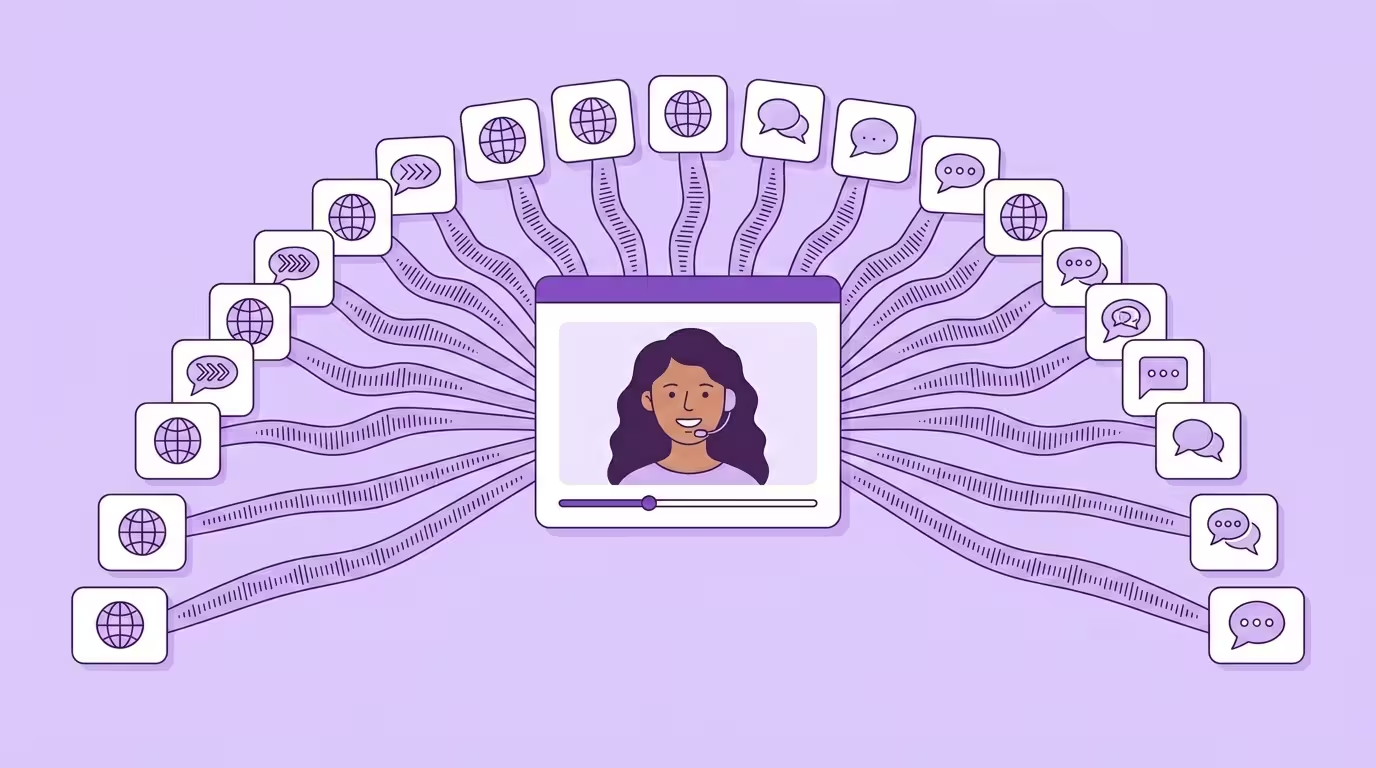
I've lost count of the number of customers who told me they spent six months trying to localize their flagship video into three languages before giving up. Three languages. Six months. That's what multilingual video localization used to cost you — not in dollars, in attention. The tools existed. Nobody could actually run them at scale.
Multilingual video localization is the process of adapting one source video into multiple languages at once — audio, on-screen text, cultural references, and visual elements — so every localized version feels native to its target audience. It's the difference between translating a video and producing it again for twenty markets in parallel. Five years ago teams like these shipped three videos a quarter. Now they ship every video in twenty languages with the same headcount.
CSA Research's "Can't Read, Won't Buy" study across 29 countries found that 76% of consumers prefer to buy products with information in their native language, and 40% won't buy at all from a website in a foreign language (Source: CSA Research, https://csa-research.com/Featured-Content/For-Global-Businesses/Cant-Read-Wont-Buy). Over 75% of the global population communicates in languages other than English. That's four out of five potential viewers who never see your video — because it only exists in one language.
This guide covers what multilingual video localization actually is, why single-language content stalls, the four layers that need work, and the process we've watched scale from three languages to thirty without breaking. It's written for marketing teams, L&D leads, creators, and enterprise buyers who are trying to reach global audiences without tripling their headcount. For the wider category, including pillar topics, software, and workflow, start with the video localization pillar guide.
Key Takeaways
- Multilingual localization is a distribution strategy in 2026, not a post-production task — the shift happens upstream, in planning and glossary.
- The four layers of multilingual video localization are audio, visuals, subtitles, and cultural adaptation. Skipping any one breaks the whole experience.
- Cloned-voice synthesis keeps speaker identity consistent across 30+ target languages — no more "twenty different people" problem.
- Editable translations before voice synthesis are the single biggest quality lever in multilingual workflows.
- AI pipelines have cut the cost per language by roughly 10x and turnaround from weeks to minutes — making every video worth localizing, not just flagships.
What Is Multilingual Video Localization?
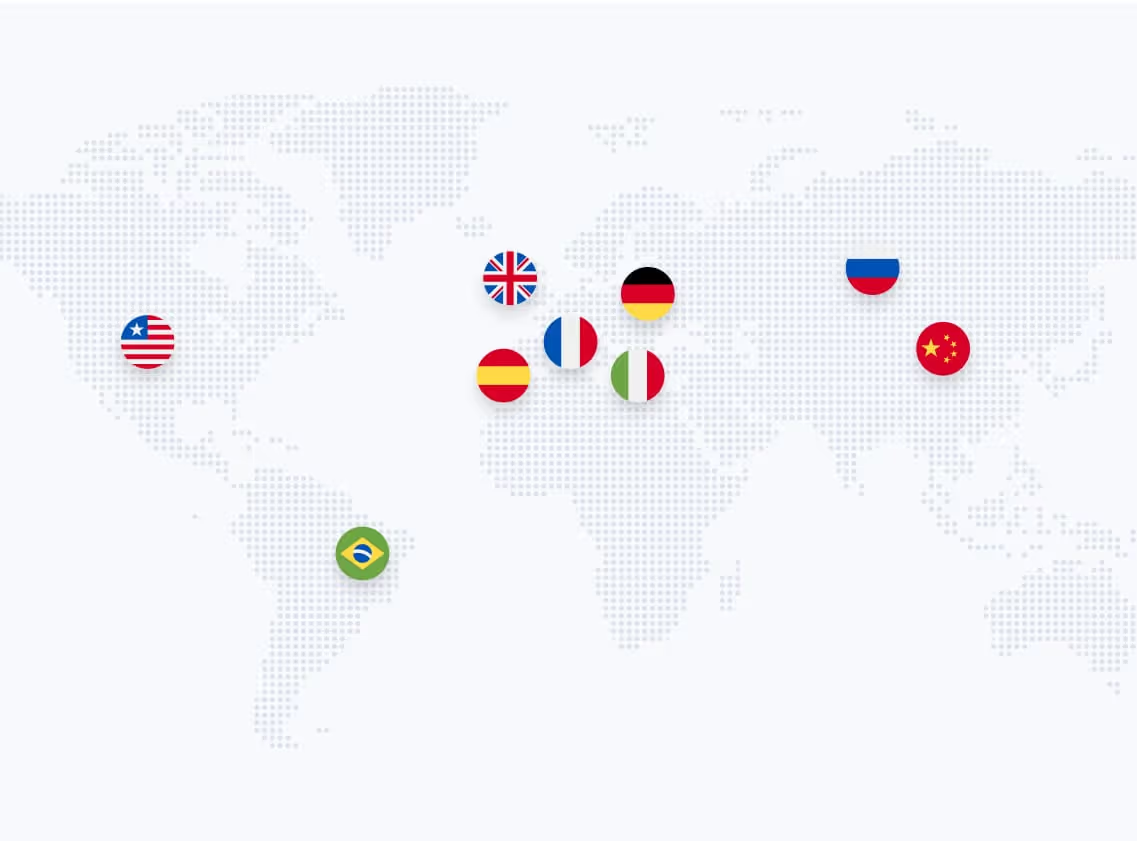
Multilingual video localization adapts video content for several linguistic and cultural target markets at the same time — a single source video becomes native-feeling versions in every language on the distribution list. Done right, a viewer in São Paulo, Seoul, and Stuttgart each watches something that feels like it was made for them. That's the bar. Anything less is translated content with extra steps.
Most teams confuse this with video translation, and the distinction matters. Video translation usually means only audio file translation, or a subtitle track layered over the original — for a broader look at the translation side, see our AI video translation guide. Localization is the wider process: it adapts idioms, jokes, graphics, and visual elements so that every localized video communicates the same meaning in a way that actually resonates with the target culture and breaks down the language barriers that limit single-language content. The multilingual part turns this from a one-off project into a repeatable pipeline — one pipeline that outputs every language in parallel, reaching new audiences in multiple markets at once.
A fully localized video operates on four layers: audio (dubbing, voice-over, or cloned-voice synthesis in the target language), visuals (on-screen text, graphics, mouth sync), subtitles and captions, and cultural adaptation. Get any one of them wrong and the whole thing feels imported rather than native. The rest of this guide walks through them — and through the process that keeps all four in sync across a growing number of target markets.
Why Single-Language Content Stalls in Global Markets
Only about 20% of the world speaks English as a first or second language. Ship your videos in English only, and four out of five potential viewers never see them. That 40% of consumers who won't buy in a foreign language — the CSA Research number I keep seeing quoted in executive decks — is the cheap-subtitle shortcut locking half your market out.
One of our customers, Liebscher & Bracht, localized their video content into 8 languages and reached 43.8 million views across all markets (case study). Same source videos, same production budget. Just a process that scaled across multiple languages instead of serializing one language at a time. On the engagement side: dubbed video in a viewer's own language typically lifts completion rates by 20–30% over subtitle-only cuts.
The market is reinforcing the pressure. The AI video translation market grew from $2.68 billion in 2024 to a projected $33.4 billion by 2034 — a 28.7% CAGR (Source: Market.us, 2024, https://market.us/report/ai-video-translation-market/). That kind of growth happens when the underlying economics collapse. They have. For most teams, studio dubbing beyond three languages was never economically rational; it just looked like the only option. Multilingual video localization in 2026 is a distribution strategy, not a post-production afterthought.
The teams that still treat global reach as a "maybe next quarter" project are watching competitors ship the same video in twelve languages the week it launches in English. The gap is not small, and it's closing fast.
The Four Layers of Multilingual Video Localization
The "why" is obvious. The "what" is four layers. Every localization project operates on them — skip one and you don't have a localized video. You have a translated video pretending to be more.
Audio — Dubbing, Voice-Over, and Voice Cloning
Audio is the layer most viewers notice first, and it's where the quality ceiling of the whole localization project gets set. There are three viable approaches, and the choice depends on the video and the target market.
Subtitles only keep the original audio and overlay translated text. Subtitles are the fastest and most affordable localization method, often the right call for internal documentation, meeting recordings, or content where visual delivery matters less than the raw information. On a tight budget, subtitles are the minimum you should do — they're better than shipping monolingual content, and they buy you cheap access to multiple languages within hours. But they split attention: viewers read and watch at once, and completion rates fall 20–30% compared to dubbed alternatives.
Voice-over lets viewers listen in their own language while some original audio stays faintly audible underneath. Voiceover is common in documentaries, corporate videos, and educational content — the translated narrator speaks over the speaker, whose voice still plays at low volume. It's more immersive than subtitles but still reminds the viewer that the content is imported. Two voices compete for the same seconds.
Dubbing replaces the original audio entirely with native speakers in the target language. Dubbing provides a more immersive experience than subtitling for most viewers. It's also more expensive and complex than subtitling due to voice talent, mouth-sync work, and production overhead — which is where AI dubbing has changed the math. Modern AI dubbing uses cloned voices to preserve the speaker's tone, pitch, and style across languages, so the dubbed audio still sounds like the original speaker instead of a generic narrator. A training video narrated by a stranger sounds like a training video. One narrated by your instructor in the learner's native language sounds like it was made for them.
Voice cloning is what broke the old economics. Full stop.
It's the single biggest economic shift in multilingual audio production. Accurate cloning tools capture the speaker's voice once from a reference sample, and the cloned voice then carries the original emotional delivery across 30+ languages with native pronunciation in each one. Same speaker identity. Different language. That's what makes dubbed content feel local instead of imported. It's also how we help customers avoid the generic-narrator problem — one reference sample, synthesis that keeps tone, pacing, and accent intact. The cloning platform turns twenty separate voice-actor bookings into one reference sample and twenty synthetic takes.
Visuals — On-Screen Text, Graphics, Mouth Sync
The original audio is only half of a localized video — every visual element the target audience sees also needs attention. On-screen text is the obvious one: lower thirds, title cards, product UI in screen recordings, animated callouts, embedded copy. All of it needs translation, and all of it needs room to grow. Translated text typically runs 20–35% longer than English — English to German expands up to 35%, English to French or Spanish by 20–25% (Source: Eriksen Translations, https://eriksen.com/language/text-expansion/). Designs that were snug in English break at the second language.
Graphics carry their own layer of meaning. Diagrams, infographics, icons — anything with embedded text needs localized versions. Color and symbol connotations shift per target culture. Units. Currencies. Date formats. Legal disclaimers. A training video that shows "$49/month" or "April 5, 2026" needs to swap both for a German viewer. Right-to-left languages like Arabic and Hebrew require mirrored layouts; subtitle placement shifts; UI screenshots may need to be re-recorded in the target locale.
Lip synchronization is the visual layer that used to be out of reach. For years, matching a speaker's mouth movements to translated audio meant Pixar-level production budgets — frame-by-frame animation that nobody shipped for a weekly training video. Modern visual sync software re-renders the speaker's mouth movements to the translated audio automatically, handling multi-speaker scenes and off-angle camera work. With accurate visual alignment, a viewer doesn't notice the substitution — they see someone speaking their language, not a dub. The difference: content that works for global audiences vs. content that just reaches them.
Subtitles and Captions
Even with dubbed audio and synced mouth movements, subtitles stay non-negotiable. They make content accessible to viewers who are deaf or hard of hearing, to people watching on mute (roughly 85% of Facebook videos are watched without sound), and to social media viewers scrolling with captions on by default. For multilingual video localization, that means every language in your distribution should have a proper subtitle track in addition to its dubbed audio.
Auto-generated subtitles are the starting point, not the endpoint. AI-powered tools can generate subtitles in multiple languages in minutes, but the raw output needs editing — timing adjustments, line-break fixes, technical terminology cleanup, and a review pass for anything culturally loaded. The fastest multilingual subtitle workflows have editable translations built in: the AI produces a first pass, a native speaker adjusts, and the corrected version ships alongside the dubbed track. Get the timing wrong between translated audio and subtitles, and viewers feel it in the first ten seconds.
Cultural Adaptation
This is the layer most teams underestimate, and the one that separates localized video content from translated video content. Cultural references, humor, idioms, examples, case studies, social proof — all of it needs rethinking for each target market. "Break a leg" translated literally into Spanish or Japanese doesn't wish anyone luck. It confuses them. A case study about an American retailer doesn't land with a Japanese audience. Football means different sports in different regions. Colors, symbols, and gestures carry different meanings — what feels premium in one country can read as inappropriate in another.
Cultural adaptation shows up in legal and regulatory text too. A marketing video that references GDPR in Germany needs different compliance language in Brazil or California. Disclaimers, terms, product claims, and regulatory callouts shift per market. Getting any of this wrong doesn't just feel off — it can trigger legal exposure.
At Dubly, we see this pattern consistently in our enterprise base: the teams that succeed treat cultural adaptation as a planning task, not a final-pass task. They brief a native reviewer on each target market before the translation even runs, flag the content that will need cultural reworking, and build the review step into the process. Cultural review at the end is a bottleneck. Cultural context at the start is a process.
Single-Language vs. Multilingual Workflows — Why the Shift Breaks Most Teams
Knowing the four layers is one thing. Running them across twenty languages simultaneously is another.
Running a localization project in one target language is a task. Running it in twenty is a system. Teams that try to scale by repeating the single-language process learn this the hard way — the result is a workflow that breaks at every seam.
The shift isn't just about volume. It's about the dependencies between languages. In a single-language project, you translate the script, record the voice-over, cut the subtitles, sign off, and ship. In a multilingual project, every decision you make in language one shows up in language twenty. A product term you render one way in German and another way in French will haunt every video you touch for the next two years. A legal disclaimer you translate on the fly in Spanish will have to be retranslated in Japanese, Portuguese, Italian, and Mandarin once legal catches up. The workflow that "works for German" becomes the rework engine for every other market.
Volume creates its own compounding problem. Five videos in one language means five review cycles. Five videos in ten languages means fifty review cycles — and if each cycle takes three days, you've just added 150 days to your timeline for no good reason. Multilingual workflows that scale don't serialize the review cycles; they run them in parallel, with a shared glossary, a shared style guide, and a single editable translation layer that every language version inherits from. The cost of adding a sixth market should be nearly zero. In the wrong process, it's another quarter of lead time.
And then there's the identity problem. Single-language dubbing books one voice actor. Multilingual dubbing used to mean booking one per language per speaker, each with their own timbre, pacing, and emotional delivery. Across twenty languages, the same speaker sounded like twenty different people. Realistic voice cloning software fixes this at a level that used to be impossible: the speaker's cloned voice carries across every target language, so the viewer hears the same person regardless of the language they watch in. It's a small detail that makes a huge difference for brand consistency across multiple languages.
Building a Multilingual Video Localization Process That Scales
The workflows break at the seams mentioned above — but they don't have to. The difference between a process that scales and one that collapses at three languages is the sequence, not the tools. Scalability is upstream. Get the setup right — glossary, style guide, best practices — and adding the sixth or sixteenth language is mechanical. This is the outline we walk customers through — the same process our team has watched hold up across hundreds of projects from creators shipping their first multilingual video to enterprise teams running it across 20+ markets. For the full end-to-end breakdown, see the detailed video localization workflow.
Content Audit
Pick which videos and prioritize target languages deliberately
Glossary and Style Guide
Set terminology and tone once, not per language
Editable Translations
Human review before voice synthesis as the quality gate
Voice Cloning
One reference sample keeps identity across every language
Lip Sync
Re-render the mouth for on-camera speakers per language
Content Audit and Language Prioritization
Not every video deserves dubbing in twelve languages. Start by deciding which ones do — and which ones don't. A five-year-old product demo with 200 views doesn't. Your flagship explainer, your highest-traffic training videos, your top-performing social posts all do. I tell every customer that walks in with "we have 300 videos, translate them all" the same thing: cut the list to ten, prove the process, then scale. The teams that ignore that advice are the ones still localizing their first batch six months in.
Catalog existing video content against longevity (evergreen vs. time-limited), performance (engagement data in the source language), and strategic value (onboarding, sales enablement, international hiring).
Then pick the target languages deliberately. Not every market deserves the same treatment on day one. Common enterprise starting sets run 5–8 languages and cover 60–70% of revenue exposure: English, Spanish (Mexico vs. Spain is a real split), Portuguese (Brazil vs. Portugal, same), French, German, Italian, Japanese, and one or two of Mandarin, Korean, or Arabic depending on the target market. Adding a tenth or eleventh language later is cheap once the process runs. Starting with twenty all at once is where teams stall.
Glossary and Style Guide (Once, Not Per Language)
Skip this step and you'll pay for it in every video that follows. Before any translation runs, define how your brand terms, product names, industry jargon, and legal language should be handled across every target language. Should "Lip Sync" stay in English or become "Lippensynchronisation" in German? Does your product name translate? Which disclaimers have mandatory phrasing per market? These decisions need to happen exactly once, not language by language.
Style guides do similar work for tone. Formality varies dramatically across markets — German business audiences expect the formal "Sie," French audiences want a specific professional register, Japanese adds entirely different speech levels depending on context. Document the style rules per target language before the first video goes through the pipeline, and every future localized video inherits the decisions. In our own enterprise base, customers who lock down the glossary at the start see significantly fewer revision cycles than those who add it later.
Editable Translations as a Quality Gate
Any multilingual process that treats translation as a black box is a process that produces embarrassing output. Machine translation has gotten good — accuracy is above 90% for major language pairs on general content — but "good enough" has limits, and the edges (terminology, legal phrasing, tone) are where accuracy actually matters.
The fix is simple: make every translation editable before it ships to voice production. A native speaker reviews the AI-translated script, corrects the technical terms, fixes the tone, and approves. The corrected version becomes the source for dubbing and subtitles. Modern translation tools that let you translate videos with an editable script — and then regenerate voice from the edits — produce significantly more accurate translations than black-box pipelines. This pattern — AI first pass, human review, then voice synthesis — is the single biggest quality lever in multilingual video localization. It's also where most teams that fail on quality have simply skipped the human review step.
Voice Cloning for Consistent Identity Across Languages
Voice cloning is what makes multilingual localization actually feel multilingual. Instead of booking different voice actors per language per speaker, a realistic cloning tool captures the original speaker's voice once from a short reference sample. The synthesized version then generates dubbed audio across every target language with native pronunciation in each one — same tone, same personality, same speaker identity. The pronunciation and phrasing shift; the person doesn't.
For creator channels and training series, cloned voice synthesis is what makes the math work. One speaker, one brand voice, twenty language versions that all sound like the same person. For enterprise, it's what keeps a CEO's all-hands video recognizably the CEO across every market the company operates in. For a deeper look at how the technology handles this end to end, see our guide to AI video localization.
Lip Sync for On-Camera Speakers
If the speaker's face is visible on camera, accurate lip sync is the difference between a video that feels local and one that feels dubbed. For years, matching mouth movements to translated audio was too expensive for anything but film. Modern generative mouth-matching runs in the cloud — a proper lip sync tool re-renders the speaker's mouth movements frame by frame to match the translated audio, handling multi-speaker scenes and off-angle camera work.
Not every video needs it. A voiceover narrator off-camera or a product screen recording doesn't. But any video where the speaker is on screen — corporate explainers, creator content, on-camera training — benefits noticeably. A visual-sync tool that actually holds up at scale removes one of the last real barriers in video localization. For the underlying engine, see Dubly's Lip Sync 2.0.
How AI Changed the Economics of Multilingual Video Localization
The numbers used to be ugly. Traditional multilingual localization meant booking studio time, scheduling voice actors, managing retakes, synchronizing audio, and then doing the same thing again for every language. A single dub in one language ran $500–$2,000 depending on video length and market. Multiply that by fifteen languages and you're looking at $7,500 to $30,000 per video — before you've touched the on-screen text, the subtitles, or the QA cycles. That's why most companies localized their flagship content and let everything else stay monolingual.
AI pipelines compressed the cost and the timeline by about an order of magnitude. The dub-per-language number has collapsed to under $20 in cloud-based workflows. Turnaround has fallen from weeks per language to minutes — a 5-minute video can be transcribed, translated, reviewed, and dubbed with cloned-voice synthesis in roughly 10 minutes per target language instead of 3–4 weeks of studio scheduling. Teams that switched from studio dubbing to AI-powered multilingual workflows routinely cut $5,000+ off the per-video localization bill and see output jump 5–10x with the same headcount.
The pricing shift isn't just about cheap — it's about which videos become worth localizing. When cost per language runs 1/10th of studio pricing, the break-even video count drops sharply. Training series that used to get localized into two languages now ship in twelve. Marketing teams that localized quarterly flagships now localize weekly social clips. Creators that expanded one language pair at a time now launch channels in five markets at once.
Human review still matters. AI pipelines make the first draft cheap, not the final draft done. Native linguists and cultural experts remain crucial for accuracy, nuance, and cultural appropriateness — particularly on high-stakes marketing, legal text, or anything emotionally nuanced. The modern multilingual workflow combines AI speed with targeted human review at the quality-critical moments. The teams getting the best results aren't the ones fully replacing humans. They're the ones freeing human reviewers from grinding through every line of translation and pointing them at the 5% where judgment actually matters.
Common Challenges (and How to Solve Them)
Every multilingual video localization project we see runs into the same handful of challenges. They're all process problems, not tool problems — which is good news, because process problems are fixable.
Inconsistent terminology across languages. Product name renders differently in German vs. French. Disclaimer phrasing drifts between Spanish markets. There's no clever fix here — you need a glossary, documented once per language pair, and editable translations that flag deviations before they ship.
Timing breaks on text expansion. Translated audio runs longer than the original almost every time — EN to DE up to 35%, EN to ES or FR 20–25%. Dubbed video breaks when the translation isn't paced for the original clip length. Handle this upstream, in translation: pick a translator or AI pipeline that explicitly targets clip-length compatibility, not just linguistic accuracy. Most black-box tools don't.
Cultural references that don't transfer. Idioms, humor, and context-dependent text often don't survive word-for-word conversion. Brief a native reviewer on each target market and flag culturally loaded content before translation runs. That's it. The teams that try to catch this at the end of the pipeline redo half their work.
Voice identity drift across languages. Traditional dubbing books a different voice actor per language. The speaker sounds like twenty different people across twenty language versions. Cloned-voice synthesis solves it — same speaker, same personality, every market.
QA that scales linearly with language count. Every language adds a review cycle. In a linear process, twenty languages means twenty sequential review cycles — a non-starter at scale. Parallel review is the only answer: native reviewers work concurrently on the same source content, feeding corrections back into a shared translation layer that every language inherits from.
Regulatory mismatches per market. GDPR in Germany, LGPD in Brazil, different FDA claims language, region-specific financial disclaimers. Handle this at the glossary and style guide layer, not in the video itself. Per-market compliance language lives in a separate document and swaps in at the translation step.
Dubly.AI for Multilingual Video Localization
We built Dubly because the existing tools were built for occasional localization. If you want to localize seriously — every video, every week, across 20 markets — none of them held up. That's what we set out to fix.
Here's what makes Dubly different when you actually run it at multilingual scale:
One reference sample, 30+ languages. Clone the speaker once — the same voice carries across every language on your distribution list, native pronunciation locked in per market. No generic AI narrator. No rotating cast of voice actors making your CEO sound like twenty different people in twenty videos.
Editable translations by default. Every translation is reviewable and editable in the platform before voice synthesis begins. Your native reviewers see the source script, the translated script, and the timing — then correct anything that needs correcting. No surprises in the dubbed output. The black-box pipelines other tools ship with are exactly why teams stop trusting their own localized content.
Generative Lip Sync 2.0 for on-camera speakers. Our visual-sync engine handles multi-speaker scenes, movement, and extreme camera angles — the shots where most mouth-matching tools break. The visible result: the speaker actually appears to be speaking the target language.
German servers. GDPR by default. If your legal team has ever asked where customer video data lives, you already know why this matters — and why every U.S.-based alternative processing your footage on U.S. infrastructure is a problem you'll have to explain. We run on German servers and ship with enterprise-grade data security out of the box.
Customer proof in multilingual use cases. Liebscher & Bracht scaled their educational video content across 8 languages and reached 43.8 million views in a few months. New Com Academy cut production costs by 85% while ramping to multilingual output. These aren't demo numbers. They're what happens when the process runs at scale.
Thanks to Dubly.AI, we were able to internationalize our Academy without reshooting a single minute. Even complex technical terminology was translated with precision — and we saved over 85% in costs. For us, it was a game changer in making our core product globally scalable.

Michael Kibele
CEO, New Com Academy
Where tools differ, and what helps. AI isn't a one-click solution across every type of content, so it's worth knowing what moves the result. Source material is the big one: every model works best on clean, well-recorded speech, so for the most accurate result you start from a clear source recording in a standard language variety. Heavy singing, dialect so thick that even native speakers disagree on transcription, or intentional mispronunciations used for effect make any model's job harder and still benefit from manual handling. Steep camera angles are exactly where most visual-sync engines break down, which is the problem Dubly was built to solve. Lip Sync 2.0 handles extreme angles and side-on movement without drift or distortion, so on-camera speakers stay convincing where other tools fail. Any video involving a recognizable voice or likeness needs explicit consent for voice cloning, a non-negotiable for us, and it should be for any serious localization platform.
Translate Your First Video
Results in just a few minutes
No credit card required
Best translation quality worldwide
| Comparison Factor | Traditional Multilingual Workflow | Dubly.AI Multilingual Workflow |
|---|---|---|
| Cost per language | $500–$2,000 per language per video | Under $20 per minute |
| Turnaround per language | 2–4 weeks (studio, voice actors, post) | Minutes |
| Speaker identity across languages | Different voice actor per language | Cloned speaker voice — same person across all |
| On-camera lip sync | Manual frame-by-frame, mostly unavailable | Generative Lip Sync 2.0, automatic |
| Review and editing | Separate review cycle per language | Parallel, editable translations per language |
| Scaling to 10+ languages | Linear cost and timeline explosion | Same pipeline, additional languages in minutes |
| Data residency | Usually U.S. servers, unclear compliance | German servers, GDPR-compliant by default |
Conclusion
Multilingual video localization in 2026 isn't a post-production afterthought — it's a distribution strategy. The teams that get it right treat every video as a multi-market asset from day one: one source, many languages, each version feeling native in its target market. The teams that don't are shipping to roughly 20% of their potential audience and wondering why engagement is soft.
The process that scales isn't complicated, but it has to run in the right order. Pick target languages deliberately. Lock down glossary and style guide once, not per language. Use editable translations as the quality gate. Use cloned-voice synthesis to keep speaker identity consistent across every language. Handle cultural adaptation at the planning stage, not the last review. And use AI for the first draft, humans for the judgment calls.
Back to the complete guide: Video Localization
Translate Your First Video
Results in just a few minutes
No credit card required
Best translation quality worldwide
About the author

Simon Pieren
Co-Founder | Marketing & Sales