Video Localization
July 3, 2026
Video Localization for E-Learning: How to Scale Global Training Without Reshooting a Course
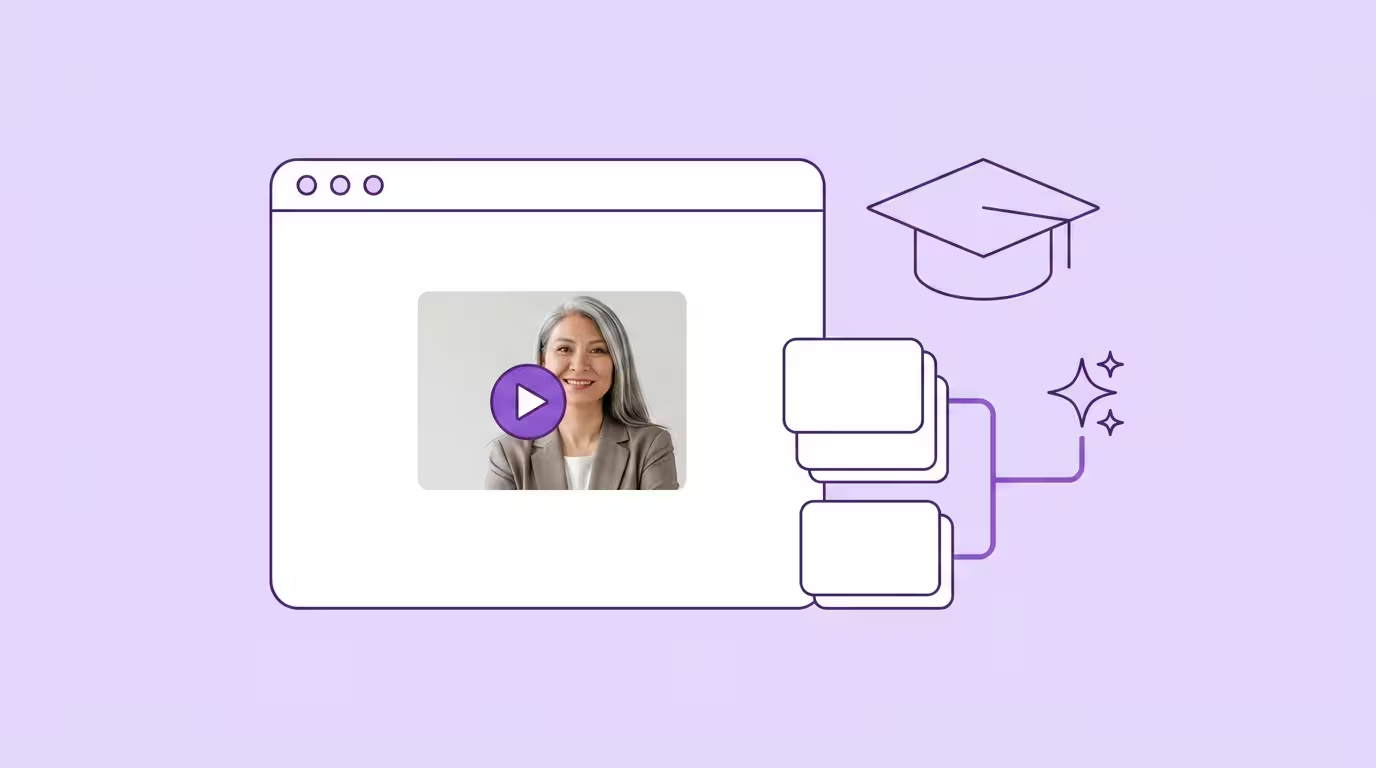
Most L&D teams I talk to have the same story. Six months of production on a flagship onboarding course, and then a request from the Spain, Japan, and Brazil teams for the same training in their languages. That math is what drives half the e-learning localization conversations we have around the world.
Video localization for e-learning is the process of adapting training videos, course modules, and online course content for learners in different languages and cultures — audio, on-screen text, graphics, examples, and cultural references — so every localized version feels built for its target audience instead of translated into it. Over 75% of learners prefer content in their native language, and localized e-learning content lifts engagement and completion rates by up to 50% versus non-localized versions.
That business case backs up what CSA Research's 29-country "Can't Read, Won't Buy" study found: 76% of consumers prefer content in their native language, and 40% won't buy at all from a website in a foreign language (Source: CSA Research, https://csa-research.com/Featured-Content/For-Global-Enterprises/Global-Growth/CRWB-Series/CRWB-B2C). Training is the same. A workforce that doesn't understand a course won't complete it.
This guide covers what video localization for e-learning actually is, the four layers that have to work, the process we watch customers use to go from one language to ten, and where the work still needs a human in the loop. It's written for L&D leads, instructional designers, and training directors. For the wider category, start with our video localization pillar guide.
Key Takeaways
- Localization goes beyond translation — it adjusts images, videos, tone, examples, currency, and cultural references for the target market.
- Localized e-learning content lifts engagement and completion rates by up to 50% versus non-localized versions.
- The process has seven phases: audit, glossary, script prep, translate + adapt, voice + mouth sync, QA, LMS packaging.
- AI-powered localization cuts per-minute cost by roughly 10×, with New Com Academy saving over 85% versus studio workflow.
What Is Video Localization for E-Learning?
Video localization for e-learning adapts video-based training for a specific target audience and culture. You translate the audio, swap on-screen text, replace culturally loaded examples, and align units, currencies, and legal references so every localized version fits the learner in that country. The industry also calls it "elearning localization."
Translation and localization aren't the same thing. A subtitled course forces learners to split attention between reading and watching. A translated-but-not-localized course uses scenarios that feel imported: a New York case study for a team in Mumbai, a dollar sign where a learner expects a yen. That's the gap this article is about.
Translation converts text from one language to another. Necessary, not enough. Localization adapts on-screen text, voice-over tone, branching scenarios, and the visual layer for each market — it's the step that decides whether the content speaks to the target audience or just reaches them. Transcreation sits next to both: rewriting a scene so it lands in a new culture where a literal line would die.
Translation shrinks the language barrier. Localization removes it.
Why Localized E-Learning Content Outperforms Translation Alone
Localized training lifts learner engagement and completion rates by up to 50% compared to non-localized versions. Over 75% of the global internet population communicates in languages other than English. Ship e-learning in English only and you exclude the majority of your potential learners.
Culturally relevant content reduces cognitive load. A learner working through a compliance module in their native language — with examples that match their regulatory environment — spends brain on the material, not on mental translation. Dubbed elearning content typically lifts completion 20–30% over subtitle-only alternatives.
At Dubly, we watch this shift play out with the clients and organizations in our enterprise base. The math flipped. Training teams used to ask "can we afford one new language this year." Now they ask "which six languages ship on launch."
That's the entire shift. Six languages is not the ambitious plan anymore. One is the cheap default.
Each new audience unlocks a new market, and a scalable pipeline makes the global audience reachable without new headcount. Agencies used to own this work; now it lives inside the course-creation stack. Many of the organizations we work with create new localized versions of every flagship course within days of the source going live. The AI video translation market grew from $2.68 billion in 2024 to a projected $33.4 billion by 2034 — a 28.7% CAGR (Source: Market.us, 2024, https://market.us/report/ai-video-translation-market/).
The Four Layers of Video-Based E-Learning Localization
Every localized training video operates on four layers. Skip one and you're shipping translated content — not localized content.
Audio — Voice-Over, Dubbing, and Voice Cloning
Audio sets the quality ceiling of the whole e-learning localization project. Three approaches, each with a fit.
Subtitles only keep the original audio and overlay translated text. Fastest and cheapest — often right for internal documentation or reference videos. But subtitles split attention, and completion rates fall 20–30% versus dubbed content.
Voice-over lets learners hear translated narration while the original plays faintly underneath. Common for documentary-style training and executive briefings. More immersive than subtitles, still clearly imported.
Dubbing replaces the original audio entirely with native speakers in the target language. For courses where the instructor carries weight — founder-led content, certification courses, onboarding series — dubbing keeps the course feeling like your training, not a translated substitute. Realistic voice cloning changed the economics. The clone learns the instructor's voice from a short reference sample and speaks 30+ languages in it. The cloned track preserves tone, pacing, and delivery. One myth worth killing: speaker synthesis doesn't carry the source accent. It produces native pronunciation in the target language — a German trainer still sounds like that trainer in Spanish, but speaks Spanish the way a Spanish native would. One source video, one reference sample, every target language — instead of twenty voice-actor bookings.
Visuals — On-Screen Text, Graphics, and Lip Sync
The audio is only half of a localized training video. Translated text typically runs 20–35% longer than English — English to German expands up to 35%, English to French or Spanish by 20–25% (Source: Eriksen Translations, https://eriksen.com/language/text-expansion/). Slide layouts that were tight in English break in the second language, and visual elements need room to breathe.
Graphics carry their own layer of meaning. Process diagrams, icons, embedded text, color schemes — all the visual elements of the learning experience need localized versions. Units, currencies, date formats, and legal disclaimers swap per region. Right-to-left languages like Arabic and Hebrew require mirrored layouts; subtitle placement shifts; UI screenshots may need to be re-recorded in the local locale.
Mouth synchronization used to be out of reach for training budgets. Modern generative lip sync re-renders the speaker's mouth movements to match translated audio automatically, handling multi-speaker scenes and moderate camera angles. Accurate lip sync is binary: the mouths match or they don't. Most mouth-sync engines stay stable only up to roughly 30° of head rotation and then break down, which is exactly where Dubly's Lip Sync 2.0 keeps going: it handles extreme angles and side-on movement without drift or distortion, so on-camera instructors stay convincing where other tools fail. When you lip sync videos well, learners stop seeing a dub. They see their instructor.
Subtitles and Captions for Training Videos
Even with dubbed audio and synced mouth movements, subtitles stay non-negotiable. They make training accessible to learners who are deaf or hard of hearing, to people studying on mute, and to anyone who prefers to read along. For most corporate compliance programs, caption coverage is also a legal accessibility requirement.
AI-powered subtitle tools generate captions in multiple languages in minutes, but the raw output needs editing — timing adjustments, line-break fixes, technical terminology cleanup. The fastest multilingual workflows treat subtitles as editable translations: AI first pass, native-speaker correction, shipped alongside the dubbed track.
Cultural Adaptation — Examples, Scenarios, and Tone
Cultural adaptation is the layer most teams underestimate. Cultural references, humor, case studies, branching scenarios, imagery, color schemes, and teaching styles all need rethinking for each target market. A branching scenario built around an American sales call doesn't land for a Japanese customer-success team. A compliance example referencing US labor law means nothing in Germany. A casual "hey folks" greeting reads as disrespectful in formal training contexts across much of Asia.
Done well, cultural adaptation also adjusts tone — formal vs. informal address, direct vs. indirect feedback patterns, the level of detail a learner in that region expects from an explanation. Language and cultural adaptation together are what separate a training course learners tolerate from one they finish and apply.
The E-Learning Localization Process Step by Step
Teams that scale from one language to ten without doubling headcount follow the same best practices: decide once, apply everywhere. Skip the setup and you'll pay on every course. For the broader sequence across marketing and product, see our video localization workflow guide.
Content audit
Catalog courses by evergreen value, strategic value, and audience demand
Glossary and style guide
Decide how brand terms and jargon get handled in each language, once
Script prep
Clean the source, lock product names, confirm timestamps
Translate and adapt
First-draft AI translation plus human cultural adaptation
Voice and visual sync
Localized audio plus generative lip sync on instructor shots
QA with native speakers
Verify accuracy, cultural fit, and LMS integrity
LMS integration
Export SCORM or xAPI, test, publish, and track per language
Step 1 — Content audit and prioritization. Catalog courses against three criteria: evergreen value, strategic value, audience demand. Pick five to ten courses, prove the process, expand. Teams that try to localize 200 courses in month one stall at 40. Instructional design choices in the source course — modular scenes, separated overlays, region-neutral examples — compound the savings at scale.
Step 2 — Glossary and style guide. This is the step most teams skip, and it's the number one reason localization projects stall at five courses in. Define how brand terms, product names, and industry jargon get handled in each target language to ensure consistency across the catalog. Decisions happen once, apply to every course. In our own customer base, teams that use a glossary from day one see significantly fewer revision cycles than those who add it later. The glossary is not a nice-to-have. It's the thing that decides whether you're running a pipeline or a permanent firefight.
Step 3 — Script prep and transcription. Clean the source before translation. Fix speaker attribution, lock technical words and product names, confirm timestamps. Every error here multiplies across every target language.
The setup ends at Step 3. From here, the pipeline is producing localized content.
Step 4 — Translate and culturally adapt. AI-powered translation tools give you the first draft; a translation tool with Translation Memory (TM) reuses previously translated segments, cutting costs and turnaround. Human review is essential for nuanced, high-quality e-learning content. This is where the localization team swaps examples, adapts scenarios, and — where needed — brings in a professional translation service for technical vocabulary.
Step 5 — Voice production and visual sync. Generate localized audio via AI voice synthesis or voice-over, then apply generative lip sync on close-up instructor shots. Goal: a localized version where the instructor appears to be speaking the target language.
Step 6 — QA with native speakers. Non-negotiable. Quality Assurance by native speakers verifies linguistic accuracy, cultural appropriateness, and functional integrity in the LMS. Roughly 80% of the rework we see in our enterprise base traces back to QA skipped at this step — not translation quality, not voice quality. Skipped QA.
Step 7 — LMS integration and packaging. Export SCORM or xAPI, test in the target LMS, confirm multilingual navigation renders correctly, publish. Then track completion rates per language. A 40% gap is almost always a localization issue, not a learner-interest one. Localized training also lifts search-engine discoverability for public-facing courses: search engines prioritize native-language content, so a course translated into six languages shows up in six regional SERPs instead of one.
Choosing the Right E-Learning Localization Software
The right e-learning localization software depends on what the rest of your stack looks like. Five best-practice questions cover most of the evaluation — roughly 80% of the enterprise procurement calls we run land on this same list.
Does it integrate with your LMS and authoring tools? E-learning localization requires technical integration with LMS and authoring tools — Articulate Storyline, Articulate Rise, Adobe Captivate, iSpring. Check SCORM and xAPI export. Tools that only do subtitles won't scale training.
Does it have real voice cloning and mouth synchronization? For video-heavy courses, these are not optional. Everything else is a decoration around them.
Does it support Translation Memory and terminology management? TM reuses segments across courses, cutting cost and turnaround as the catalog grows. Terminology management keeps industry-specific terms consistent across every course you ship. We've watched a large training customer go from 18 different translations of the same product name (one per course, one per language) to exactly one — that single cleanup shaved weeks of review per new course.
Does it give you editable translations and human review? A native-speaker reviewer should be able to correct AI output and ship the corrected version. Locked translations ship with errors you discover only after learners complain. A company running regulated training can't afford the "fix-it-later" workflow.
What's the data-handling model? For compliance training and regulated content, data location is a procurement question, not a technical one. European customers ask about data security and GDPR first. DSGVO is consistently the number-one topic in our enterprise opening calls.
For a side-by-side of the category, see our video localization software overview.
What It Costs — and Where the Savings Come From
Traditional studio-based e-learning localization ran roughly $50–$100 per finished minute of video per language. A 20-hour curriculum into six languages was a six- or low-seven-figure project spanning 6–12 months. That math is why most L&D teams had a "top three courses only" policy.
AI-powered e-learning localization shifts the ratio by about an order of magnitude. The same 20-hour curriculum into the same six languages now runs in weeks, at roughly 1/10 of the per-minute cost. AI voice replaces per-language voice-actor bookings. Generative mouth sync replaces frame-by-frame animation. Translation Memory compounds savings across every course you add.
In practice: New Com Academy used Dubly to save over 85% versus their previous studio workflow and internationalize their Academy without reshooting a single minute. "Even complex technical terminology was translated with precision," CEO Michael Kibele told us. That's not an outlier. It's roughly the math for any video-heavy e-learning catalog that moves from studio dubbing to AI localization with proper QA.
Translate Your First Video
Results in just a few minutes
No credit card required
Best translation quality worldwide
For the full cost math, see our pricing page.
Common Pitfalls in E-Learning Video Localization
A few things to watch for, and a few things to avoid as you scale.
Technical and regulated content needs expert review. Medical training, financial compliance, and engineering certifications require subject-matter experts in every target language. AI gets most of the way on general content, and dense technical material is where any model wants a clean, well-recorded source and a human pass before it ships.
Dialectal or humor-driven content loses in translation. If a course relies on wordplay or regional dialect, AI produces clean output that misses the point. Adapt the script before translation — or accept the localized version will lose some personality. If you're building courses from scratch, avoid baking in culturally loaded humor you'll need to reengineer per market.
Text expansion breaks slide layouts. Courses built with tight slide templates need redesign or dynamic layouts that grow with translated text.
Baked-in text requires re-rendering. Logos, title cards, or lower thirds rendered into the video rather than added as overlays need to be recreated per language. Keep graphics separate from footage wherever possible.
Voice cloning requires consent. We require explicit consent from any speaker whose voice is cloned. For courses with external talent, this is a contract question before it's a technical one.
Traditional vs. AI E-Learning Video Localization
| Comparison Factor | Traditional Studio Workflow | Dubly.AI E-Learning Localization |
|---|---|---|
| Time to localize | 6–12 months for a 20-hour curriculum into 6 languages | Days to weeks for the same curriculum, including QA |
| Cost per finished minute | $50–$100 per minute, driven by voice talent and mouth animation | Starting around $3 per minute; New Com Academy saved 85% |
| Instructor voice consistency | New voice actor per language — the localized version sounds like someone else | AI voice keeps the instructor's identity across 30+ languages |
| Mouth-sync quality | Animation is optional and expensive; most courses ship without mouth sync | Generative lip sync renders mouth movements to match translated audio |
| Scaling to new languages | Re-book talent, re-record, re-mix per language — linear cost growth | One reference sample scales to every language; TM reuses across courses |
| Data handling | Content travels between studios, voice actors, and post houses | European platform with GDPR-compliant processing and enterprise data controls |
How Dubly Approaches E-Learning Video Localization
We built Dubly because the existing tools were a mess for training. Marketing-grade voice clones, mouth sync that only worked on one face at a time, and no data story for European enterprise buyers. Our customers needed to ship compliance courses and certifications in six languages without the instructor turning into someone else or the slides breaking. Dubbing is a method of video localization, and AI dubbing is how Dubly approaches it specifically for training.
Three things matter, and all three are the reason we built Dubly instead of wrapping someone else's API. First: the AI voice keeps the instructor as the instructor — no source accent bleeding into Spanish. Second: mouth sync runs as the last step and holds up on the off-axis and side-on shots that trip up other engines, not just the head-on framing most instructor-led training uses anyway. Third: everything runs on European infrastructure with GDPR-compliant processing. That last one is the first question every enterprise L&D team asks us. Not the tenth. The first.
Even complex technical terminology was translated with precision.

Michael Kibele
CEO, New Com Academy
We didn't build a marketing video tool and call it training-ready. We watched one customer try to ship a 30-hour compliance curriculum on a marketing-focused dubbing platform — two-minute cap per video, no SCORM export, voice consistency dropping every scene break. Dubly handles long-form courses, multi-module curriculums, and regulated content where compliance and brand content live in the same project.
Conclusion: Localize Once, Scale Everywhere
Video localization for e-learning isn't what it was three years ago. The trade-off between "one great course in English" and "twelve weak translations" is gone. A workforce that learns in its own language finishes the training. One that doesn't, doesn't. That's the whole game.
The teams that win don't skip the planning steps. They build the glossary, the style guide, and the QA process once. They treat culture as a layer, not a translation problem. And they pick a platform that handles the full stack instead of stitching five tools together.
Back to the complete guide: Video Localization
Translate Your First Video
Results in just a few minutes
No credit card required
Best translation quality worldwide
About the author

Simon Pieren
Co-Founder | Marketing & Sales