Video Localization
July 3, 2026
Video Localization vs. Translation: The Real Difference
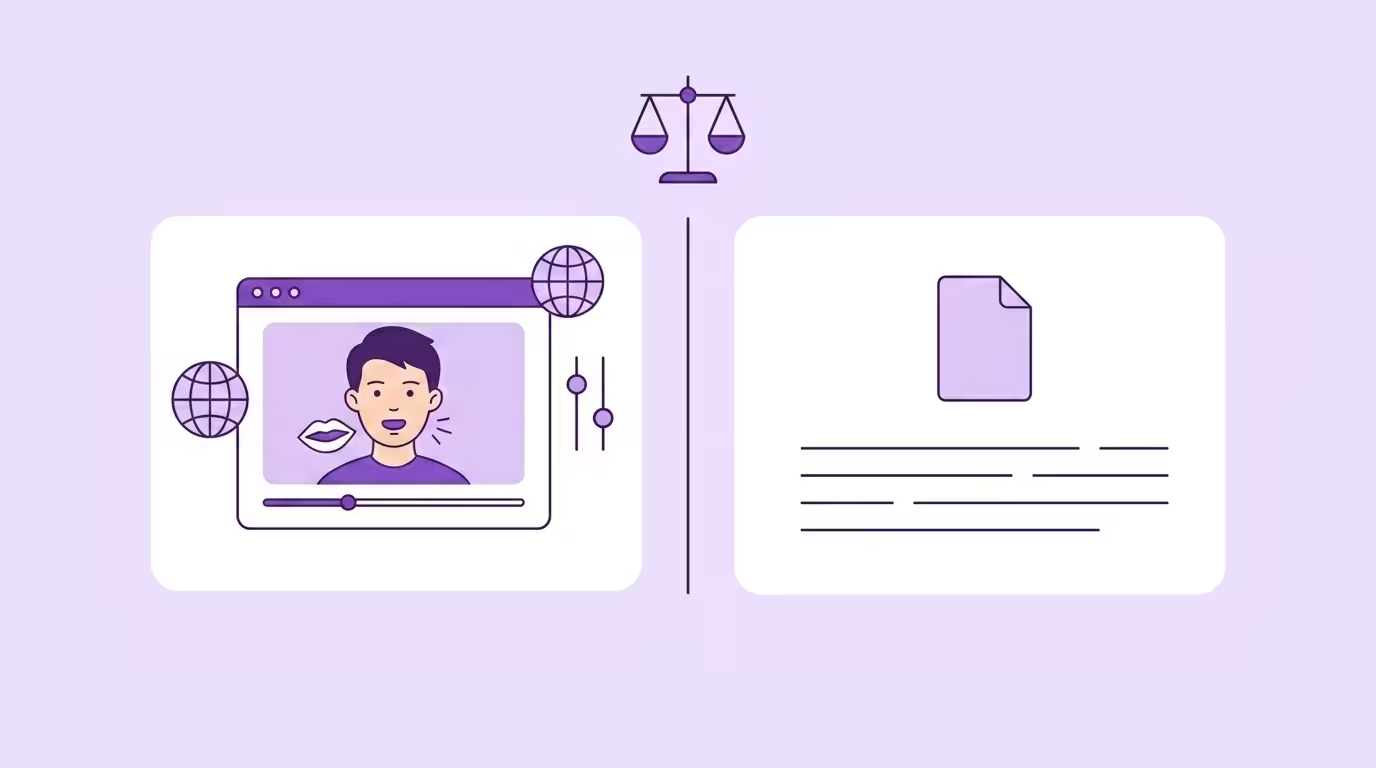
Translation converts text from one language to another. Localization adapts the entire experience — cultural references, audio, on-screen visuals, legal context — so your video content feels local in the target market. Translation is a crucial component of localization, not a substitute for it. For video, that distinction is the gap between subtitles that carry meaning and a localized version where the speaker actually speaks the viewer's language.
Most companies start with translation because it's cheaper and quicker. Subtitles get the job done for baseline accessibility. But if you're trying to build real engagement with a global audience — training employees in their native language, scaling marketing across markets, growing a YouTube channel in five countries — translation alone leaves value on the table.
I've been watching localization pricing collapse for three years. Most of the industry still hasn't caught up to what that means for content strategy.
The decision between translation, localization, and transcreation used to be about budget. Now it's about what the video has to do. We've watched enough teams get it wrong to write this down once.
Key Takeaways
- For video, translation means subtitles and captions. Localization means a dubbed, lip-synced, culturally adapted version that feels like it was produced for the target audience.
- Translation and localization are related but not interchangeable. Translation is a crucial component of the localization process, not a substitute for it.
- Subtitles work for testing new regions and low-stakes material. Localization drives real engagement, retention, and brand perception across international audiences.
- Transcreation recreates emotional intent for a different culture — essential for brand campaigns, overkill for most video projects.
- Match the approach to the video type: translate for accessibility, localize for engagement, transcreate for emotional impact. Internationalize the source so all three scale.
- AI-powered localization has made the full process almost as fast and affordable as translation used to be — removing the cost barrier that forced companies to settle for subtitles.
Translation vs. Localization — The Core Difference
Translation is the process of converting text from one language to another while preserving meaning. The main goal of translation is to convey the same information as the original content — nothing more, nothing less. A translator (or a machine translation engine like DeepL) takes the source and renders it in the target language as accurately as possible, with accuracy now above 90% for major language pairs on general content. Professional translators still own the edges — domain terminology, tone, legal phrasing — where accuracy actually matters. For video, translation usually means subtitles or captions: the fastest path to making material accessible across 20+ languages in hours, not weeks. The translation industry has moved fast with AI tools, and for straightforward informational content, machine output is often good enough. But "good enough" has limits.
Localization (sometimes written as l10n) is the broader process that contains translation. Localization adapts product or content to the specific language, culture, and target market — a video, a website, a mobile app, a software product. For video specifically, you're adapting the audio through AI dubbing or professional voiceover, adjusting on-screen text and graphics, rethinking cultural references that don't travel across regions, and lining up the details — date formats, currencies, measurement units, legal disclaimers — with what the target audience expects. They're different tools. Using one where you need the other is a fixable mistake that costs more than it saves. Translation serves as an integral part of the larger localization process, and the localization process is what makes localized content feel local rather than imported.
A concrete example. A German onboarding video mentions "Datenschutz" and references GDPR. A straight translation renders it as "data protection" — technically correct, but missing context. A localized version does more work. It adjusts the regulatory framing for the viewer's region, swaps the compliance language, and uses voice cloning so the instructor sounds like themselves in English instead of being read over by a stranger. Both versions carry the same information. Only the localized one carries the same authority.
Locale matters too. Locale is important because some languages are spoken in several different regions, and each one expects different conventions. Spanish for Mexico isn't Spanish for Spain. Portuguese for Brazil isn't Portuguese for Portugal — Brazil has 215 million speakers, Portugal around 10 million, and they expect different phrasing, different examples, different voice actors. A localization strategy that flattens that distinction loses credibility with the exact audiences you're trying to reach. Flawless translation is an essential element of the work, but locale-aware adaptation is what makes it land.
Where Translation Works — And Where It Falls Short
Translation is the right starting point in many scenarios. Subtitles are ideal for testing whether your content resonates with a new target audience before you commit to full localization. They're cost-effective, fast to produce with modern translation tools, and cover the basics: viewers can follow along, get the message, and decide whether they want more.
For internal documentation, meeting recordings, or videos where visual delivery matters less than the information itself, translated subtitles or captions often suffice.
Not every video needs full localization. Pretending otherwise wastes budget that should go toward the material driving business results. Subtitles buy reach. Localization buys engagement. Pick the one that matches what you're trying to do — the failure mode we see most often is teams localizing every piece of internal documentation and then running out of budget before they get to the marketing videos that actually drive revenue.
But translation has real limits with video. Subtitles force viewers to read and watch at once, which splits attention and drops retention — completion rates fall by 20–30% on subtitle-only versions compared to dubbed video in the viewer's own language.
CSA Research found that 76% of consumers prefer buying products with information in their native language, and 40% won't buy at all from a website in a foreign language (Source: CSA Research, "Can't Read, Won't Buy," https://csa-research.com/Featured-Content/For-Global-Businesses/Cant-Read-Wont-Buy). That 40% number should stop any executive deck cold. It means a cheap subtitle shortcut is locking nearly half your potential buyers out of the transaction. A subtitle isn't information "in" their language. It's information laid over someone else's.
The gap goes deeper than accessibility. Idioms, humor, and context-dependent text don't survive word-for-word conversion — the cultural meanings get lost entirely. "Break a leg" translated literally into Spanish or Japanese doesn't wish anyone luck. It confuses them. Date formats stay in the source format. Currencies stay in dollars. Measurement units stay imperial or metric — whichever the source video used. And the speaker's tone, pacing, and emotion stay locked in the source language, creating a disconnect between what the viewer hears and what they read. For organizations trying to ensure a coherent global presence, those small mismatches compound fast into real language barriers.
What Localization Adds to Video Content
Video localization rebuilds the experience, not just the words. The goal isn't a translated version of your original video — it's a version that feels like it was made for the viewer, in their market. Three layers do the work.
Audio. A studio session that used to cost $500–$2,000 per language now runs under $20. That's the headline. The rest is mechanics: instead of forcing viewers to read translated text while a foreign voice talks over them, the localization process replaces the original audio track. With voice cloning, you record the speaker once and Dubly preserves their vocal identity across 30+ languages, with native pronunciation in each one. Same tone, same energy, same personality. A training video narrated by a stranger sounds like a training video. One narrated by *your* instructor in the learner's native language sounds like it was made for them.
Visuals. On-screen text, graphics, lower thirds, embedded copy — all of it needs work. The design has to accommodate text expansion (translated text typically runs 20–35% longer; EN→DE up to 35%, EN→ES/FR 20–25% — Source: Eriksen Translations, https://eriksen.com/language/text-expansion/). Right-to-left languages like Arabic require mirrored layouts. And the mouth has to match the words. Modern lip sync software re-renders the speaker's mouth movements to the translated audio — handling multi-speaker scenes and off-angle camera work — so the viewer never notices the substitution. Lip synchronization used to be the domain of Pixar-level production budgets. Now it runs in the cloud.
Cultural context. This is the layer most teams underestimate. A marketing video aimed at the US needs different case studies, different social proof, and different touchpoints than one aimed at Japan — the target culture decides what resonates. Humor shifts region to region. Colors and symbols carry different meanings: what feels premium in one country reads as inappropriate in another. Good localization teams address those cultural barriers head-on instead of assuming linguistic accuracy equals cultural relevance. Localized content feels homegrown because someone actually asked the question: what would this video look like if it had been shot here?
The plumbing behind all three layers — glossaries that keep product names consistent across 10–40 languages, translation memory that reuses up to 60% of previously translated segments, editable translations your team can fine-tune before voice synthesis runs, TMS platforms that handle date formats and compliance text per market — runs through your localization strategy. Tools automate the rules. Strategy decides which rules apply to which region.
Transcreation — When Even Localization Isn't Enough
Some content needs reinvention, not adaptation. Transcreation is a creative process where the original message is rewritten for the target culture while preserving its emotional intent, voice, and strategic goals. You're not translating a campaign. You're rebuilding it for a different audience.
This matters most for high-stakes marketing: slogans, advertising campaigns, emotional storytelling. We had a health brand customer whose German "hype" campaign used an idiom about strength ("Kraft statt Kompromiss") that didn't survive a direct English render — the Spanish creative team rewrote the entire concept around resilience instead of strength, kept the tonal weight, and saw better engagement in Latin America than the source version got in DACH. That's what transcreation actually looks like. Not Nike translating slogans — a creative team rebuilding the emotional architecture because direct translation flattens the point.
For video, transcreation kicks in when emotional impact matters more than literal accuracy. A company manifesto, a product launch film, a high-production campaign spot — that's when the creative vision needs room to breathe in a new market, not a tighter box. Standard localization handles most of the work. The high-impact moments still need human creative judgment that no translation tool can replicate.
Most video projects don't need this level of effort. Training material, product demos, tutorials, corporate communications, and creator videos are better served by high-quality localization. Transcreation is worth the cost on maybe 5–10% of what a global business produces — the pieces where every emotional beat has to land and standard adaptation would flatten the impact.
Translation vs. Localization vs. Transcreation — At a Glance
| Comparison Factor | Translation | Localization | Transcreation |
|---|---|---|---|
| Scope | Text and language only | Language + culture + audio + visuals | Complete creative recreation |
| Output for video | Subtitles, captions | Dubbed audio, lip sync, adapted visuals | New script, new creative direction |
| Cultural adaptation | Minimal | Comprehensive | Complete reinvention |
| Speed | Hours | Hours to days (with AI tools) | Days to weeks |
| Cost | Low | Medium (AI) to high (manual) | High |
| Quality assurance | Linguistic review | Linguistic + cultural + technical QA | Creative review + market testing |
| Best for | Internal content, first market tests, accessibility | Training, marketing, product videos, creator content | Brand campaigns, slogans, emotional storytelling |
These aren't competing approaches. They're points on a spectrum. Most teams end up using all three — not because they planned it that way, but because different content types pull in different directions. Translation for volume. Localization where the video has to do real work. Transcreation for the handful of pieces where everything has to land. The industry is moving toward AI-powered tools that let teams move up the spectrum without proportional cost increases.
Why This Matters for Global Reach
Getting this wrong shows up on your P&L. An inaccurate translation in a compliance video costs more to fix than to get right the first time. Across our Dubly customer base, we see roughly a 2.5x engagement lift on localized videos vs. subtitled-only versions in the first 90 days. The companies still treating localization as a "nice to have" are losing ground to competitors who figured this out two years ago.
Liebscher & Bracht is the cleanest example we have. One German source library, localized into eight languages. 43.8 million views across all eight channels. Same content. Same creative team. Different viewer experience in each country.
Global reach compounds in both directions. If viewers in one region understand and engage, they share the video, embed it, link to it — and that behaviour feeds SEO signals that raise the source-language version's visibility too. Translation costs, once a budget line reviewed quarterly, now behave more like hosting or CDN — a small recurring cost of being available everywhere. The tooling moves fast enough that any localization workflow documented 18 months ago is probably already missing a step.
Teams targeting specific markets still need in-country review. The right cadence depends on content type: documentation ships fast and iterates; brand campaigns need a slower, more careful pass. Tooling isn't the bottleneck anymore. The bottleneck is deciding what to localize for which audience, when — and being ready to measure the outcome. The teams moving fast at Dubly do three things: they pick one workflow and stop changing it every quarter, they let the creative layer flex per market while the technical layer stays fixed, and they measure engagement per language instead of per video — which is how they know when a market is worth doubling down on.
Where Internationalization (i18n) Fits — Source-Side Prep
Teams that treat internationalization as part of the initial production brief localize 3–5x faster than teams that don't. That's the whole story on i18n.
Internationalization (i18n, with localization as l10n) is what happens before translation starts. In video, it means shooting and structuring source videos so they can be localized without re-editing from scratch. Separate voiceover from on-screen graphics. Keep on-screen text on its own layer. Avoid baking currencies, dates, or region-specific examples into the picture when they can live in a caption or overlay.
Skip i18n and every new language becomes a custom project instead of a production run. The source is locked to one market, and you pay that tax forever. The teams we see winning at scale don't treat the source as sacred. They treat it as a template. That's the actual deliverable — not 50 translated videos, but infrastructure that produces 500 without starting from scratch each time.
How to Choose the Right Approach for Your Videos
The decision isn't purely about budget. It's about what the video has to accomplish in each target market. Here's the framework we see working across 330+ customers localizing video at scale:
Start with translation when you're testing a new region, handling low-stakes internal material, or working with a tight budget. Subtitles get your videos accessible in hours instead of days and give you data on whether the audience in that country actually engages with the topic. If completion rates rise 10% or more vs. the source-language version, the audience is responding — upgrade to full localization. If they're flat, save your budget for a different country. Translation is a sensible beachhead — it's not meant to be the finish line.
Invest in localization when the video represents your company to external audiences, when comprehension and retention matter (training, compliance, onboarding), or when you're scaling into international markets where you want lasting presence. The investment pays off in measurable ways: higher engagement, 30–50% stronger completion rates, and measurable lift in brand perception. For companies with existing video libraries, localizing your highest-performing material first gives the best return — teams that start here see ROI within 60–90 days. The localization industry hit roughly $56B globally in 2026. The pattern holds whether you're a 10-person startup or a Fortune 500 team.
Reserve transcreation for videos where emotional resonance is the primary goal and where the concept wouldn't survive direct adaptation. If the piece relies on wordplay, humor specific to one country, or deeply emotional storytelling, transcreation is how you make sure the impact lands. Bring local creative teams in early — don't try to reinvent a message at the end of a localization workflow.
The hybrid approach works best. Most organizations produce a mix of content types — video, text, marketing campaigns, mobile apps, support documentation. A global marketing team might transcreate their hero campaign, localize product demos and customer testimonials across multiple languages, and translate internal meeting recordings. The approach follows the content type. Brand campaigns get transcreation. Product demos get localization. Internal recordings get subtitles. That's it. One note on SEO: properly localized pages with market-specific metadata rank in local search — subtitle-only versions don't, because the crawler sees source-language content. Conduct keyword research per target market rather than translating existing keywords — what people search for shifts dramatically by language and culture, often by 40–60% between markets.
How AI Is Closing the Gap Between Translation and Localization
The old rule was simple: translation is cheap and fast, full localization is expensive and slow. Most businesses defaulted to subtitles — not because subtitles were good enough, but because full localization wasn't feasible at scale. Localized video was a luxury reserved for flagship campaigns in Spanish, German, Japanese, or Mandarin. A handful of languages, tops. Website localization and software localization went through this same shift a decade earlier, when CMS-driven workflows replaced one-off translation projects. Video is just catching up.
AI translation uses machine learning to consider context and style preferences, and that changes the equation. Modern AI video localization services combine machine translation software with voice cloning tools, AI dubbing, and generative lip sync to translate videos, localize video content, and reach new audiences in minutes instead of weeks. The result: the localized voice sounds like the original speaker, and the mouth matches — voice synthesis and frame-by-frame lip sync in one run. The localization project that used to require voice actors, studios, directors, and manual syncing now runs through a software platform. Cost per minute has dropped from roughly €80 (studio dubbing) to around €5 (AI-powered localization) — a ~94% reduction. At €5 a minute, you don't make the same decisions you did at €80. Everything changes — the approval process, the market strategy, what you bother translating at all.
The old translation agency model — gate-keeping the work, billing by the word — is being replaced by platforms that advise on strategy. Companies no longer choose between translating everything or localizing a handful of hero videos. The entire library goes through one pipeline: transcription, translation, dubbing with voice cloning, accurate lip sync, quality assurance — with human review where the brand demands it.
The quality gap between AI-based translation tools and human-led localization keeps narrowing. For informational and business video content, AI-localized versions are often indistinguishable from manually produced ones. Cultural nuance still benefits from human oversight — but AI handles the heavy lifting, letting professional translators and localization teams focus on the creative layers where their expertise actually matters. What used to mean wrangling three agencies, two studios, and a project manager spreadsheet now runs in one Dubly workflow — from transcription to final delivery.
One thing we've learned building localization technology at Dubly: companies that start with one language pair and expand within three months aren't doing it because they planned to scale. They're doing it because the engagement data made the decision for them. Most companies don't need to choose between translation and localization at all — they need both. Subtitles as a fast entry into new regions, full localization for the videos that actually drive revenue and retention. The language barriers that used to wall off international audiences simply aren't there anymore.
That said, localization isn't magic. If the source video is unclear, poorly structured, or leans on culture-specific humor, localizing it won't fix those problems — it'll replicate them in every language. The best results come from videos built with scale in mind from day one: clean audio, clear speakers, messaging that doesn't depend on untranslatable wordplay. One thing the machine won't catch: if your brand voice leans on regional slang or dialect humor, you need a native speaker in the loop. AI gets you to 95%. That last 5% is the part where the audience decides whether you feel local or just close.
Conclusion
Translation converts words; localization rebuilds the entire viewer experience — audio, visuals, and cultural context — so the video feels made for the target market rather than imported. Subtitles buy reach for testing new regions and low-stakes material, full localization buys the engagement and retention that drive revenue, and transcreation covers the handful of pieces where every emotional beat has to land. AI-powered localization has collapsed the cost and time gap that once forced teams to settle for subtitles, so most companies no longer choose between translation and localization. They use both. If you're still deciding whether localization is worth it, the math changed. Explore pricing built for localizing at scale, and test the results on your own material before committing to a rollout across markets.
Back to the complete guide: Video Localization
Translate Your First Video
Results in just a few minutes
No credit card required
Best translation quality worldwide
About the author

Simon Pieren
Co-Founder | Marketing & Sales