AI Lip Sync
June 11, 2026
AI Lip Sync Technology: How Generative Models Match Mouth to Speech
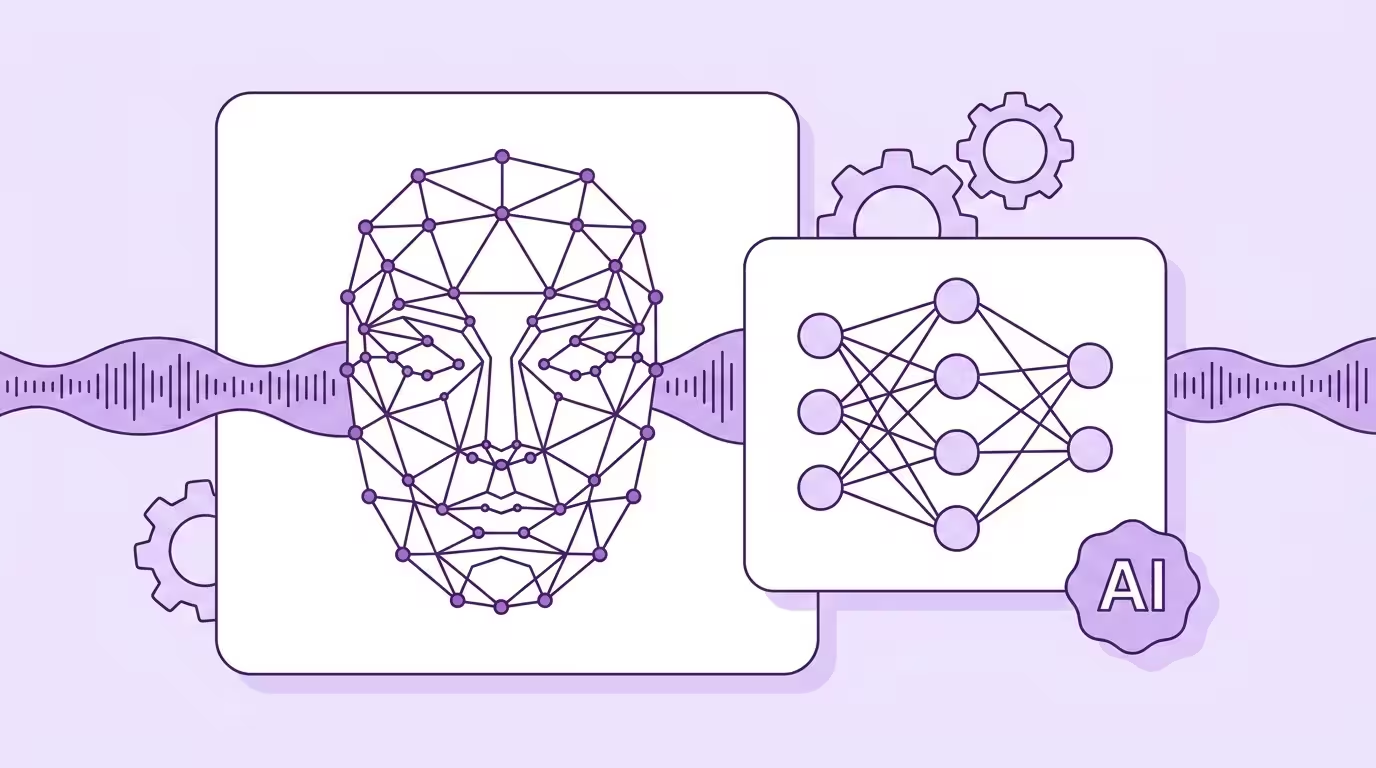
AI lip sync technology generates new video frames where a speaker's lip movements match dubbed audio in another language — frame by frame, phoneme by phoneme. Not by stretching or warping the original. By creating entirely new visual information for the lip area while leaving the rest of the face untouched.
That distinction matters. Early approaches tried to manipulate existing pixels. The results looked distorted — like a face made of rubber. Modern generative AI lip sync creates new pixels, synthesized from the model's understanding of how human lips form specific sounds across languages. Reconstruction, not manipulation.
This article goes deeper than the pillar guide. The actual engineering: how these models work, what makes them accurate, where they break, and the three-year sprint from research demo to production tool.
Key Takeaways
- Generative models map phonemes to visemes using deep learning trained on thousands of hours of real human speech
- Temporal smoothing creates the natural flow between lip positions — the key to convincing results
- Language-specific phonetic models ensure native-looking output per language, not one-size-fits-all
- Quality depends on coarticulation, jaw dynamics, skin blending, and temporal stability
- Extreme angles, facial hair, and fast speech are where most tools break; Lip Sync 2.0 was engineered specifically for these cases
From Phonemes to Visemes: The Core Mapping
Every spoken sound — a phoneme — has a corresponding visual lip shape — a viseme. The English "m" closes the lips. The "ah" opens wide. The French "u" rounds differently from the English "oo."
Sounds simple. It's not.
The mapping isn't one-to-one. Try distinguishing "p", "b", and "m" visually — they look nearly identical. And the same phoneme looks different depending on what comes before and after it. Linguists call this coarticulation: your lips start shaping the next sound before the current one finishes. Speech isn't a sequence of positions. It's a continuous, overlapping flow.
This is what AI lip sync models learn. Not "sound X = lip shape Y." But "sound X, in this context, at this speed, with this emotional intensity, preceded by W and followed by Z = this specific configuration across these frames." Thousands of hours of training video. Dozens of languages. The model learns the underlying physics of how human faces produce speech.
That's why the results look natural when it works. And why bad implementations — the ones that treat each sound as an isolated position — look robotic even when individual frames are technically correct.
How Generative Models Actually Work
The Architecture
Four components, working together:
Audio encoder. Takes the dubbed audio track and extracts phonetic features — which sounds happen when, how long, how intense. This isn't speech recognition. It's not converting audio to text. It's understanding the physical shape of the sound — what the lips need to do.
Visual encoder. Maps the speaker's face from the source video. Structure, skin texture, lighting, how this particular person's jaw moves, their natural range of lip motion. Everyone speaks differently. The model needs to know this specific face.
Generator. The core. Takes phonetic features from the audio encoder plus visual features from the video encoder and synthesizes new frames. Only the lip region gets replaced. Face, background, lighting — all preserved. This is where the actual lip sync happens.
Discriminator. The quality police. Evaluates whether the generated output looks real. Generator tries to fool it, discriminator tries to catch fakes. This adversarial loop — thousands of iterations — is what pushes results toward photorealism. It's why 2026 output looks fundamentally different from 2023 output.
Temporal Smoothing
Here's a problem that doesn't seem like a problem until you see it: transitions.
Generate each frame independently, and the result looks jittery. The lips snap between shapes instead of flowing. Real speech doesn't work that way — there are no hard cuts between positions. Everything blends.
Temporal smoothing generates intermediate frames between key positions. The model doesn't just know "at 1.0 seconds, lips here" and "at 1.1 seconds, lips there." It generates the continuous movement between them. The lips flow the way real lips do.
This single technique is what separates choppy early lip sync from the smooth results we see today. And it's harder than it sounds — the model has to predict not just where the lips should be, but how they should move to get there.
Language-Specific Phonetic Models
Different languages look fundamentally different on the face. Japanese has a narrower range of mouth openings than Portuguese. Arabic uses throat sounds with subtle visual cues. Tonal languages like Mandarin add pitch variations that affect jaw position.
One model for all languages? Doesn't work. Or rather — it works poorly for everything instead of working well for anything.
We use language-specific phonetic models. Each of our approximately 38 supported languages gets its own mapping. This is why quality varies between language pairs — it's not a bug, it's a data question. English, German, Spanish, Japanese have massive training data. The output is indistinguishable from native content. Less common languages have less data, so the quality ceiling is lower.
We'd rather deliver excellent results in fewer languages than mediocre results in many. Combined with voice cloning, each language gets native-sounding audio AND native-looking lip movements. That combination is what makes dubbed video actually convincing.
Translate Your First Video
Results in just a few minutes
No credit card required
Best translation quality worldwide
What Changed Between 2023 and 2026
Three years. From "impressive demo" to "production tool." Here's what actually drove that:
Transformer Architectures
The single biggest leap. Previous models (autoencoders) processed frames in isolation or with very limited context. Transformers process entire sequences — understanding not just frame 47, but the ten frames before it and the ten frames after. Context eliminates jitter. Context enables flow. This is what made smooth, natural-looking output possible.
Training Data at Scale
Early models: hundreds of hours of video. Current models: thousands. Across dozens of languages, accents, speaking styles, lighting conditions, camera angles. The more examples the model sees, the better it handles situations it's never explicitly trained on. A speaker with unusual jaw movement. A difficult lighting setup. An accent the model hasn't encountered before. More data means better generalization.
Multi-Task Learning
Here's what changed the game: modern models don't just learn lip sync. They simultaneously learn face detection, head pose estimation, emotion recognition, and occlusion prediction. All at once.
Why does that matter? Because the model doesn't treat lips in isolation anymore. It understands lips as part of a face, a face as part of a scene. When someone's hand moves toward their chin, the model already knows what's about to happen — and adjusts its approach before the occlusion occurs. That contextual understanding is what enables multi-speaker handling, dynamic head tracking, and all the features that make this viable for real video content.
Processing Speed
GPU improvements plus model optimization (quantization, pruning, distillation) took processing from hours to minutes. Our Lip Sync 2.0 is 90% faster than the first generation. Same quality. Fraction of the compute.
Speed matters more than people realize. If processing takes 24 hours, teams skip lip sync for anything time-sensitive. At 10 minutes per video, they use it on everything. Speed is what turned this from a specialty tool into infrastructure.
The Quality Factors
What separates good lip sync from great isn't subjective. Four factors consistently determine perceived quality. Here's what they are — and where most tools fall short.
What Makes Results Look Natural
Coarticulation accuracy. Do the lips start the next sound before finishing the current one? They should. Real speech overlaps. If the model generates each sound in isolation, the output looks robotic — even if every individual frame is technically correct.
Jaw dynamics. Whispers barely open the jaw. Emphatic statements drop it wide. Laughter throws everything off. If the model doesn't capture how the jaw behaves independently from the lips, the result looks flat. The lips move, but the face doesn't.
Skin blending. Generated pixels need to match surrounding skin perfectly. Texture, lighting, color, shadows. Any seam is immediately visible. The best models achieve invisible blending even at 4K. Good models show subtle artifacts at full resolution. Bad models show obvious patches.
Temporal stability. No flickering. No jitter. No sudden jumps. The output needs to be as stable as the original footage. This is where temporal smoothing and transformer architectures earn their engineering investment.
Where Most Tools Fail — and How Lip Sync 2.0 Handles It
Most lip sync solutions on the market struggle with these scenarios. Lip Sync 2.0 was built to solve them:
Extreme angles. Most tools start showing artifacts around 15-20 degrees and fail entirely beyond 30. Lip Sync 2.0 uses adaptive head pose rendering — each angle gets its own generation strategy. Natural-looking output even when speakers move and turn.
Facial hair. Where other tools fail completely with dense beards, Lip Sync 2.0 separates skin from hair and generates new skin positions without disturbing the beard. Works reliably for most beard styles.
Fast speakers and dynamic scenes. Rapid-fire dialog, quick speaker transitions, energetic presentations — Lip Sync 2.0 intelligently compresses lip sync with speaking tempo rather than simplifying movements.
Teeth and mouth interior. Open sounds expose teeth alignment and tongue position. Lip Sync 2.0 generates this complex internal geometry — a detail that cheaper tools simply skip.
The Engineering Behind Lip Sync 2.0
The capabilities above aren't theoretical. They're the result of specific architectural decisions:
Persistent face tracking maintains speaker identity across frames — even when faces overlap or temporarily vanish. Each person's lip sync comes from continuous tracking data, not frame-by-frame guessing. That's why multi-speaker scenes work where other tools produce crossover artifacts.
Predictive occlusion fills in what it can't see — intelligently, based on audio, the speaker's typical behavior, and surrounding context. Not hallucination. Prediction backed by data.
Adaptive rendering gives every head angle its own optimized generation strategy. The model switches approaches in real time as the speaker moves. Combined with everything above, this is what makes Lip Sync 2.0 work on real video — not just staged demos.
Lip sync is only the visual half. The audio side — voice cloning, neural translation, the full multilingual pipeline — runs in parallel and feeds the timing data the lip generator depends on: AI Dubbing — Complete Guide.
Back to the pillar guide: AI Lip Sync — Complete Guide
Conclusion
The engineering behind AI lip sync in 2026 is genuinely impressive. Generative models that understand coarticulation, temporal flow, multi-speaker scenes, and language-specific phonetics — producing results that are indistinguishable from original footage for most professional content.
Not every tool delivers this. Extreme angles, dense facial hair, fast speech: that is where most systems still break. Lip Sync 2.0 was built for exactly these cases and processes them without drift or distortion. And for talking heads, interviews, training content, marketing, the quality is there.
What made it possible: transformers, massive datasets, multi-task learning, relentless optimization. What keeps improving: everything. Every quarter. The gap between AI-generated lip sync and human-quality production narrows with each model generation.
Translate Your First Video
Results in just a few minutes
No credit card required
Best translation quality worldwide
About the author

Maximilian Engler
Co-Founder | Product