Tech
AI Lip Sync Explained: Stop Asynchronous Lips in Video Translations
Asynchronous videos look unprofessional. Learn how AI Lip Sync and Visual Dubbing perfect your translations – GDPR compliant and scalable.

Simon Pieren
Dec 23, 2025
Full Data Sovereignty
Personal point of contact
Highest Quality Lip Sync
Trusted by 1,200+ Companies
Tech
September 12, 2025
Imagine uploading a single video—and the whole world understands it. No more managing five different YouTube channels, no version control chaos, and no losing watch time to fragmented audiences.
This is now reality: YouTube Multi Language Audio (MLA) is the quietest yet most powerful revolution for content creators and brands in years.
What used to be reserved for MrBeast and major corporations is now rolling out to the broader market. But the feature alone won't help if you don't have the audio tracks. This leaves many companies facing a dilemma: Pay for expensive dubbing studios or miss out on international reach? In this article, we show you why MLA changes your business model—and how you can bridge the gap between your content and the world using modern AI Video Translation.
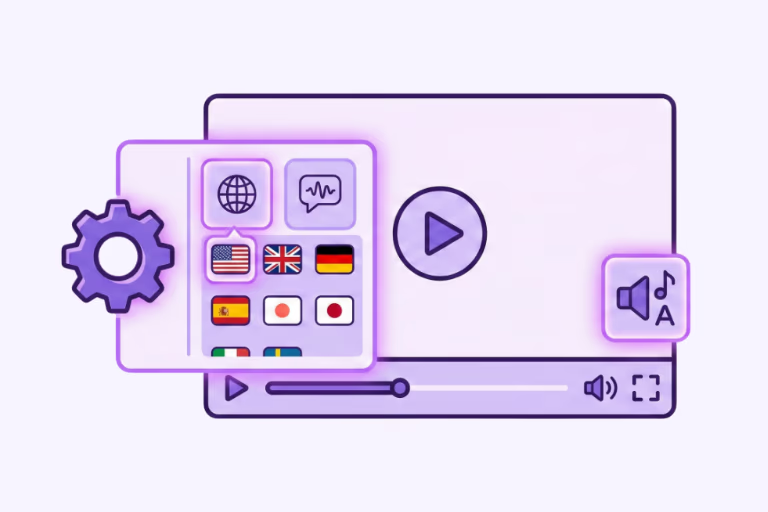
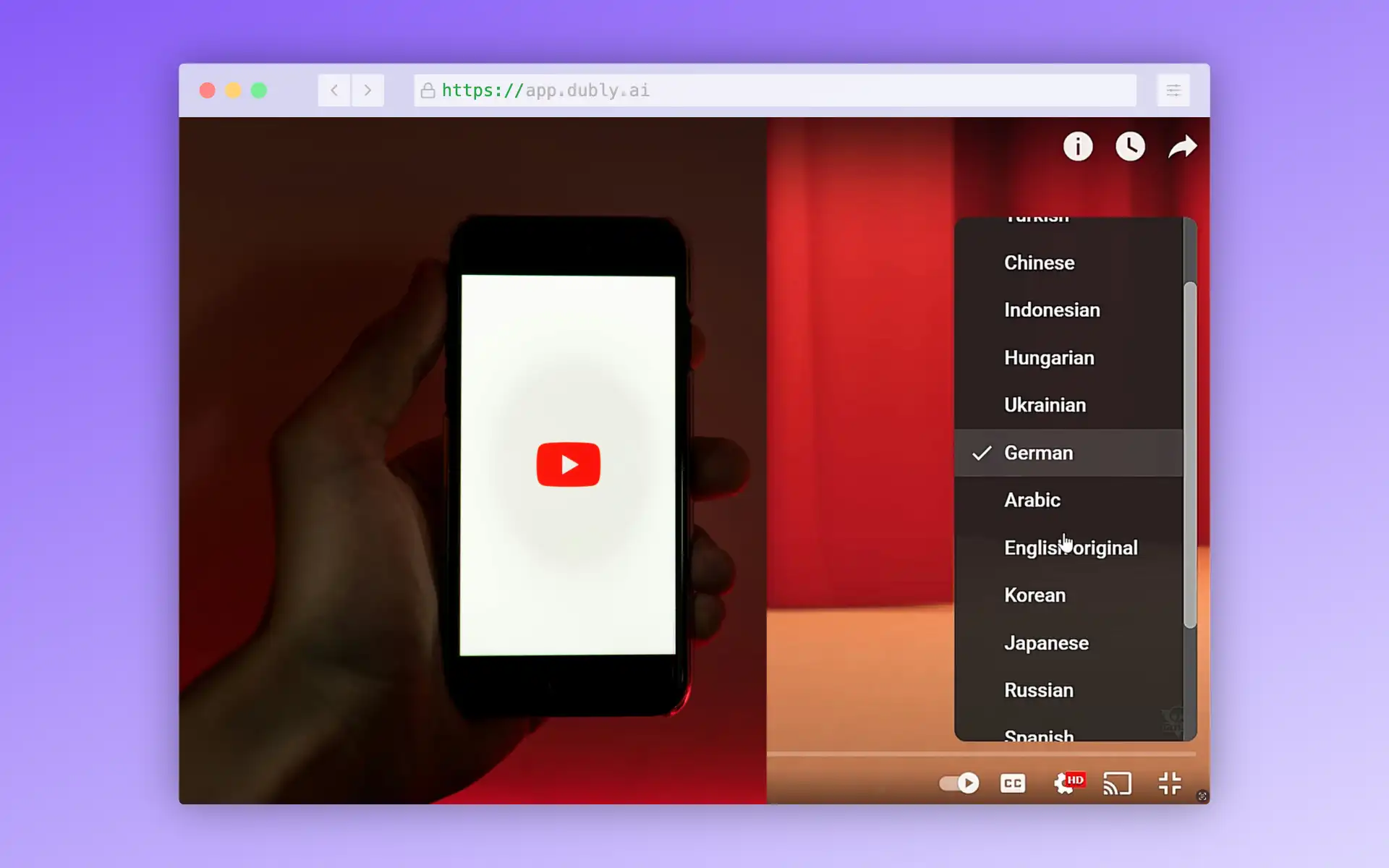
In short: It’s the "Netflix switch" for YouTube. Instead of uploading a separate video for every language (e.g., German, English, Spanish), you bundle all audio tracks into a single video upload.
The viewer simply clicks the gear icon in the player, selects "Audio Track," and immediately hears their native language. The video continues seamlessly. For you as a creator or brand, this means:
Previously, the strategy was clear: One channel for DE, one for EN, one for ES. That’s not wrong, but often inefficient. Today, the trend is clearly moving toward consolidation.
With Multi Language Audio, you consolidate your power. A video that performs globally also ranks better locally. Companies that switch now are building one strong global brand authority.
Now to the elephant in the room: Where do the Spanish, French, or Chinese audio tracks come from? YouTube provides the tech (the player), not the content.
Relying purely on manual processes here will quickly hit budget limits. According to industry standards (like the VDS Fee Compass), entry-level fees for professional voice actors often start around €150 per minute. You can find a detailed cost comparison for video translation here in our blog.
Here is the comparison of why AI Dubbing (as we offer at Dubly.AI) is disrupting the market:
| Comparison Factor | Traditional Studio | Dubly.AI |
|---|---|---|
| Cost Structure | High & often inflexible (approx. €150/min entry) | Highly efficient (starting at approx. €2/min) |
| Time Required | Weeks (Casting, recording, post-prod) | Minutes (Upload, AI process, download) |
| Voice Consistency | Foreign actor's voice | Voice Cloning (Your original voice in every language) |
| Scalability | Linear (More languages = More effort) | Exponential (30+ languages at the push of a button) |
| Data Privacy | Contract-dependent (often unclear with freelancers) | Enterprise-Ready (GDPR, servers in Europe) |
At Dubly, we built our platform exactly for this: To bridge the gap between your video and YouTube's Multi-Language feature. You don't need to be a tech expert.
Pro Tip: If quality is your top priority, check out our feature for Auto-Dubbing with Lip Sync, ensuring not just the sound but also the lip movements match perfectly. Reminder: YouTube is not supporting Lip Synced Versions as a seperate track at the moment.
The best part? You retain full control. Thanks to glossaries and free reviewer access, you can ensure technical terms are perfect before you go live.
Results in just a few minutes
No credit card required
Best translation quality worldwide
Want to conquer the world tomorrow? Start smart.
YouTube Multi Language Audio isn't just a nice gimmick; it is the future of video distribution. It rewards quality and consolidation. The barrier has always been the price of translation. With Dubly.AI, that wall falls. You can now run Hollywood strategies—on an SMB budget.
👉 In this blog, we'll show you how to translate your entire YouTube channel at once, saving you a lot of time.
Key Takeaways
About the author

Maximilian Engler
Co-Founder | Product
Tech
Asynchronous videos look unprofessional. Learn how AI Lip Sync and Visual Dubbing perfect your translations – GDPR compliant and scalable.
Simon Pieren
Dec 23, 2025
Use Cases
Looking for an AI video translator? We answer how to translate video free using 3 methods: Subtitles, Basic TTS, and Professional Lipsync.
Simon Pieren
Dec 8, 2025
Use Cases
Looking to "translate video free"? Learn the technical differences between standard dubbing and generative AI Lip Sync, and how to test professional quality risk-free.
Simon Pieren
Nov 28, 2025