Tech
AI Lip Sync Explained: Stop Asynchronous Lips in Video Translations
Asynchronous videos look unprofessional. Learn how AI Lip Sync and Visual Dubbing perfect your translations – GDPR compliant and scalable.

Simon Pieren
Dec 23, 2025
Full Data Sovereignty
Personal point of contact
Highest Quality Lip Sync
Trusted by 1,200+ Companies
Use Cases
November 20, 2025
Companies today rely on video for training, marketing, and internal communication.
But as internationalization accelerates, one key question arises:
How can messages be conveyed across language barriers - quickly, authentically, and affordably?
Traditional video dubbing is expensive and slow.
AI video translation is revolutionizing brand communication:
With precise lip-sync, automatic voice adaptation, and GDPR-compliant technology, Dubly.AI enables authentic, multilingual videos - faster, more cost-effective, and more credible than traditional dubbing.
Video has become the beating heart of modern brand communication — yet language often remains the invisible barrier.
Global campaigns reach only a fraction of their potential audience because subtitles and dubbed voices frequently sound unnatural.
AI-powered video translation eliminates these barriers.
It automatically translates content - including voice, tone, and lip movements - allowing brands to communicate authentically across the world.
Dubly.AI demonstrates how companies can use this technology to open new markets, strengthen trust, and dramatically reduce production costs.
Videos in a viewer’s native language create proximity and trust.
Companies that localize their content increase conversion rates by up to 76% and open entirely new markets.
AI video translation combines several neural models:
The result looks as if the video were filmed directly in the target language - no awkward synchronization or mismatched voices.
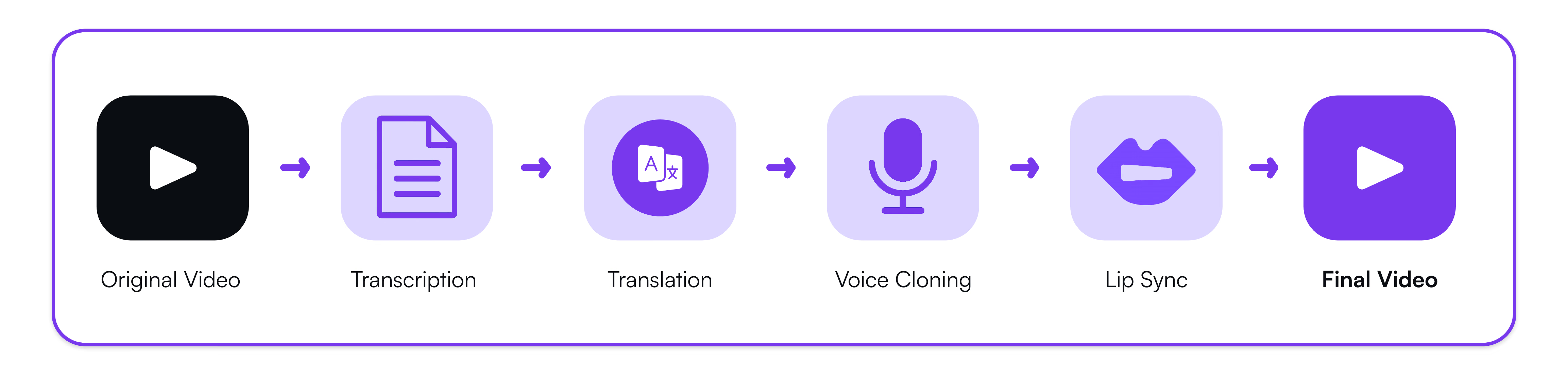
Dubly.AI efficient translation Process
Traditional dubbing requires studios, professional speakers, editing, and sound mixing - a costly, manual process.
AI-driven solutions like Dubly.AI automate many of these steps and deliver results in minutes rather than weeks.
| Criterion | Traditional Dubbing | AI Video Translation (Dubly.AI) |
|---|---|---|
| Time Required | Several weeks | Few minutes to hours |
| Cost per Minute | From €100 | From €2 |
| Authenticity | Often unnatural synchronization | Natural lip-sync & emotion |
| Scalability | Not feasible | To 32+ markets with one click |
The manual translation process includes transcription, translation, voice casting, studio recording, and synchronization - costing not only time but also significant budget.
A ten-minute video can easily consume €1,500–€4,000 per language, often taking several weeks to complete.
For global brands, that simply isn’t scalable.
Systems like Dubly.AI are changing the industry:
As a result, costs drop to just a few euros per minute, and a full translation cycle takes hours instead of weeks.
AI doesn’t replace creativity - it automates repetitive work, freeing brands to focus on storytelling, quality, and strategy.
1. Marketing & E-Commerce (see case study)
Campaign videos are localized within seconds - enabling global reach without additional production.
2. Education & E-Learning (see case study)
Training materials and online courses become multilingual, making knowledge accessible across borders.
3. Corporate Communication (see case study)
Global teams share CEO messages, HR updates, and internal communications in employees’ native languages.
4. Creators & Influencers (see case study)
Content creators expand their communities across languages - authentically and emotionally.
Liebscher & Bracht, Europe’s most successful health channel on YouTube, reached millions of viewers in German-speaking countries.
But their mission - sharing knowledge about pain therapy - deserved to go global.
The goal: make their content available in multiple languages without losing credibility, natural tone, or production quality.
Results through AI video translation:
“How do you handle data protection?”
This is the question we hear in almost every meeting - and it often determines whether a project can even proceed.
Germany enforces the strictest data protection laws in the world.
A single violation can cost millions - and trust, once lost, is gone forever.
Dubly.AI is one of the few companies that operates 100% GDPR- and EU-compliant - a genuine differentiator in the AI translation sector.
Every client receives a complete data protection package including:
This foundation pays off: Dubly.AI passes even the toughest enterprise compliance audits - with fewer back-and-forths, shorter approval cycles, and faster go-lives for large corporations.
AI video translation is more than an innovation - it’s a strategic turning point.
Brands that invest early will not only be heard - they’ll be understood.
About the author

Simon Pieren
Co-Founder | Marketing & Sales
Tech
Asynchronous videos look unprofessional. Learn how AI Lip Sync and Visual Dubbing perfect your translations – GDPR compliant and scalable.
Simon Pieren
Dec 23, 2025
Use Cases
Looking for an AI video translator? We answer how to translate video free using 3 methods: Subtitles, Basic TTS, and Professional Lipsync.
Simon Pieren
Dec 8, 2025
Use Cases
Looking to "translate video free"? Learn the technical differences between standard dubbing and generative AI Lip Sync, and how to test professional quality risk-free.
Simon Pieren
Nov 28, 2025