Übersetze dein erstes Video

Ergebnis in wenigen Minuten

Keine Kreditkarte notwendig

Beste Übersetzungsqualität weltweit

Jetzt Video hochladen
Maximilian Engler
Maximilian Engler
Co-Founder | Product & Technology

Who Should Use a Custom Glossary?

  • Tech and software companies with defined feature names and product terms
  • Marketing teams with strict brand language guidelines
  • Highly regulated industries (e.g., legal, finance, healthcare)
  • Agencies and multi-brand teams that manage multiple client voices

In short: anyone who wants to avoid things like “Cloud Connector” being translated into “Sky Joiner.”

To blog overview

Tech

September 12, 2025

Why Custom Glossaries Are Essential for Professional Video Translation

Why Custom Glossaries Are Essential for Professional Video Translation

If you translate videos regularly, you’ve probably seen it happen:
Product names or key terms get mistranslated, inconsistently phrased, or localized into something that just sounds... off. “Onboarding Flow” becomes “Entry River”? Not quite the tone you were going for.

For any company with clear brand language, technical terminology, or sensitive content, consistency and accuracy are critical.

That’s why Dubly lets you create and apply a custom glossary directly at the account level – ensuring your voice stays your voice, across all languages.

What is a Custom Glossary?

A custom glossary is a list of terms you want translated in a specific, controlled way — every time.

Examples might include:

  • Onboarding Flow → Onboarding Process
  • Dashboard → Dashboard (not “Instrument Panel”)
  • Lead Nurturing → Lead Nurturing (left untranslated)
  • Support Ticket → Support Ticket

Your glossary makes sure translations stay consistent, brand-aligned, and professionally accurate — no matter how many videos you process.

Why Glossaries Matter

Without one, you risk:

  • Inconsistent terminology ("user" vs. "customer" vs. "client")
  • Mistranslations of technical terms
  • Shifts in tone or voice across content
  • Wasted time reviewing and correcting output manually

A well-maintained glossary ensures your product, service, and tone are always translated the way you want them – and understood the way you mean them.

How Glossaries Work in Dubly

Dubly keeps it simple and centralized:

  • You create your glossary manually in the account settings
  • The glossary is active by default across all videos you process with that account
  • The system applies the glossary automatically during translation
  • You can edit or expand your glossary at any time
  • All updates apply instantly across future video translations

📌 Note: Currently, glossaries must be entered manually – uploads are not yet supported. But once created, they’re automatically enforced across all translations on your account.

FAQ: Why Custom Glossaries Are Essential for Professional Video Translation

What is a custom glossary and what is its purpose?

A custom glossary is a list of terms that must be translated in a specific, predetermined way. It ensures consistency in tone, brand voice, and technical terminology across all videos.

Why do glossaries matter for brands and professionals?

Without a glossary, terminology becomes inconsistent, technical terms get mistranslated, style and voice vary — resulting in extra work and subpar results.

How does Dubly apply glossaries in practice?

You create the glossary in account settings, it applies automatically to all videos. You can update or expand it anytime, and new translations benefit immediately.

Who especially needs custom glossaries?

Tech companies, marketing teams with strict brand guidelines, regulated industries, agencies and multi-brand operations find glossaries especially relevant.

Why does a glossary noticeably improve translation quality?

Because a glossary provides context: it ensures brand terms, style and tone are precise and not lost through default AI translations.

{{cta}}


{{callout}}

Conclusion: Translation Is More Than Words – It’s Your Voice

AI-driven video translation is fast and scalable – but professional results require context.
A glossary provides that context by telling the system what matters to you.

Dubly gives you the tools to manage your terminology, your tone, and your consistency — all in one place.

Does the Dubly.AI free trial include the Lipsync feature?

Yes. We believe you need to experience the full technology to understand its value. The free trial includes Generative Lipsync and Voice Cloning, not just simple audio translation.

Is there a difference between a standard "Video translater" and Dubly.AI?

Yes. A standard "Video translater" often only translates text or audio. Dubly.AI is a comprehensive AI solution that adapts the visuals (mouth movements) to the audio, creating a seamless experience.

Can I use Dubly.AI for long-form content?

Yes. While many free tools limit you to 60 seconds, Dubly’s engine is built for scale – from TikTok Shorts to hour-long corporate training modules.

Can I use translate video free tools to internationalize my content?

Yes, absolutely. Using free tools is a great starting point to test new markets without a budget. However, keep in mind that methods like subtitles or basic video translator apps usually only transfer information, not emotion. To truly internationalize your brand's personality and retain viewers, you will eventually need lipsync technology to ensure the audience feels connected to you, not just the text.

Does a free ai video translator work for all types of videos?

It works well for content where the speaker is not visible, such as screen recordings or faceless tutorials. However, for any video featuring a person speaking on camera, a standard tool often falls short. Because it lacks lipsync, the visual mismatch distracts the viewer. For content meant to build trust or emotion, you need a solution that adapts both the voice and the visuals.

Is there a free version of Dubly.AI?

You can translate your first video for free so you can validate the quality with your own files. We believe in letting you prove the value first.

Does this work for any language?

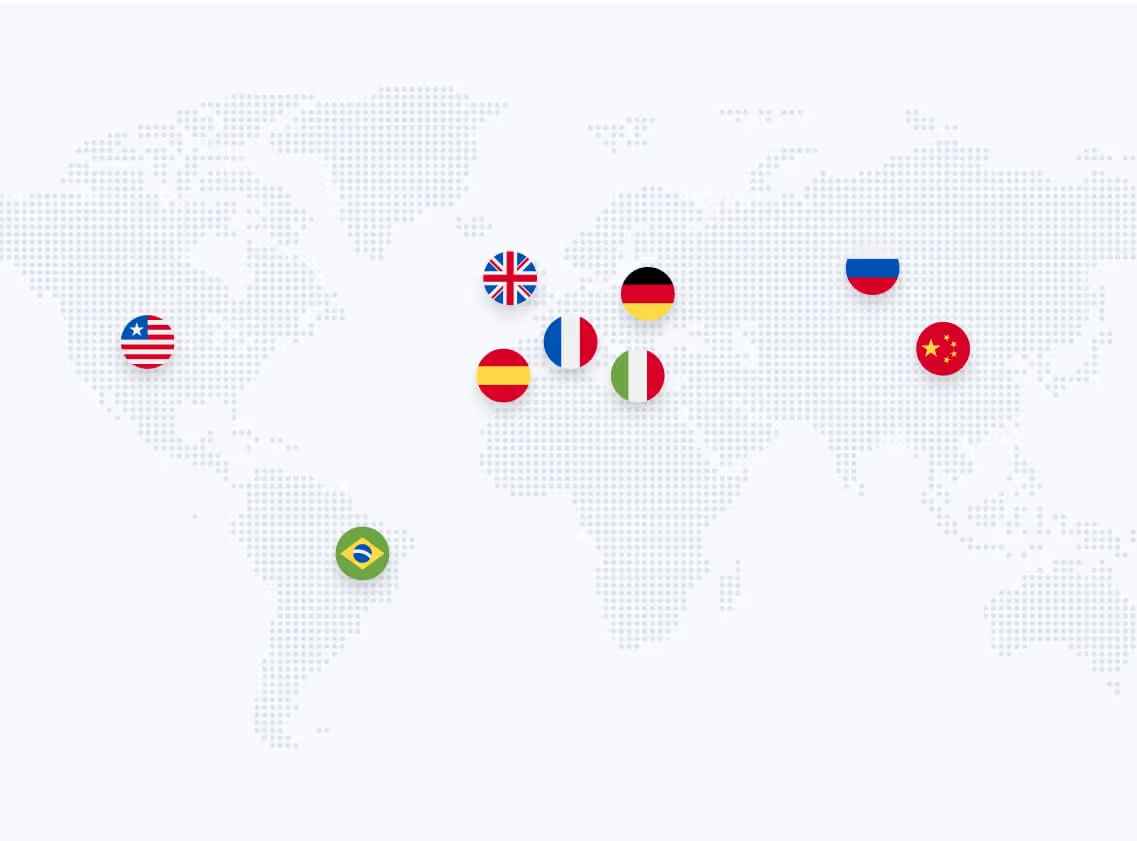
Our AI supports over 30 languages, covering the majority of global markets (English, Spanish, German, French, Japanese, Mandarin, etc.). The Lip Sync works universally across these languages.

How accurate is the translation?

AI translation is very good (95%+), but for critical content, context matters. That is why we offer Native Speaker Control (NSC) as an add-on, where humans review the AI's work. This combines the speed of software with the precision of a native speaker.

Can I automate this process?

Yes. For agencies, media houses, or companies with high volume, we offer an API. This allows you to integrate video translation directly into your content management workflow, removing manual upload steps entirely.

Über den Autor

Maximilian Engler
Co-Founder | Product & Technology

Newest articles

All articles
How to Translate Video Free: 3 Ways to multiply your reach

Use Cases

How to Translate Video Free: 3 Ways to multiply your reach

Looking for an AI video translator? We answer how to translate video free using 3 methods: Subtitles, Basic TTS, and Professional Lipsync.

Simon Pieren

Simon Pieren

December 8, 2025

Artikel lesen
Translate Video Free: A Guide to AI Translation, Lip Sync & Voice Cloning

Use Cases

Translate Video Free: A Guide to AI Translation, Lip Sync & Voice Cloning

Looking to "translate video free"? Learn the technical differences between standard dubbing and generative AI Lip Sync, and how to test professional quality risk-free.

Simon Pieren

Simon Pieren

November 28, 2025

Artikel lesen
How AI Video Translation Connects Global Teams

Use Cases

How AI Video Translation Connects Global Teams

How AI video translation breaks down language barriers in enterprises - secure, empathetic, and scalable.

Simon Pieren

Simon Pieren

November 24, 2025

Artikel lesen