Use Cases
September 19, 2025
How to Translate Training Videos with Screen Recordings and Voiceover

Can Screen Recordings Be Translated Automatically?
Yes – with AI-powered video translation, it is possible to accurately translate screen recordings including voiceovers into multiple languages.
Key factors:
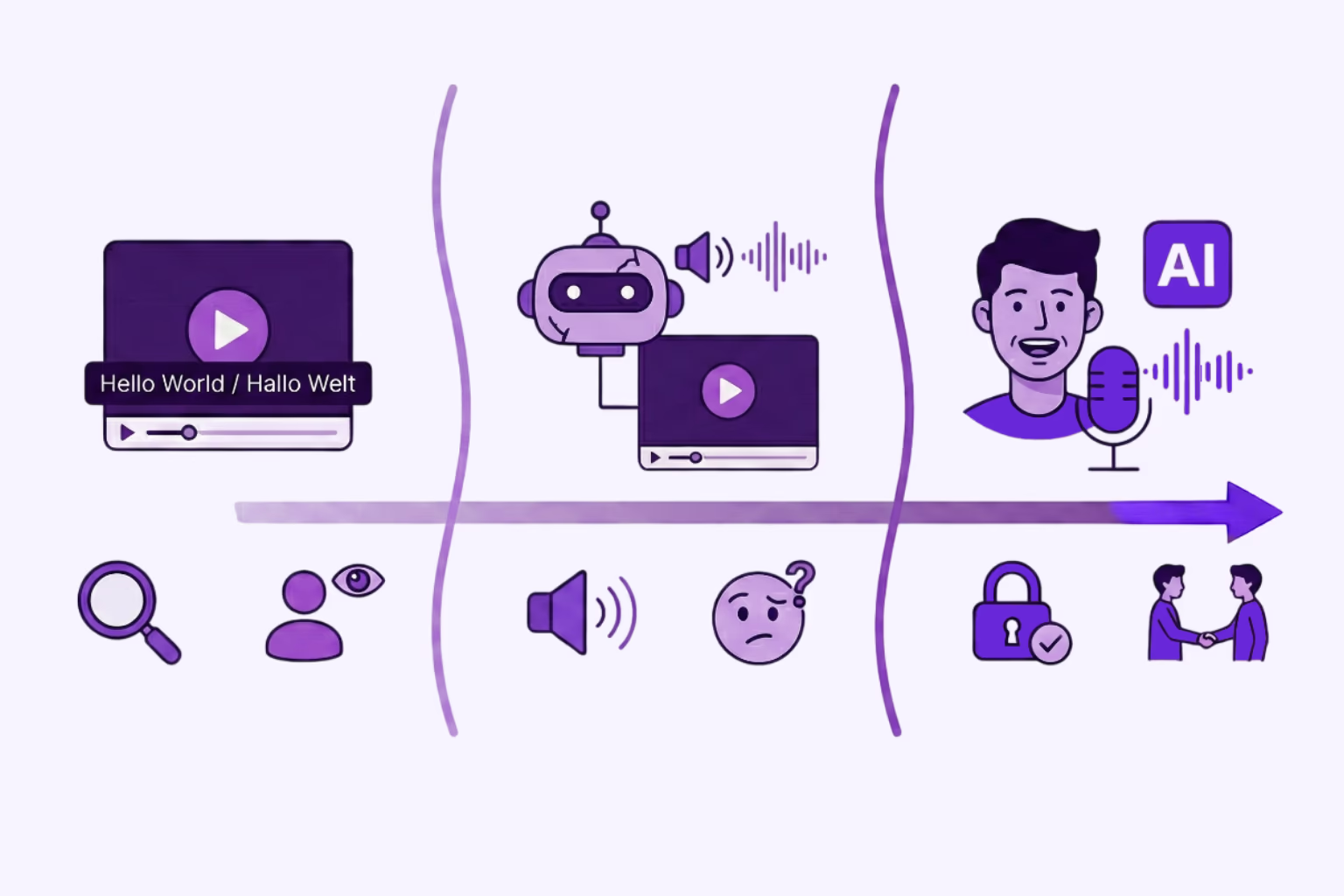
- Audio quality remains intact
- Voice cloning allows the original voice to be reproduced in other languages
- Lip sync ensures realistic visual alignment when speakers are visible
- Technical vocabulary is preserved through glossaries and custom prompts
👉 Dubly.AI provides exactly this combination – and is 100% GDPR-compliant.
Step-by-Step: Translating Screen Recordings with Dubly
1. Prepare Your Content
- Export your training or screen recording (MP4, MOV, or similar format).
- Optionally: Create a glossary with brand-specific terms or abbreviations.
2. Start the Dubly Workflow
- Upload your video to Dubly or use the API for bulk processing.
- Configure:
- Target language(s)
- Voice cloning (retain original voice in other languages)
- Glossaries & custom prompts for technical terms
- Lip sync for videos with visible speakers
- Multi speaker support if multiple trainers are included
- Target language(s)
3. Quality Assurance
- Review automatically generated previews.
- Optionally use Native Speaker Control (NSC) – Dubly’s premium service where certified native speakers refine timing, language, and pronunciation within 72 hours.
4. Export and Publish
- Download the final video or integrate directly via API into your LMS, intranet, or video platform.
- Scale your training content into as many languages as needed.
Why Dubly Is Ideal for Screen Recordings
Other tools often provide only simple translations without considering brand language or authenticity. Dubly goes further:
- ✅ Perfect voice cloning for consistent trainer voices
- ✅ Lip sync at the highest quality for realistic output
- ✅ Glossary management for technical terms and abbreviations
- ✅ Bulk processing via API for large training libraries
- ✅ GDPR-compliant – sensitive training content remains protected
- ✅ Enterprise support for seamless LMS integration
Real-world use cases: BMW relies on Dubly for international training, Cornelsen for learning content, and Axel Springer for media productions.

FAQ
Can I automatically translate training videos with screen recordings?
Yes. With Dubly, screen recordings and training videos can be accurately and realistically translated into multiple languages.
Does Dubly support multiple speakers in one video?
Yes. With multi speaker support, different speakers are identified and translated with individual voice cloning.
Can the original trainer’s voice be preserved?
Yes. With voice cloning, trainers’ voices can be reproduced in all target languages.
Does lip sync work with screen recordings?
Yes. If a speaker is visible in the recording, Dubly ensures realistic lip sync – applied at the final stage of the workflow for maximum accuracy.
Is Dubly suitable for long training videos?
Yes. Dubly also supports very long videos – unlike many providers that only handle short clips (10–30 minutes).
Conclusion: Translate Screen Recordings Efficiently
Yes – even complex training videos with screen recordings can be translated automatically. With Dubly.AI, content, terminology, and brand identity are preserved while translations remain realistic and GDPR-compliant.
👉 For highly sensitive content, you can add Native Speaker Control for an extra layer of quality.
What is the difference between Dubbing and Lip Sync?
Dubbing refers to the process of translating a video's speech and re-recording it. Lip Sync (Lip Synchronization) is the visual sub-process where mouth movements are adapted to the new audio to make it appear authentic.
Does AI Lip Sync work with multiple speakers?
Yes, advanced platforms like Dubly.AI feature Multi-Speaker Support. The AI automatically detects different voices in the video and applies Lip Sync and Voice Cloning individually to each speaker.
Is AI Lip Sync safe for corporate data?
That depends on the provider. Many tools use uploaded videos to train their AI models. Dubly.AI, however, is a German company and explicitly does not use client data for training public models.
Can I process long videos with AI Lip Sync?
Unlike many web apps that cut off after a few minutes, Dubly.AI is designed for enterprise requirements and processes even long keynotes, webinars, or e-learning courses exceeding 60 minutes in length.
Does AI Lip Sync alter the speaker's face?
With Visual Dubbing, only the mouth area (and parts of the jawline) is subtly adjusted to form the new sounds. The speaker's identity, facial expressions, and eye area remain completely preserved.
Does the Dubly.AI free trial include the Lipsync feature?
Yes. We believe you need to experience the full technology to understand its value. The free trial includes Generative Lipsync and Voice Cloning, not just simple audio translation.
Is there a difference between a standard "Video translater" and Dubly.AI?
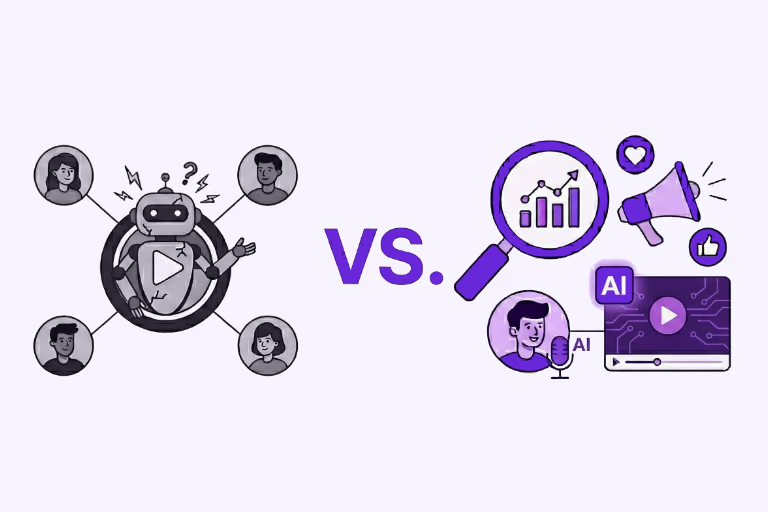
Yes. A standard "Video translater" often only translates text or audio. Dubly.AI is a comprehensive AI solution that adapts the visuals (mouth movements) to the audio, creating a seamless experience.
Can I use Dubly.AI for long-form content?
Yes. While many free tools limit you to 60 seconds, Dubly’s engine is built for scale – from TikTok Shorts to hour-long corporate training modules.
Can I use translate video free tools to internationalize my content?
Yes, absolutely. Using free tools is a great starting point to test new markets without a budget. However, keep in mind that methods like subtitles or basic video translator apps usually only transfer information, not emotion. To truly internationalize your brand's personality and retain viewers, you will eventually need lipsync technology to ensure the audience feels connected to you, not just the text.
Does a free ai video translator work for all types of videos?
It works well for content where the speaker is not visible, such as screen recordings or faceless tutorials. However, for any video featuring a person speaking on camera, a standard tool often falls short. Because it lacks lipsync, the visual mismatch distracts the viewer. For content meant to build trust or emotion, you need a solution that adapts both the voice and the visuals.
Is there a free version of Dubly.AI?
You can translate your first video for free so you can validate the quality with your own files. We believe in letting you prove the value first.
Does this work for any language?
Our AI supports over 30 languages, covering the majority of global markets (English, Spanish, German, French, Japanese, Mandarin, etc.). The Lip Sync works universally across these languages.
How accurate is the translation?
AI translation is very good (95%+), but for critical content, context matters. That is why we offer Native Speaker Control (NSC) as an add-on, where humans review the AI's work. This combines the speed of software with the precision of a native speaker.
Can I automate this process?
Yes. For agencies, media houses, or companies with high volume, we offer an API. This allows you to integrate video translation directly into your content management workflow, removing manual upload steps entirely.
Über den Autor

Newest articles

Tech
AI Lip Sync Explained: Stop Asynchronous Lips in Video Translations
Asynchronous videos look unprofessional. Learn how AI Lip Sync and Visual Dubbing perfect your translations – GDPR compliant and scalable.

Simon Pieren
December 23, 2025

Use Cases
How to Translate Video Free: 3 Ways to multiply your reach
Looking for an AI video translator? We answer how to translate video free using 3 methods: Subtitles, Basic TTS, and Professional Lipsync.

Simon Pieren
December 8, 2025

Use Cases
Translate Video Free: A Guide to AI Translation, Lip Sync & Voice Cloning
Looking to "translate video free"? Learn the technical differences between standard dubbing and generative AI Lip Sync, and how to test professional quality risk-free.

Simon Pieren
November 28, 2025